
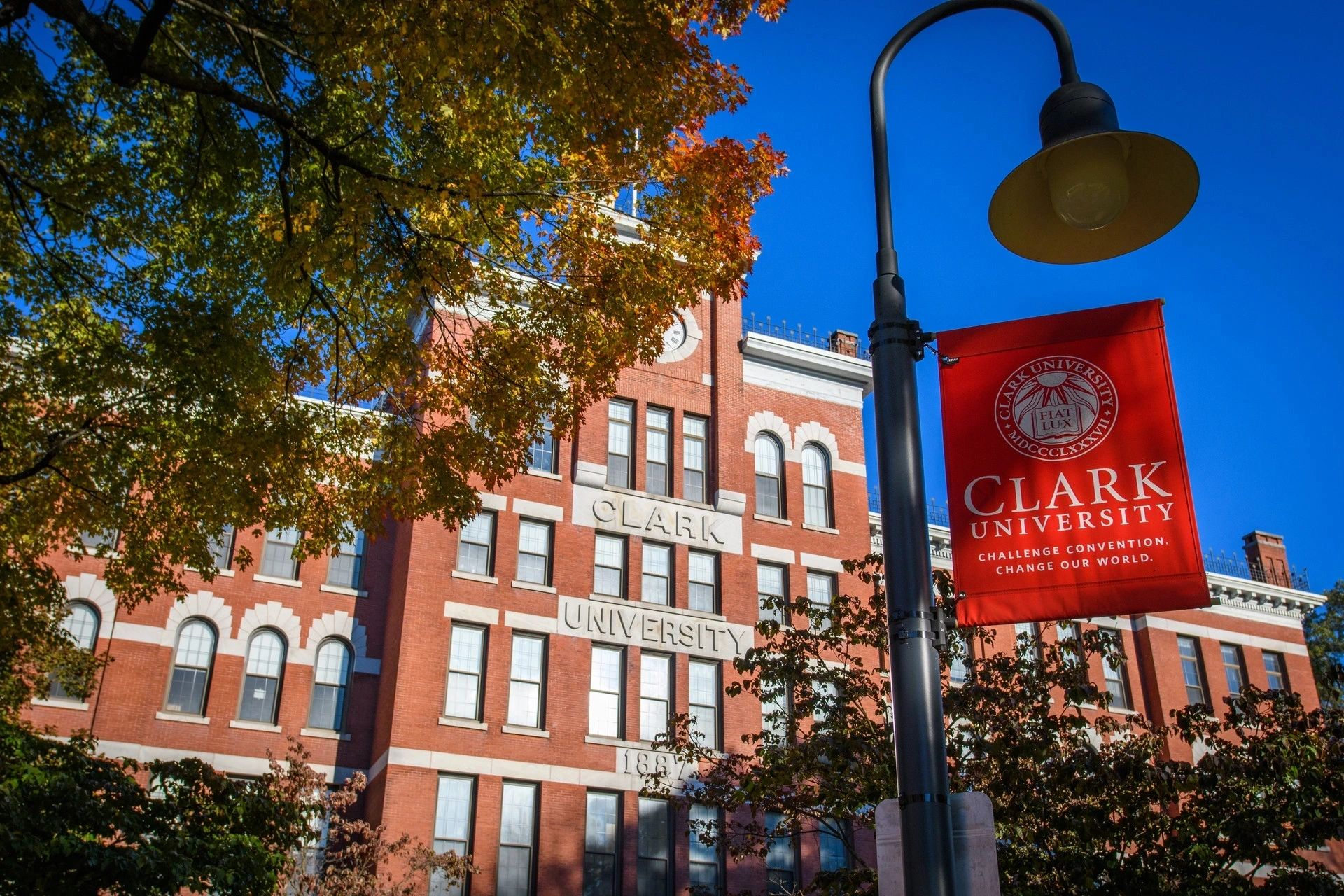
WORCESTER—Clark University has released a sweeping restructuring plan that will reduce full-time faculty positions by up to 30% and consolidate academic programs into three new interdisciplinary schools, part of a long-term strategy to address budget constraints and shifting enrollment patterns.
The university announced earlier in the month that the changes will unfold over the next three years, starting with retirements and natural attrition. The plan also includes a 5% cut to staff positions. Clark currently employs 228 full-time and 101 part-time instructional faculty members.
The reductions begin with non-tenure, pre-tenure, and adjunct faculty, while any impact on tenured faculty remains uncertain pending further procedural steps.
A response to enrollment and budget challenges
The restructuring follows what officials describe as a “critical inflection point” for higher education. Clark’s fall enrollment is 80 to 100 students short of projections, and the university faces rising operational costs and international enrollment uncertainties.
“Rather than simply meet this challenging moment as an exercise in budget constraint, we have taken a longer view,” a university spokesperson told the Worcester Guardian. “We’re leaning into current strengths to offer students an even more compelling experience going forward.”
Clark is consolidating academic offerings into three thematic schools: climate, environment and society; media arts, computing and design; and health and human behavior.
These schools emphasize interdisciplinary learning while maintaining a liberal arts core, say advocates. Students are expected to study across fields, gaining critical thinking skills, global awareness, and creative problem-solving abilities.
Provost John Magee said the plan builds on years of faculty-administration collaboration under the university’s “Clark Inspired” strategic framework.
“It captures all that is best about Clark,” Magee said in a statement, “and offers our students even better outcomes, enhanced academic support, more ways to engage in hands-on experiential learning, and more flexible, interdisciplinary learning.”
Several senior Clark faculty members said the quality of education remains strong and believe the introduction of “The Clark Experience”—a new experiential learning framework launched last year—will have a greater impact on students than the structural changes alone.
But not everyone in the Clark community agrees. Eve Harmon, a recent graduate who earned both her undergraduate and graduate degrees at Clark, said the changes left her feeling angry and disappointed. “Clark has made a lot of decisions in recent years that I have disapproved of, particularly around issues that students have made clear are important to them,” she said, citing the administration’s response to a student-led divestment campaign and its efforts to block unionization among student workers.
“I see this as the latest example of Clark declining to take responsibility for their poor financial decisions and putting the burden on students and faculty,” Harmon added. “These changes tarnish Clark’s reputation as a welcoming liberal arts school that values community, for sure.”
Program cuts and business school merger
As part of the overhaul, underenrolled programs—particularly courses with fewer than five students—will be phased out. However, currently enrolled students will still be able to complete their existing majors, the university said.
The School of Business and School of Professional Studies will also be merged into a single division. That move prompted the resignation of Business School Dean David Jordan, effective July 5. Jordan, who returned from retirement in 2024 to help rebrand the business school, cited a misalignment with the university’s strategic direction. He has not yet responded to requests for comment.
From Harmon’s perspective, the merger recalls previous administrative consolidations that left key student support offices understaffed and overburdened. “One example that comes to mind is when the Identity, Student Engagement, and Access office was merged with the First Generation support office,” Harmon said. “While I don’t know the specifics of what the School of Business and SPS merge will look like, I can only imagine it will have similar consequences.”
A petition is now circulating questioning how the merger could affect the business school’s accreditation, though university officials say its accreditation will remain intact.
Looking ahead
The restructuring shifts the university’s student-faculty ratio from 8:1 to 10:1. While some community members fear this may erode Clark’s traditionally intimate academic environment, administrators argue the ratio remains competitive and is key to financial sustainability.
Harmon echoed those concerns, recalling the value of small, discussion-based classes during her time at Clark. “I took a class this past semester with Professor Jude Fernando called Farming for Multispecies Justice; there were ten of us in that class, total, and that allowed for us not only to have in-depth discussions but also to build community with one another,” she said. “I worry very much that with these cuts, classes like this won’t be able to exist at all.”
“Clark is strong, there is great enthusiasm for the Clark student experience, and we do important, impactful work around the world,” a university spokesperson said. “This plan helps us offer more innovative solutions to global challenges and a more sustainable operating model.”
The university has held town halls for faculty and staff, and notified students and families of the changes. The Clark chapter of the American Association of University Professors has not issued a formal response but is expected to closely monitor implementation.
Officials said the changes are necessary to adapt to a rapidly evolving higher education landscape—and to ensure that Clark remains a leader in liberal arts education for decades to come.
Matt Olszewski is a freelance content and news writer based in Boston, MA. In his free time, Matt enjoys running, hiking or skiing. Matt recently graduated with his MPH from Tufts University. He can be reached at mattoskier@gmail.com
