
WORCESTER—The Worcester City Council is set to tackle a full agenda Tuesday, Nov. 26, highlighted by the annual tax classification hearing, a pivotal decision that determines not only the rate, but how the city’s tax burden is distributed between residential and commercial property owners.
City Manager Eric Batista’s FY25 tax classification package proposes a total assessed value of $24.325 billion for all taxable properties, reflecting a 9.45% increase from the previous year. The combined single tax rate is proposed at $16.44 per $1,000 of assessed value. However, the council must decide whether to shift more of the tax burden onto businesses or to continue offering relief to homeowners.
Last year, the council adopted the lowest possible residential tax rate of $13.75 per $1,000 of assessed value, leading to an average $103 reduction in tax bills for homeowners. Meanwhile, the commercial tax rate was set at $30.04 per $1,000, resulting in an average $175 increase for business property owners. This decision continued a trend of shifting a greater portion of the tax burden onto the business community. The Worcester Regional Chamber of Commerce has expressed concern over this approach, arguing that higher commercial tax rates make it harder to attract and retain businesses, stifling economic growth in the city.
With additional costs stemming from policies like the Community Preservation Act, inclusionary zoning, and the specialized stretch code, business leaders—including small business owners and downtown employers—have called on the council to provide tax relief and support to promote sustainable growth.
Worcester has maintained separate tax rates for residential and commercial-industrial property owners since adopting a split tax system in the 1980s.
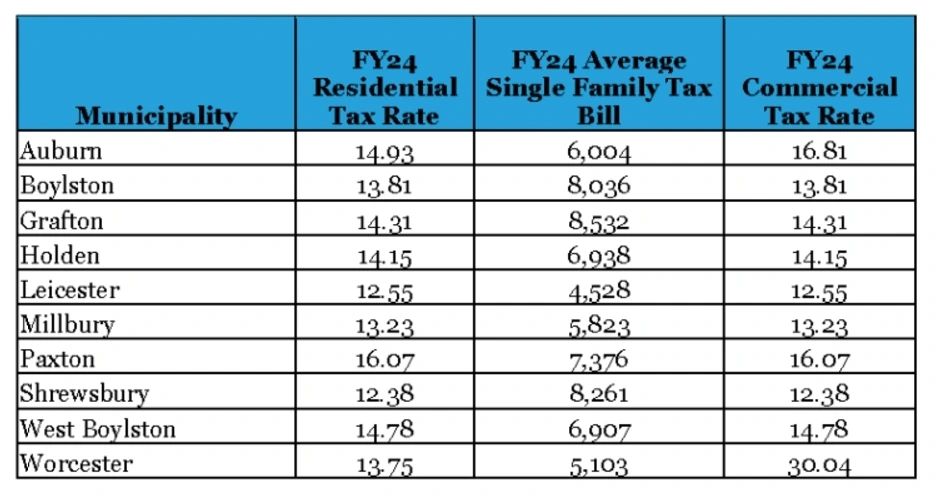
According to data submitted by City Assessor Samuel Konieczny, Worcester’s FY24 average single-family tax bill of $5,103 ranked 251st statewide, with a residential tax rate that placed it 127th among Massachusetts municipalities. Commercial and industrial properties, which make up nearly 37% of the city’s tax levy, faced the seventh-highest tax rate in the state. Despite the relatively high rates for businesses, Worcester’s average single-family tax bill was second-lowest among neighboring communities, trailing only Leicester.
The tax classification discussion will also touch on new growth, which exceeded budget estimates by $2.2 million, totaling $9.7 million. This increase raises the city’s excess levy capacity to $25.79 million, a development aligned with the city’s Financial Integrity Plan to mitigate tax burdens.
Development in focus: Webster Square and Lakeside Apartments
Beyond tax rates, the council votes on adopting an Urban Center Housing tax increment financing (TIF) plan for the Webster Square area. This plan aims to support redevelopment, including the Worcester Housing Authority’s initiative to raze and rebuild the Lakeside Apartments at 30 Lakeside Ave. The project replaces 202 existing units and add 172 new units, for a total of 374.
The TIF plan spans 125 acres, encompassing Mill Street Plaza, Eddy’s Plaza, the Webster Square Manufacturing District, and businesses along Park Avenue, Mill Street, and Main Street. This program offers partial real estate tax exemptions to incentivize residential development, with a goal of revitalizing the area’s commercial potential.
Zoning reform proposals from Worcester Now | Next
The council will also discuss proposals from District 5 Councilor Etel Haxhiaj tied to the Worcester Now | Next long-range plan. These include eliminating or reducing minimum parking requirements for developments and implementing reforms to tree protection ordinances. Both measures aim to promote sustainable growth and align with broader urban planning trends, such as reducing costs associated with parking minimums.
A recent Worcester Regional Research Bureau report highlighted the economic impacts of parking minimums, adding urgency to the discussion.
With decisions on tax rates, zoning reforms, and development incentives, the meeting is expected to shape key aspects of Worcester’s fiscal and urban planning strategies.
Other council agenda highlights:
- Tax incentive program oversight: The council considers a request for a report on compliance with existing tax increment financing (TIF) and tax increment exemption (TIE) programs.
- Accessory dwelling units: Councilors explore potential updates to the city’s accessory dwelling unit (ADU) regulations to expand housing options.
- Event street closures: City staff investigates the feasibility of closing streets for community events, with input from local businesses.
- ARPA fund allocations: A financial comparison report examines how Worcester distributed its American Rescue Plan Act (ARPA) funds compared to similar cities.
- Snow operations rate increase: The council debates increasing private contractor rates for snow removal services.
- Pothole fill requests: A report assesses why pothole filler is not provided to residents for use on private streets.
- Police spending reports: The council reviews communications on internal police detail spending and drone usage for FY23 and FY24.
- City manager’s employment agreement: Discussions cover a potential extension of Batista’s employment beyond December 2024.
Worcester City Council meets on Tuesday, Nov. 26, at City Hall in the Esther Howland (south) Chamber at 6:30 p.m. It is also live streamed on the city’s website.
Editor Charlene Arsenault can be reached at carsenault@theworcesterguardian.org
As the Worcester Guardian marks a year of delivering free, independent digital news to our city, our dedication to this mission strengthens. Please consider a tax-deductible donation to support our ongoing commitment to providing hyperlocal news coverage to Worcester. Scroll to the bottom of our home page to sign up for our daily newsletter