
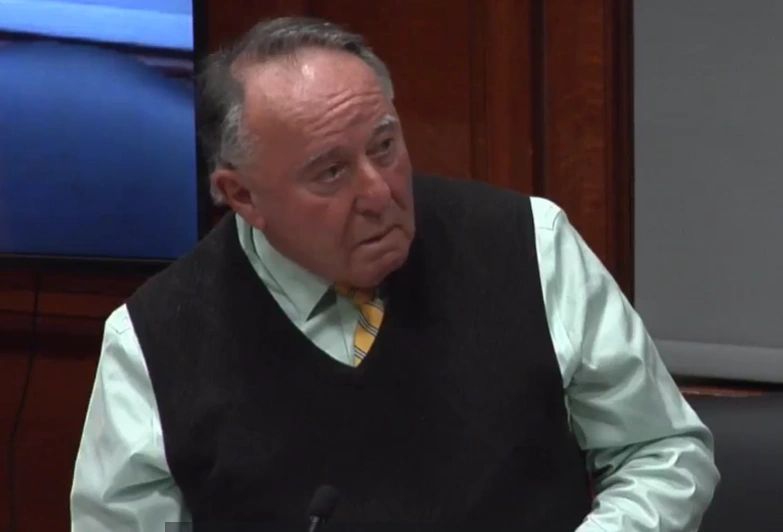
WORCESTER—Questions about traffic safety and public health dominated the first City Council meeting of 2026 as councilors pressed city officials on the growing number of speed humps and the persistent problem of discarded needles across the city.
Returning Councilor Gary Rosen opened the discussion by raising concerns about the pace at which speed humps are being installed, arguing some are catching drivers off guard.
“I’m not against speed humps,” Rosen said, noting they are effective at calming traffic. “But they seem to be proliferating at a rapid pace.”
Rosen said speed humps were initially rejected by the city years ago before eventually being approved, but he questioned whether the city has a clear end goal. Citing Beechmont and Haviland streets, Rosen said there are six speed humps within roughly a mile — four on Beechmont and two on Haviland.
“I don’t know how many we have in the city of Worcester,” he said. “I just hope that we have a plan. If there are 200, I hope we’re not looking for 500 or 700. There has to be some day that we stop putting so many up. Are we going to have speed humps everywhere in the city?”
Rosen also pointed to a speed hump near a turn off Salisbury Street, saying it can be difficult to see.
“You tend to miss the sign and you hit it too fast, even if you’re going 25 mph,” he said, adding that many humps blend into the roadway and are sometimes obscured by parked cars.
Rosen asked City Manager Eric Batista to provide a one-page report outlining the city’s plans and criteria for installing speed humps.
“All of the speed humps right now are either requests that are coming into the council … or some suggestions that the Department of Transportation and Mobility is providing,” Batista said. He added that city staff have been discussing clearer parameters, including reasons a request for a speed hump might be denied.
Disposal of used needles and other sharps
Later in the meeting, Rosen raised concerns about the disposal of used needles and other sharps, urging the city to consider requiring retail pharmacies to provide collection kiosks — similar to an ordinance adopted in Boston.
Several collection sites already exist in Worcester, including at the Department of Public Health, the Kennedy Health Center and the Worcester Senior Center. Rosen said most of the needles collected come from people using them for legitimate medical purposes, such as diabetes or injectable medications.
“Basically, 99.9% of the sharps—the needles and the lancets that they collect — are [from] people who are using those for medical purposes,” Rosen said.
He argued that people using illicit drugs often obtain needles from pharmacies and asked why those same businesses are not required to take them back.
“Why do we allow Walgreens and CVS to sell them but not take them back?” Rosen said, adding that pharmacies told him it was not their policy.
While acknowledging not all needles would be returned, Rosen said even partial participation could reduce the number found in parks, sidewalks and alleys.
Road to Care Mobile Addiction Service
Councilor Kate Toomey cited data previously presented by the Road to Care Mobile Addiction Service operated by UMass Chan Medical School. Between October 2023 and June 2025, the program distributed 15,391 needles and collected 1,206.
“I really don’t think these needles are coming from people who buy them to do illicit drugs,” Toomey said, suggesting the city explore enforcement of existing needle exchange programs and whether UMass could sponsor additional collection boxes.
Councilor Morris Bergman questioned whether the city has the legal authority to require pharmacies to accept used needles.
“I think it would be great if they volunteer,” Bergman said. “I think it’s a good idea, but I think requiring somebody to take back something they sold, just because they sold it…is a little unrealistic.”
Bergman also pointed to ongoing challenges with a proposed deposit requirement on small liquor bottles, saying similar efforts have stalled.
“We all know we have a problem here,” Rosen said. “Boston had it, too, and they still have it, but they decided to do something about it by requiring the pharmacies that sell them to take it back. It’s worth a try.”
Councilor Khrystian King offered an amendment calling for a report on whether the city could partner with other businesses or organizations to expand needle disposal options and conduct targeted “needle sweeps” in areas where discarded sharps are common.
“The issue of needles is paramount,” Councilor Satya Mitra said, suggesting Worcester consult with Boston officials about how their program was implemented.
The council ultimately referred the matter to city administration for further review.
Contact Steve Smith at steve@stevephotographysmith.com