
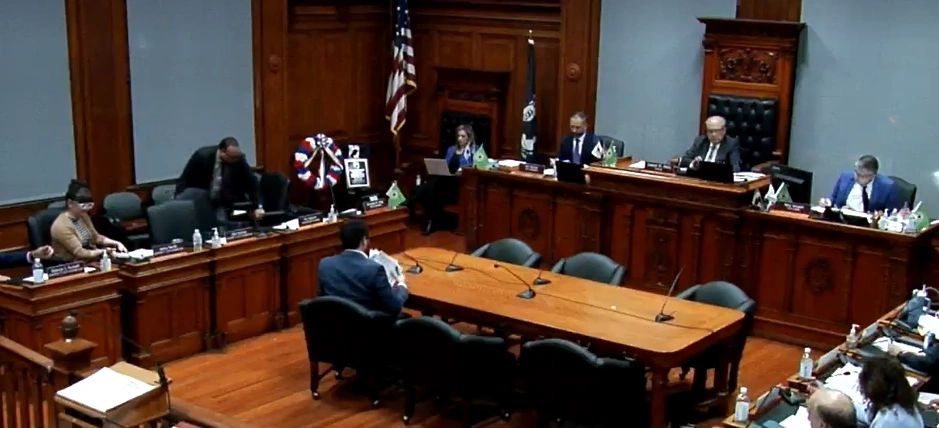
WORCESTER—City Council returns to chambers Tuesday with a packed agenda that spans the city’s $947.9 million proposed FY2026 budget, a new housing production plan, federal HUD funding, employee salary adjustments — and a set of complaints from an activist challenging council procedures.
The council is expected to vote on the FY2026 operating budget, which represents a 6.2% increase over the current year. Education remains the largest line item, at $574.4 million (60.8% of the total budget), with $412 million funded by state Chapter 70 aid.
The city’s finances remain stable heading into the new fiscal year, according to a report from Chief Financial Officer Timothy McGourthy. As of April 30, property tax collections are at 94%, and local receipts are at 96%, with no significant concerns flagged. Free cash stands at $25.2 million, and enterprise funds — including the Water, Sewer and Green Hill Golf Course funds — are generally healthy.
Councilors also consider a proposed 2% cost-of-living adjustment and wage increases for about 470 non-represented municipal employees, including management, professional, technical, administrative and clerical staff. The raises, effective July 1, are intended to align non-union pay with recent union agreements.
The administration also presents the 2024 Green Worcester Plan annual report, which notes a 9.5% citywide reduction in greenhouse gas emissions since 2009 and an 18.6% drop in municipal energy use over the past decade. Other highlights include the planting of Worcester’s first Miyawaki Forests, completion of the first phase of a stormwater master plan, and individualized energy assistance provided to more than 700 residents.
Another major item on the docket is approval of FY2026 funding recommendations for several federal HUD programs, including Community Development Block Grants (CDBG), Emergency Solutions Grants (ESG), HOME Investment Partnership funds, and Housing Opportunities for Persons with AIDS (HOPWA). The city is set to receive a combined $6.85 million — about 1.8% less than last year — for these programs.
Funding supports affordable housing, public facilities, infrastructure, and social and human services. The proposal will first head to the Health and Human Services Committee for a public hearing.
Council also reviews and consider adoption of Worcester’s new housing production plan, a key piece of the city’s FY2025-29 strategic plan. The plan, developed through extensive public input and data analysis, outlines priorities and policies to expand affordable housing. Once approved by both the planning board and city council, the plan will be submitted to the state for final approval.
Meanwhile, local activist David Webb has filed four open meeting law complaints against the council. Among his allegations: a meeting was switched to remote format with short notice; a meeting began 45 minutes late; and a public safety meeting was moved to a new venue due to safety concerns. In one complaint, Webb urged the council to “not be cowards, afraid of accountability.”
Other highlights on the agenda:
- Discontinuing the old Foster Street layout: Council considesr discontinuing a leftover portion of the former Foster Street roadway near Washington Square — a remnant from previous reconfigurations under the Union Station Urban Renewal Plan. Clearing this outdated section from the official map also helps smooth the path for a long-planned second hotel project at Washington Square, which officials hope will break ground later this year.
- Summer fun at city beaches and spray parks: Worcester’s 2025 aquatic program is ready to make a splash again this summer, thanks to a continued partnership between the city and the YMCA of Central Massachusetts. The Y oversees operations at four beaches and a pool, while the city runs three spray parks. The program also includes free swim lessons for kids ages 5 to 12 and free kayak and paddleboard rentals at Coes Pond.
- Growing Worcester’s urban canopy: The city is pushing ahead with its goal of planting 2,000 new trees by 2026 — using a thoughtful, site-specific approach called “Right Tree, Right Place.” A recent survey identified 552 potential planting locations, and 359 trees have already been planted this year. Efforts accelerate through 2025 and 2026, with a focus on areas funded by ARPA. A related report also answers councilors’ questions about how many tree wells exist citywide and how they are being addressed.
- Elm Park Playground renovations underway: Renovations are in progress at the Elm Park Playground to improve safety and accessibility. The focus is on upgrading the playground’s safety surfacing, a critical element for injury prevention. The city is aiming for a late-July reopening but notes that weather — especially rainfall — could affect the timeline. Signs are posted at Elm Park and Blithewood Park to direct families to alternate play spaces during the construction.
- Accepting new grants and donations: Council reviews a robust list of grants and donations this week. Highlights include $423K from the Workforce Competitiveness Trust Fund, nearly $300K for the Connecting Activities program, more than $4.3M in workforce development grants, $425K for parkland acquisitions and renovations, $37K for new kitchen equipment at the Worcester Senior Center, and $40K from the College of the Holy Cross to support Recreation Worcester programming.
- Improving safety at Park Ave. and Lovell Street: City transportation officials are planning a series of near-term safety improvements at the problematic intersection of Park Avenue and Lovell Street, which has seen an uptick in crashes. Planned changes include adding protected left-turn lanes, relocating a nearby driveway exit, and improving the alignment of the intersection. The goal: reduce conflict points and improve visibility for drivers and pedestrians alike.
- New funds for neighborhood improvements via CSX: The CSX Community Investment Fund, originally created as part of a 2010 rail agreement, is getting a $1 million boost. The fund, which supports economic development in neighborhoods near the CSX rail facility, will now provide up to $999,999 each for projects in the Canal District, Shrewsbury Street, and Grafton Street neighborhoods. City officials works with district councilors and the community to select future projects.
- Where should the new EV chargers go? Thanks to a $500K state grant, the city is installing 10–15 new curbside electric vehicle charging ports — and residents can weigh in on where they should go. An interactive crowdsource map is open through June 16 for public input. Afterward, officials select final locations based on criteria including sidewalk width, electrical capacity, proximity to multi-family housing, and community interest.
- Bringing The Aud back to life: Councilor Khrystian King has requested a report detailing the city’s agreement with the American Heritage Foundation regarding the Worcester Auditorium. The report covers ownership of the building, financial commitments, and the maintenance schedule for the long-vacant landmark, which is slowly edging toward new uses.
- Tracking unhoused status in death data: Councilor Etel Haxhiaj is advocating for the city to work with the state Medical Examiner’s Office to better track the impact of homelessness on deaths. The proposal includes adding unhoused status as an indicator on death certificates — data that could inform future public health and housing efforts.
Worcester City Council meets Tuesday, June 10, at City Hall in the Esther Howland (south) at 6:30 p.m. It is also live streamed on the city’s website.
Have news, tips, or a story worth telling? Reach Editor Charlene Arsenault at carsenault@theworcesterguardian.org—because good stories (and great scoops) deserve to be shared.
