
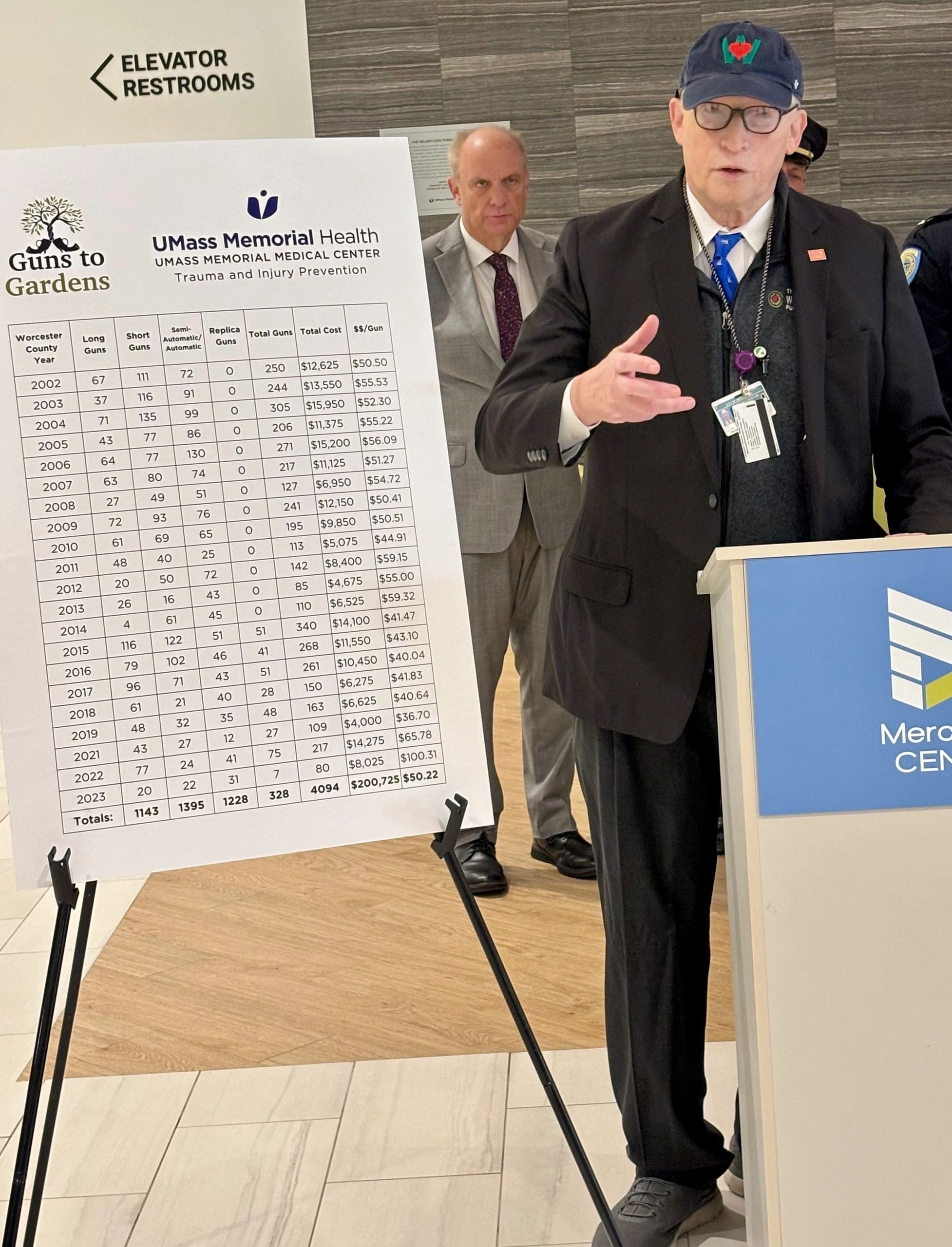
WORCESTER—Since the Guns 2 Gardens gun buyback program began in 2002 in Worcester, 4,094 guns have been turned in to local police departments in exchange for grocery gift cards.
So more than 4,000 guns have been taken off the streets with the goal of reducing gun injuries and deaths.
Dr. Michael Hirsch, Worcester Division of Public Health medical director and UMass Chan Medical School assistant vice provost for health and wellness, and chief quality officer of the surgery department, started the gun buyback program in Worcester after forming one in Pittsburgh in 1994. He has advocated gun safety since his close friend, Dr. John C. Wood II, was killed in 1981 in New York City in an attempted robbery.
Hirsh is convinced that the gun buyback program has saved lives. He remembers a defense attorney bringing 23 AK-47 assault rifles to the gun buyback in 2006 or 2007. The attorney’s brother had been experiencing mental illness issues and had purchased weapons online in Vietnam along with a tripod, sniper scope and bayonet. Fortunately, the weapons had never been fired.
The attorney refused to take any grocery cards in exchange for the weapons. He instructed the program to have the UMass community relations department donate them to families in need. He was just pleased to get them away from his brother and off the street.
Hirsh recalls the attorney saying, “I think we just saved a mass shooting.”
Guns 2 Gardens will take place in Worcester from 9 a.m. until 1 p.m. Saturday at the police department headquarters at 9-11 Lincoln Square and at City Welding & Sheet Metal Fabrication at 10 Ararat St.
People are invited to bring unwanted, unsecured and unloaded weapons in plain plastic or paper bags. Grocery gift cards will be distributed for each operable gun, $50 for a rifle, $100 for a pistol and $150 for an automatic or semi-automatic weapon.
Non-operable guns, ammunition and firearm accessories will also be accepted, but gift cards will not be issued for them.
Hirsh promoted Saturday’s gun buyback program at a press conference Thursday morning at the Mercantile Center lobby. Worcester County Senior First Assistant District Attorney Jeffrey Travers, Mayor Joseph M. Petty, Deputy Police Chief Edward McGinn and Guns 2 Gardens Massachusetts founder John Hayden also spoke. Police chiefs from Fitchburg, Milford, Northboro and Southbridge were on hand as well.
Guns will also be accepted on Saturday from 9 a.m. until noon at the police departments in Southbridge, Northborough and Milford, and from 10 a.m. until noon at the police department in Fitchburg.
City Welding will destroy all collected firearms on Saturday, and Hayden and his fellow blacksmiths will later turn some of the weapons at facilities in Waltham and Brighton into garden tools that will be used in Worcester County gardens to produce fruits and vegetables for the community.
Hayden said he got the idea of making garden tools in early 2019, but the pandemic put everything on hold. He said he made a few dozen garden tools last year and hopes to make many more this year.
Some of the garden tools have been used in the UMass community garden, which grows produce that is donated to those in need.
“Our program is clearly not getting gang violence reduction,” Hirsh said of the gun buyback, “but we know that a lot of the gangs as an initiation will have their initiates go get a gun before they can join the gang. They’re not going to gun shows in Virginia or New Hampshire. They’re just stealing them out of people’s homes.”
Hirsh estimated that there’s a 25 percent chance of finding a handgun in a bedside table in a Worcester home and a 10-20 percent chance of finding one in a car’s glove compartment.
“That’s where a lot of the gang violence might be impacted,” he said, “because you’re depriving an initiate of the chance to join a gang or at least delay it. Maybe it makes them think about it.”
Hirsh believes the program can reduce gun suicides, lessen the chances of inquisitive toddlers locating unsecured weapons and hurting themselves or others, and prevent episodes of domestic violence from escalating into lethal events.
At a child fatality review conference in Florida recently. Hirsh learned that Worcester has suffered from far less gun violence and suicide than other communities represented at the conference. So he hopes the gun buyback program has played a role in that.
If those 4,094 weapons weren’t turned in, Hirsh believes at least a few of them would have been involved in tragic events and that saving only one life would justify the program.
“Every life is important,” he said, “and we just think keeping the streets clean of these types of weapons is a contribution to public health.”
Hirsh and Wood were on call in the emergency room at Columbia Presbyterian Hospital in New York City when Wood was shot in the chest outside the hospital. Wood was rushed into the ER on a gurney. Hirsh and others couldn’t resuscitate him.
Asked what Wood would have thought of the Guns 2 Gardens program, Hirsh replied, “I think he’d be digging it. He was a very optimistic person. Much more so than I was back then.”
Since 2002, Guns 2 Gardens has distributed $200,725 in grocery gift cards for the 4,094 firearms collected.
Hirsh pointed out that it would cost about $200,000 to care for four survivors of gunshot wounds at UMass.
“So even if four of those 4,000 weapons were involved in a shooting incident, we’ve actually saved money that way,” he said.
Last year, only 80 firearms were collected, the fewest since the program began and less than half the 217 guns that were collected the year before. Hirsh hopes to build that number back up again.
“The long game is something that surgeons generally don’t get into,” he said, “because we like the instant gratification of going to the OR and fixing the problem, but this has taught me a lot about being patient and seeing the changes over time.”
No names will be asked at the gun buyback and amnesty will be granted during the collection. No gun registration will be required for Worcester County residents.
According to the Johns Hopkins Bloomberg School of Public Health, Massachusetts had 263 gun deaths in 2022, the most recent year for which data is available. That was the second lowest gun death rate in the country, but it still increased 18 percent from 2013. Those deaths included 106 homicides and 149 suicides.
The Centers for Disease Control and Prevention (CDC) reported that in 2022 there were more than 48,000 firearm-related deaths in the U.S, the second most ever. That averages about 132 deaths per day. More than half of them were suicides and more than four out of every 10 were homicides.
In 2022, firearm injuries were among the five leading causes of death in the U.S. for people aged 1-44 and the leading cause of death among those aged 1-19.
Guns 2 Gardens is sponsored by UMass Memorial Medical Center, the Worcester County District Attorney’s Office, the City of Worcester and the Worcester Police Department and the Worcester Department of Public Health.
Bill Doyle has been a professional journalist for 47 years, most of them as a sports writer for the Telegram & Gazette. He covered the Boston Celtics for 25 years and has written extensively about golf, boxing and local high school and college sports. He also worked for the campus newspaper when he attended UMass-Amherst. He can be reached at billdoyle1515@gmail.com