
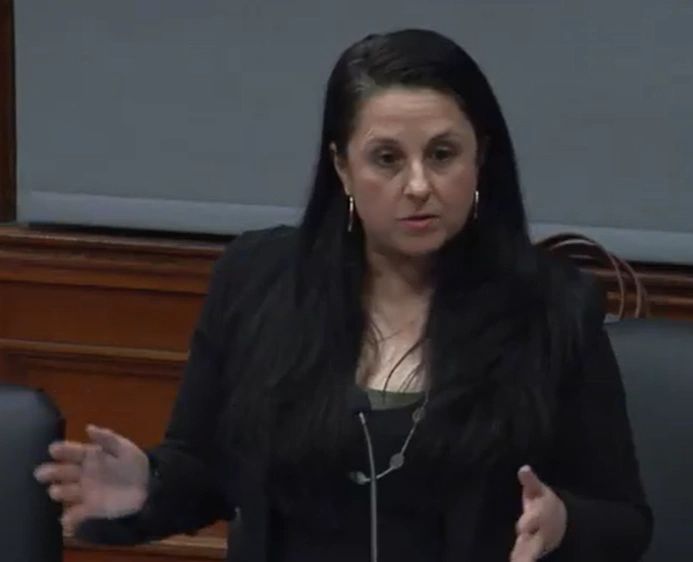
WORCESTER—District 5 City Councilor Etel Haxhiaj is pressing the city for detailed information on how proposed federal cuts to permanent supportive housing could impact Worcester, warning of what she described as a looming humanitarian crisis for some of the city’s most vulnerable residents.
At the council’s Dec. 9 meeting, councilors unanimously approved an order requesting that City Manager Eric Batista provide a report outlining the expected local impacts of U.S. Department of Housing and Urban Development funding changes. The report is to include how many permanent supportive housing units may not be renewed, how many residents could lose housing as a result, and how those changes could affect homelessness levels citywide.
“These are called permanent supportive housing because they are permanent,” Haxhiaj said. “These folks need supportive services attached to their housing… they tend to stay in them for a long time, and rightly so.”
Haxhiaj said Worcester County has more than 700 permanent supportive housing units, with a significant share located in the city. She emphasized that residents in those units include chronically homeless individuals and families with disabilities, and warned that proposed federal limits on how much Continuum of Care funding can be used for permanent housing could force people into transitional programs with strict time limits.
“Where do folks go from there?” she asked. “That’s up to the specific community to figure that out — and we haven’t figured that out.”
Haxhiaj also raised concerns about federal policy changes that could attach new conditions to housing funds, including requirements related to law enforcement involvement in encampment removals, mandatory treatment participation, immigration status reporting, and the elimination of diversity, equity and inclusion considerations.
“We have a hidden avalanche of a humanitarian crisis,” she said, adding that families experiencing homelessness are increasingly falling outside traditional shelter systems. “It’s no longer the case that families are always taken care of.”
In addition to the funding impact report, councilors also approved a separate request asking the city manager to work with departments and stakeholders to establish an Office of Housing Stability. The proposed office would focus on preventing involuntary displacement, assisting residents facing eviction, and strengthening tenant protections.
Councilor Khrystian King voiced strong support for the requests, cautioning against policies that could criminalize homelessness or reduce services.
“We ought not to be moving in any direction towards criminalizing homeless,” King said. “We’re in the midst of a federal policy shift.”
Batista told councilors that the city is already working closely with housing providers and regional partners to respond to rising needs amid funding uncertainty. He said his administration meets regularly with service providers and is developing a broader strategic plan informed by a recent assessment from consultants affiliated with Rutgers University and Boston University.
“The federal government keeps throwing different curveballs,” Batista said, noting that shifting rules have complicated long-term planning. “If you want access to those dollars, you have to take that approach — so that’s something we have to navigate collectively with our providers.”
Batista acknowledged that potential funding losses could impact hundreds of households and also threaten the nonprofit workforce that provides supportive services. “It’s not only the housing that’s impacted,” he said. “The individual is impacted, the workforce is impacted.”
Discussion during the meeting also turned to shelter capacity and cold-weather conditions. Batista said Worcester’s existing shelter network is at capacity and that the city continues to pursue an overflow shelter while working with state and regional partners to expand available beds.
The following morning, the city announced that a temporary overflow shelter will open Monday, Dec. 15, at 50 Oriol Drive, confirming that plans discussed during the meeting were already moving forward. The low-barrier shelter, operated by South Middlesex Opportunity Council, will offer 36 beds and remain open through April.
Councilors ultimately voted unanimously to advance both orders to the city manager, signaling broad concern about the potential fallout from federal housing policy changes and the city’s preparedness to respond.
The meeting also marked one of Haxhiaj’s final appearances on the council, as she prepares to leave office at the end of the year after losing her seat in the November election. Throughout her tenure, Haxhiaj has been a consistent advocate on issues related to homelessness, housing access, immigration and discrimination, and she has used her final meetings to press the city on what she views as urgent and unresolved humanitarian needs.
Have news, tips, or a story worth telling? Reach Editor Charlene Arsenault at carsenault@theworcesterguardian.org—because good stories (and great scoops) deserve to be shared.
The Worcester Guardian is an independent nonprofit news organization. Support local journalism by making a DONATION today.
