
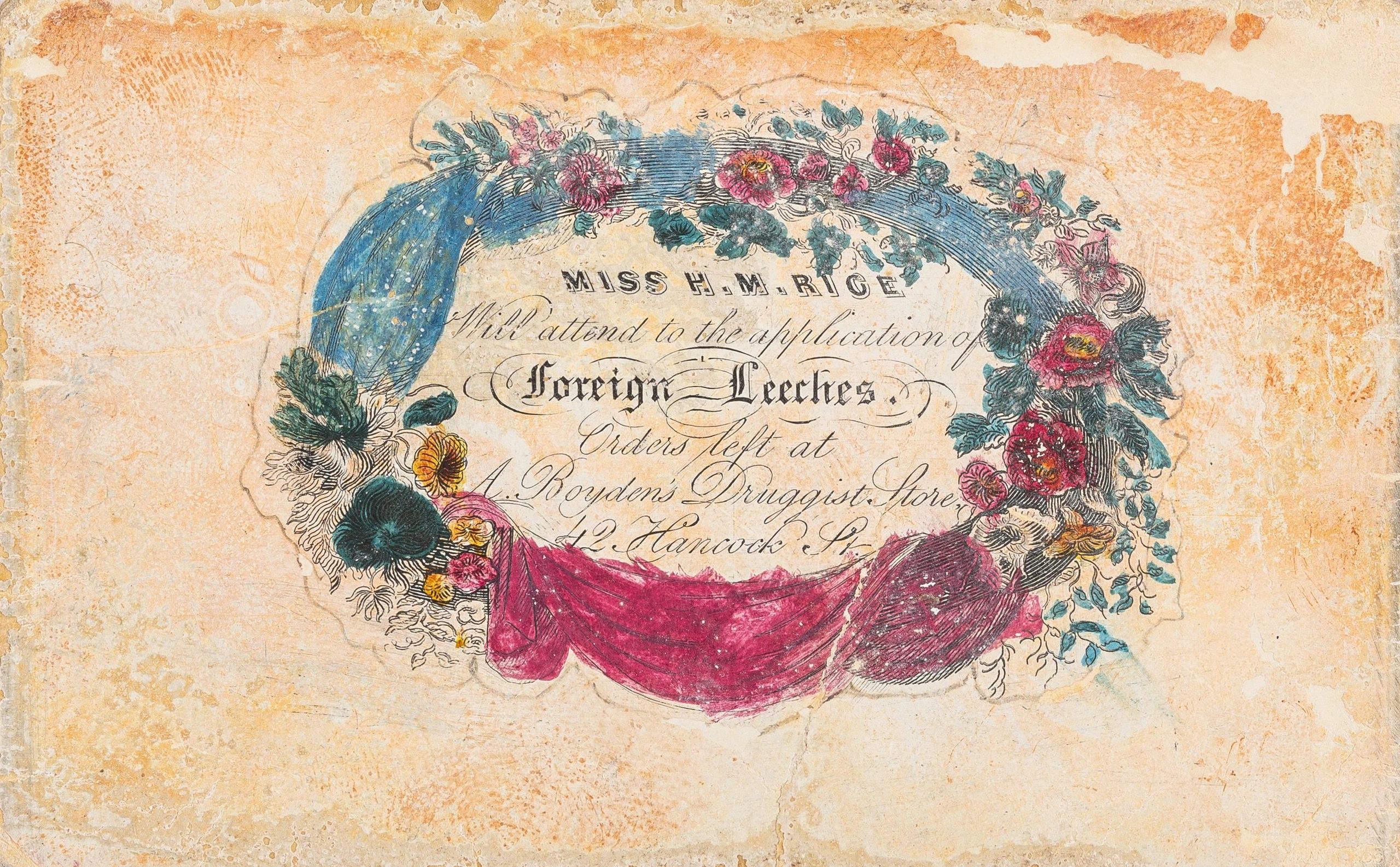
WORCESTER—In the late 1830s, Miss H. M. Rice of Boston made her living by applying leeches to the bodies of people suffering from a variety of ailments. At the time, bloodletting was a common medical practice, and Rice advertised her services by handing out small business cards printed with formal script and floral embellishments. One of her elegant cards is in the American Antiquarian Society (AAS) collection and was part of a recent AAS digitization project. The Society scanned and cataloged more than 750 materials depicting or created by working women in the nineteenth century and made them freely available on its website.
“Ordinary women contributed to the economy in all kinds of ways in the 1800s,” said Christine Morris, curator of graphic arts at AAS. “But what they did for work is often overshadowed in the archives by the achievements of men and prominent women. This digitization project uncovered many of the hidden examples of what women did every day to support themselves and their families.”
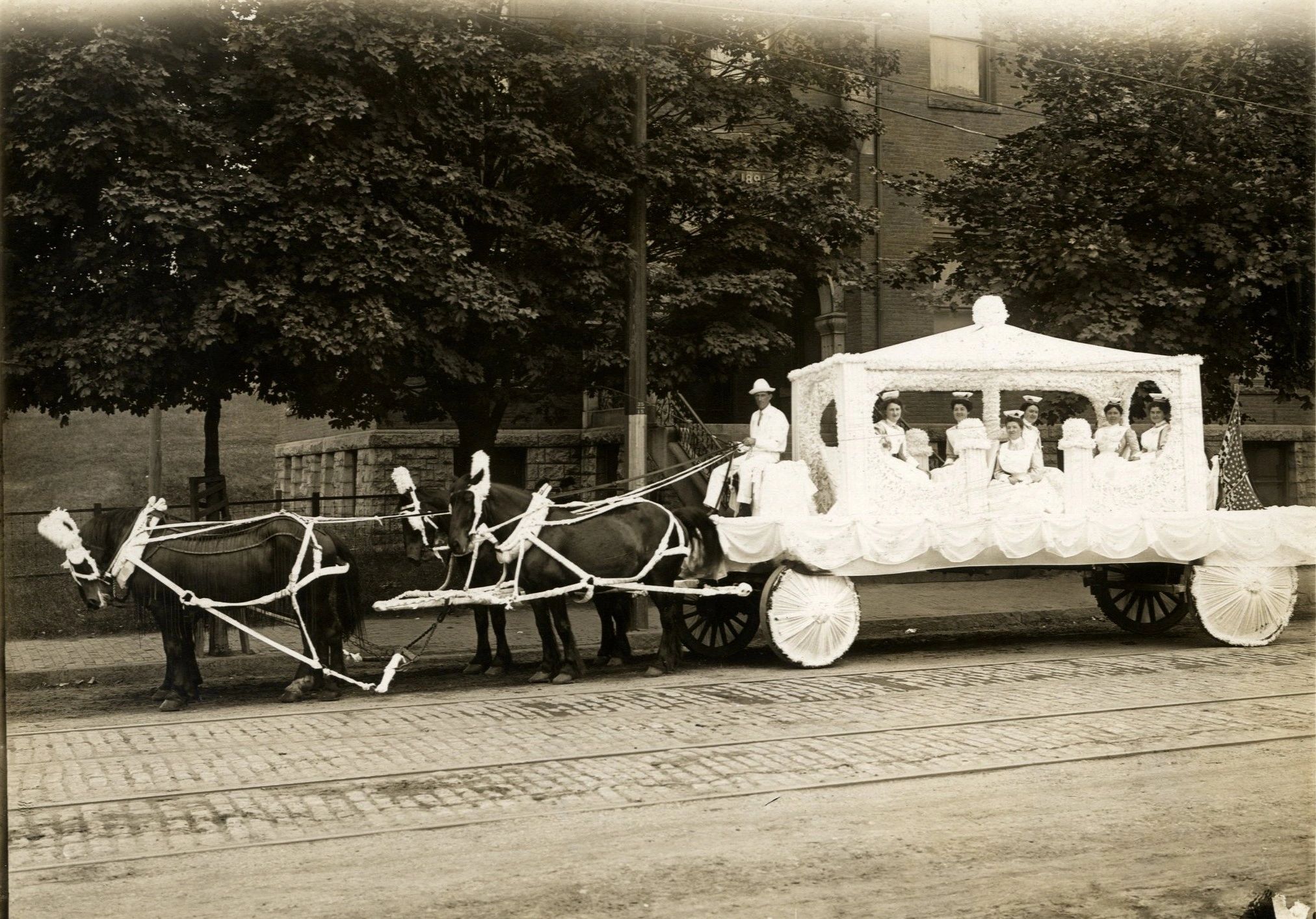
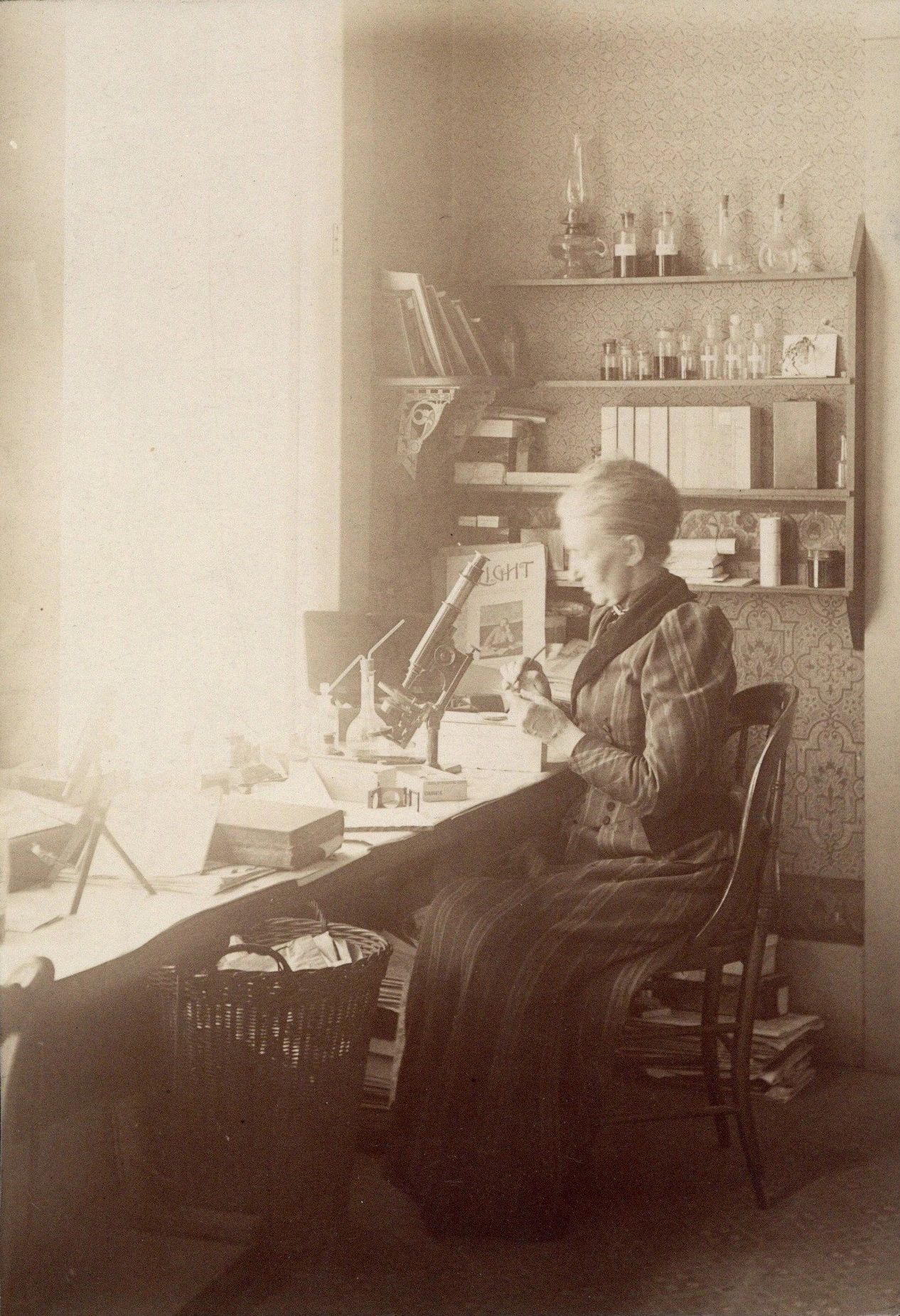
To prepare for the project, which was funded by a grant from the Gladys Krieble Delmas Foundation, Morris conducted a deep search in AAS’s graphic arts collections—totaling 448,000 items. She came across an abundance of materials related to working women, including photographs, trade cards, broadsides, and sheet music. Many pertain to women in Worcester, including photographs of teachers, nurses, and shop and factory workers. One photograph, taken on August 22, 1893, shows Olive Morrow, the custodian of the Worcester Natural History Society (now the EcoTarium), sitting at a table with a microscope and specimen slides.
Some of the materials Morris found reveal more enterprising occupations, such as an advertisement for a “great pedestrian feat” to be performed in Worcester’s Washburn Hall by seventeen-year-old Lillie Hoffman. Dubbed “the youngest and most promising pedestrienne (sic) ever brought before the public,” Miss Hoffman was to walk “500 quarter miles in 500 consecutive hours.” Tickets to watch her walk around the Hall while accompanied by music cost 25 cents each or $1.00 for a package of five.
Morris also discovered a gap in AAS’s holdings. “More than 1,600 women worked as professional photographers in the United States in the 1800s, yet only six were represented in
our collections,” she said. “I knew this was an opportunity to tell the story of working women better and decided to focus on finding photographs made by women.”
Her hunt took her to antiques and book fairs throughout the Northeast, and in April 2023, she found her first photograph at the Allentown Paper Fair in Pennsylvania. “It was at the end of a long day perusing through binders and boxes of photos,” Morris said. Her find was a portrait of a woman identified as Mary Winslow, taken by photographer Elizabeth J. Merrill (b. ca. 1820) of Oskaloosa, Iowa.
In addition, Morris networked with dealers, researched family histories on ancestry.com, and scoured eBay. By the time the digitization project ended in August 2024, she had increased the collection from the original six to 150 photographs taken by more than one hundred American women across thirty-five states.
One local find was a view of Northfield, Massachusetts, taken by the photography firm of Towne & Whitney in Northfield, Athol, and Fitchburg. Anna F. Towne and Alma Whitney founded the company in 1890, after Towne divorced her husband of fifteen years. She was the daughter of Simon Wing, a Boston photographer, and Whitney was a former schoolteacher. The couple and business partners also trained and employed other women, including Towne’s daughter Anna M. Towne.
Morris also bought photographs showing other examples of working women, including a full-length portrait of a woman wearing a white apron and a necklace of sausages around her neck. In the photograph—taken in Berlin, Wisconsin—the woman holds a banner for J.C. Clink Meat Market in her right hand and a sheep on a leash in her left hand, with a piglet at her feet.
“The woman is an example of a ‘banner lady,’” explained Morris. “Retailers hired women and girls to pose for advertising photos such as this one. Their clothing and even their hairdos were decorated with actual products for sale, literally making them living banners.”
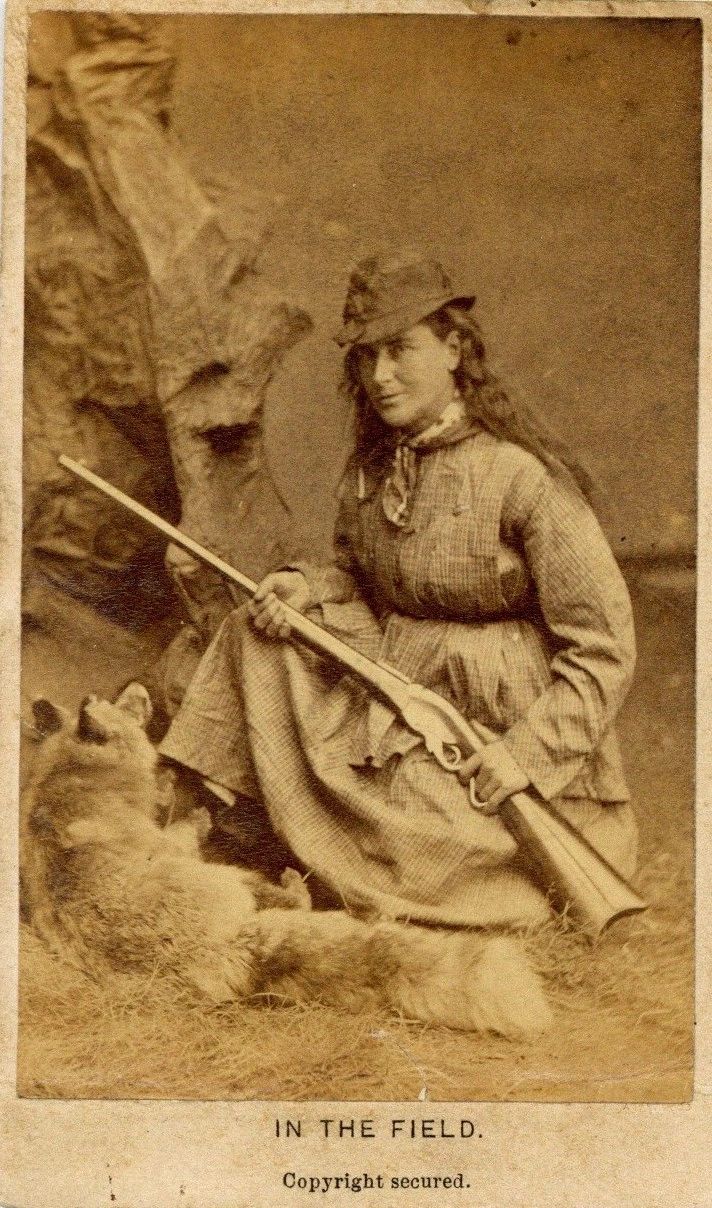
Another photographic print depicts a young woman wearing a dress and hat and holding a rifle with a life-like fox in the foreground. Taken in 1876, the photograph promotes the taxidermy skills of Mrs. M.A. Maxwell of Boulder, Colorado.
“Examples like these dispel common stereotypes of what women did for work in the nineteenth century. Women had a variety of skills that were of value in the marketplace,” said Morris. “Thanks to the digitization project, we can now tell a more complete story of how ordinary American women worked.”
Even though the project has ended, Morris is still on the lookout for women photographers from Worcester. “There were five female photographers working in Worcester in the 1800s, but
so far, I haven’t been able to find any of their photographs. If anyone owns any works by nineteenth-century Worcester women photographers, I would love to see them!”
About the American Antiquarian Society
The American Antiquarian Society (AAS) is a national research library and community of learners dedicated to discovering and sharing a deeper understanding of the American past. Through wide-ranging programs, community engagement, and research support for scholars and students, the Society works to cultivate a broad community of inquiry―locally and nationally. Since its founding in 1812 by Revolutionary War patriot and printer Isaiah Thomas, AAS has assembled what is today the world’s largest and most accessible collection of printed, handwritten, and visual sources from before 1900 in what is now the United States. As a learned society, AAS has over 1,100 members, who are elected based on distinctive achievement in academic or public life.
The American Antiquarian Society is located at 185 Salisbury Street in Worcester, MA. The library is open Mondays, Wednesdays, Thursdays, and Fridays from 9:00 a.m. to 5:00 p.m. and Tuesdays from 10:00 a.m. to 5:00 p.m. Free public tours are held every Wednesday at 3:00 p.m. To learn more, visit americanantiquarian.org.
This article is part of an ongoing, bi-monthly series supplied by the American Antiquarian Society that focuses on the society’s collections and how they deepen the community’s understanding of Worcester’s–and the American–past. Through wide-ranging programs, community engagement, and research support for scholars and students, the AAS works to cultivate a broad community of inquiry―locally and nationally.
