
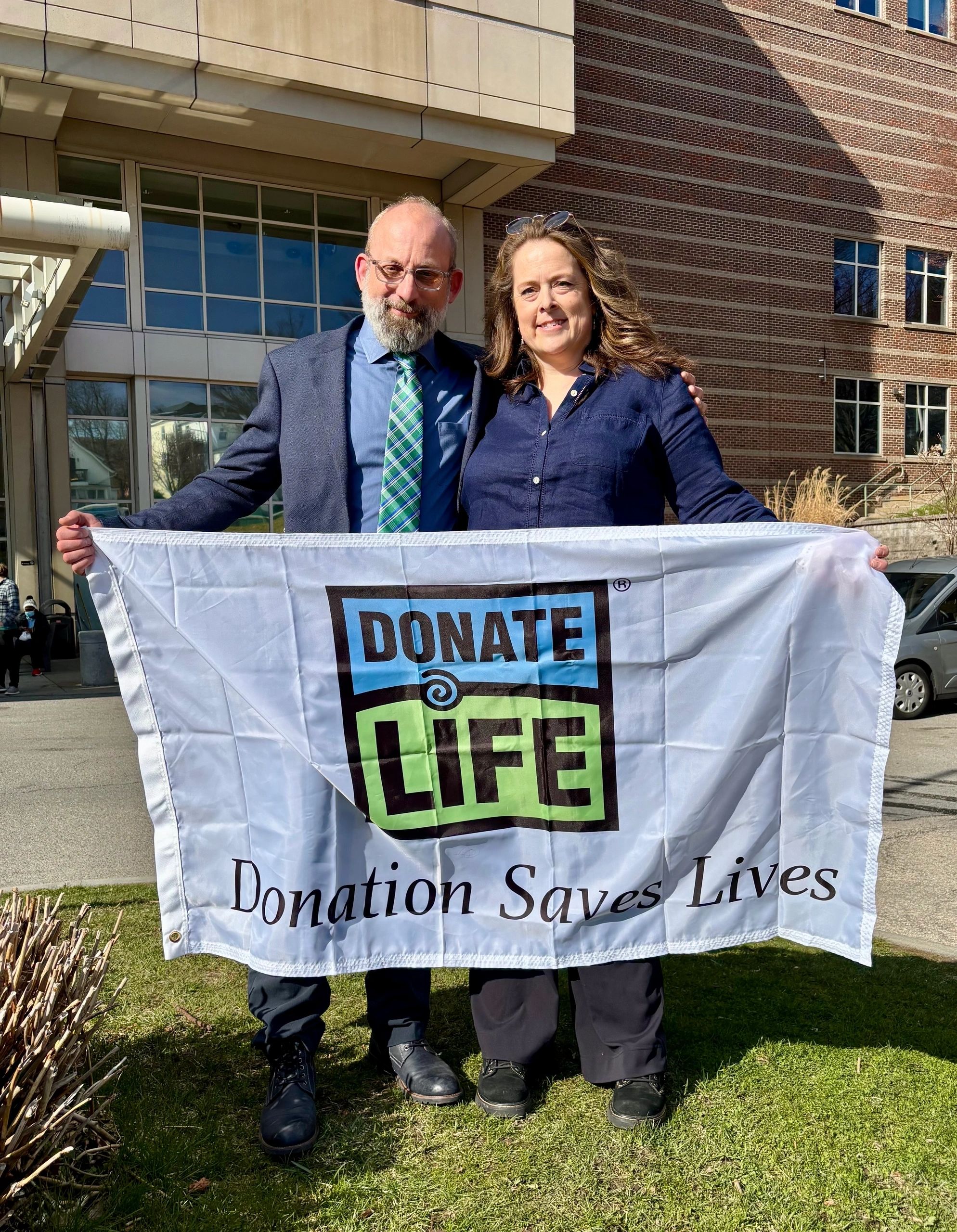
WORCESTER—When Erin Murphy thinks about how her husband helped her receive a kidney transplant much sooner than expected, she has only one way to describe it.
“It’s a miracle,” she said.
Murphy, 51, was 40 when she began to feel tired and she found out that she had polycystic kidney disease, which causes cysts to grow in the kidney and disrupts normal kidney function. High blood pressure, abdominal pain and kidney failure can occur.
Doctors at UMass Memorial Medical Center monitored her and last April she was placed on the waiting list for a kidney transplant after her condition worsened. She was told she might not receive another kidney for five or six years.
Murphy’s husband of 26 years, Keith Baldinger, 54, wanted to donate one of his kidneys to his ailing wife, but her rare blood type of B positive prevented them from being a good match for the transplant.
So through the National Kidney Registry’s Voucher Program, Baldinger donated a kidney to someone he didn’t know so Murphy could get a voucher that gave her priority status on the living donor transplant wait list.
“I think it’s just amazing,” Murphy said.
Baldinger donated a kidney on Dec. 3, which was, appropriately enough, GivingTuesday and Murphy received her kidney on Jan. 28, only eight weeks later.
“We were shocked,” she said.
Both surgeries took place at UMass Memorial Medical Center University campus. Both patients are recovering nicely.
“I don’t feel like I have somebody else’s organ inside me,” Murphy said. “I think I healed really well. I always had a positive attitude. When they asked me how much pain I was in, I was always like a 2 (on a scale of 1 to 10).”
“I feel great. I think I’m back to normal…because I don’t sleep at night anymore,” Baldinger said with a laugh.
Murphy can’t thank her husband enough.
“He’s amazing,” Murphy said. “He wanted to do it. Here, they made sure that he was physically 100 percent able to donate and that made me feel more comfortable.”
While testing Baldinger prior to his kidney donation, doctors discovered an anomaly on his appendix. Dr. Laurence Belin performed Baldinger’s appendectomy in September. Coincidentally, he also performed Murphy’s kidney transplant in January. Dr. Dheera Reddy removed Baldinger’s kidney.
“I wasn’t thinking of the other person,” Murphy said. “It was strictly to help her. It was a selfish act. That’s what I call it.”
After his wife received her donated kidney, he began to realize that he helped not only his wife, but someone else as well.
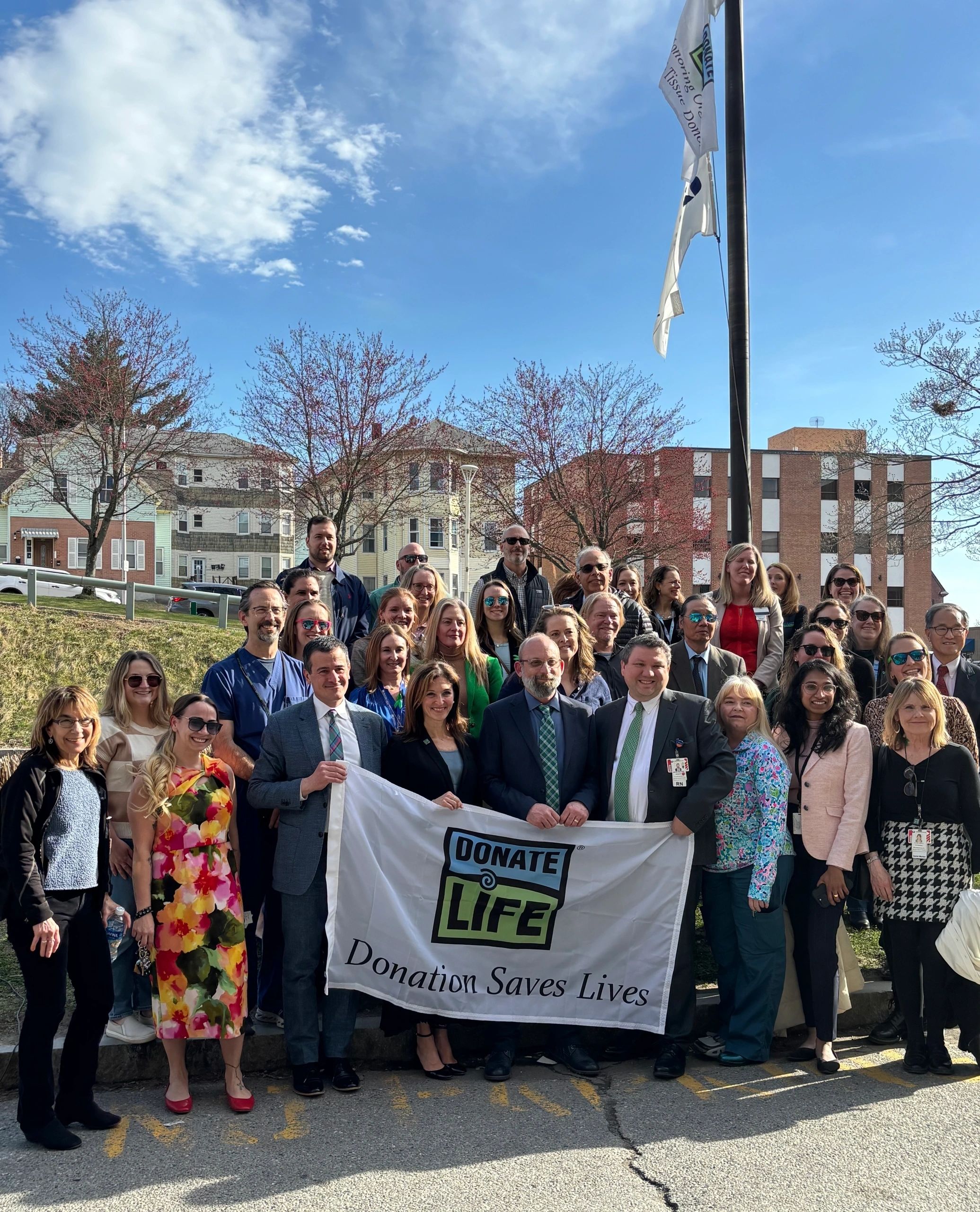
“It’s super cool,” he said. “The reality for me is that it helps her. She needs to stick around. I want her to. But to know that somebody else out there is not maybe suffering any more, that makes you feel good.”
Baldinger and Murphy were on hand Monday when a flag-raising ceremony was held in collaboration with New England Donor Services in front of the UMass Memorial Medical Center Memorial Campus to honor Donate Life Month.
Last November, before they were told of their surgery dates, they never would have expected to be at such an event so soon.
“I thought five years down the road,” Murphy said. “I thought I would have to go on dialysis before I found one.”
They hope their story inspires others to donate kidneys and other organs.
“The reality is it’s not difficult,” Baldinger said, “with modern medicine and what you go through to get here. There’s risks, but they’re low. You can live with one kidney, it’s OK.”
Since the program began at UMass Memorial Medical Center in 1987, about 1,500 transplants have been performed. About a third of those involved live donors.
“The UMass transplant clinic, the staff that is there, they’re unbelievable,” Baldinger said. “She’s been dealing with the kidney department for awhile and that’s always been good, but then going to the transplant clinic and the way they treat you with compassion and empathy. They’re honest. If you want to know what’s wrong with you, say you’re going to donate an organ because they tell you everything.”
Murphy did her fair share of research online, but she praised her doctors for answering any questions she had.
Dr. Babak Movahedi, chief of transplant surgery at UMass, said he remembers three donors and three recipients all swapping organs on the same day.
“It gives people a life back,” Movahedi said. “They call it the gift of life and it is truly the gift of life because coming off dialysis, being able to live a normal and productive life, a healthy life, adds several years to their life expectancy. They can participate in the world. They can work, they can travel. When you’re on dialysis, it’s very hard to travel.”
Movahedi continued to praise the donors, noting that whether living or deceased donors, are saving numerous lives.
“They really show that there is still goodness in this world with everything that’s happening around us every day…all the wars and all the horrible things that are happening,” added Movahedi.
Baldinger is the assistant town manager for operations in Shrewsbury. Murphy was a hairdresser for 32 years, but she recently closed her salon to focus on her health.
Polycystic kidney disease is a genetic condition that Murphy inherited from her mother and which she passed along to their 21-year-old daughter, Malorie Baldinger. Malorie may have to receive a kidney transplant some day, but her parents hope medical advances to control the cysts and other new treatments will push that off for quite a while, maybe forever. Some transplanted kidneys can function for 15 years, but others can last 40 years or more.
Baldinger would like to meet the person who received his kidney and Murphy would like to meet her donor, but they don’t know who either person is yet.
The recipient of Baldinger’s kidney contacted UMass and expressed interest in learning more about him. Baldinger sent a letter six or eight weeks ago and is waiting for a reply.
“I’d love to meet him,” he said, “and I definitely want to thank the person that helped my wife.”
Murphy plans to write a letter that will be presented to the donor and it will be up to the donor if he or she would like to get in touch.
“I just want to say I’m grateful,” she said, “and how appreciative I am that they donated. It’s nice to thank somebody in person.”
According to the National Kidney Registry, more than 90,000 Americans are waiting for a kidney transplant. A kidney from a living donor usually lasts longer than a kidney from a deceased donor and allows the recipient to undergo a transplant much sooner.
Alex Glazier, president and CEO of New England Donor Services, told the audience at the flag-raising ceremony that there has been an 80 percent increase in donors in the region since 2020.
Bill Doyle has been a professional journalist for 47 years, most of them as a sports writer for the Telegram & Gazette. He covered the Boston Celtics for 25 years and has written extensively about golf, boxing and local high school and college sports. He also worked for the campus newspaper when he attended UMass-Amherst. He can be reached at billdoyle1515@gmail.com