

WORCESTER—These days, a dedicated hockey fan can find out who leads the ECHL in plus-minus among players who wear size 9 1/2 skates.
Plus-minus is a sacred hockey number like goals, assists, points and PIM. Not-so-sacred, but probably just as important, is how many faceoffs a player wins or loses. Railers center Jake Pivonka is one of the best in the league at that.
“Let’s see,” wondered Railers coach Jordan Smotherman as he looked at the Quabbin Reservoir of statistics he can swim through in hockey’s world of infinite numbers. “[Pivonka] has won 59 percent of his faceoffs. That’s in 947 faceoffs.
“Our centers, in general, have been very good.”
Some players make careers out of winning faceoffs but that is not all Pivonka has done for Worcester this season.
“I wouldn’t say there’s a secret to it,” Pivonka said. “I think it’s more practice-based. Obviously, if there is something you’re good at, you practice being good at it. My dad was a center and he kind of instilled it in me pretty young, so I’ve always focused on that part of the game.”

Pivonka’s dad is Michal Pivonka, one of the best players ever to wear a Washington Capitals uniform. He compiled 599 points in 825 games with the Caps, 418 of them assists.
So, about the ancient and honorable art of faceoffs and how important they are.
Before computers, before TV, before radio, before the airplane, the car and the telephone there was one established hockey fact that remains in place today.
As Smotherman put it, “If the other team doesn’t have possession of the puck, they can’t score.”
Jake Pivonka’s faceoff ability has always been there but the scoring part of his game is evolving. That’s an important part of a resume for any young player looking to move up.
Through Worcester’s first 59 games Pivonka was closing in on a 20-goal season at 17-17-34. He also led the team’s forwards in plus-minus at plus-5, which says something about the opposition not having the puck. Since Pivonka is a rookie, it is hard to say his scoring is a surprise but it is certainly a step up from what he did in college.
In four seasons at Notre Dame Pivonka scored nine goals in 129 games. He spent last season at Nebraska-Omaha and scored 10 goals in 37 games.
“I had a bit of a different role, for sure,” he said of his college career. “Obviously, you’re playing a lot more games as a pro and it’s easier to get into the swing of things. In college, it’s two games each weekend, 30 in a season.”
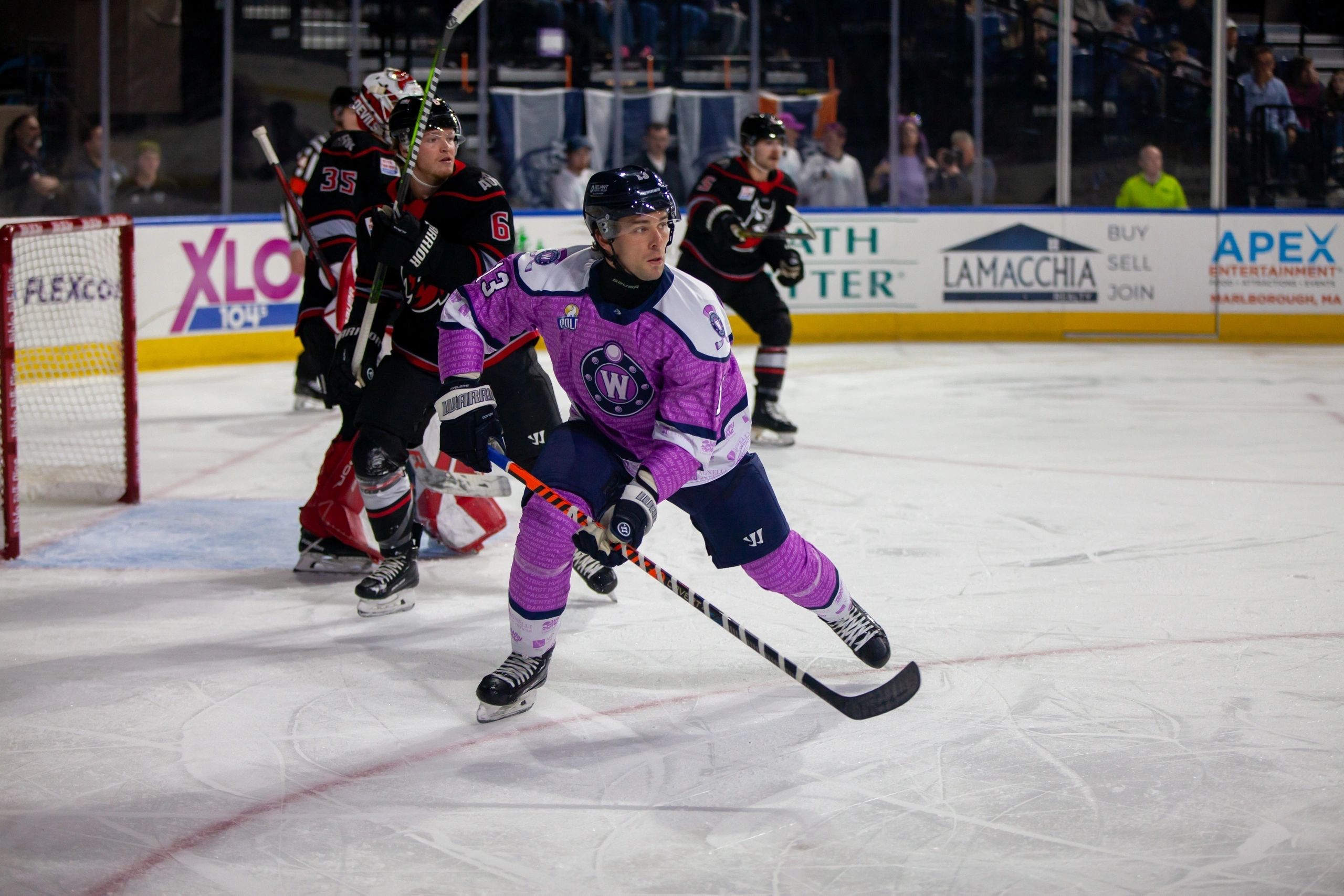
Pivonka may have the same career path as former Sharks forward Mike Iggulden. He scored 13 goals in 110 games at Cornell and was an offensive powerhouse in the AHL. In 2006-07, Iggulden scored 13 goals in his first 27 games with Worcester.
“Guys can get typecast in college,” Smotherman said. “Most players who get to Division 1 have been scorers. As a college freshman, they’re on a team with Top Six forwards who are established and they have to learn to play a different way to get their ice time.
“I think in Jake’s case, in watching tapes from school, he was labeled as the guy who would be your third line centerman, kill penalties for you, win faceoffs in key areas, and that was about it.”
While Pivonka has family history going for him he has geography working against him, at least in terms of playing pro hockey. He was born on Olathe, Kansas while his dad was finishing his pro career with Kansas City of the International Hockey League in 1990-00.
No NHL player, to date, has been born in Kansas.
Jake Pivonka was born on Feb. 28, 2000 and the family moved to Florida’s West Coast right after that so Jake does not recall any wheat fields or tornadoes and never visited the original Pizza Hut in Wichita.
Back then, Florida was a place hockey players retired to, not where they developed. Thus, the Pivonkas moved to suburban Chicago to give Jake a chance to compete at a higher level.
It turned out to be a good move. Pivonka was taken by the Islanders in the fourth round of the 2018 draft and made his pro debut late last season with Bridgeport.
He loved Notre Dame — who doesn’t — and earned his degree in finance. The move to Nebraska-Omaha helped him round out his game.
“It was a change-up, hockey wise,” he said. “I kind of moved to a different role, then transitioned to here. It was a good progression in getting more offensive with my game.”
That progression has showed up in Pivonka’s vital statistics, the traditional ones. The goals and assists add to his value on the roster as a great faceoff man.
“He’s got good leverage,” assistant coach Bob Deraney said of that particular skill. “He gets down there, and the other thing is getting your head over the dot so the other guy can’t get in. The good ones — I think they watch the linesman’s hand, and they have that quick twitch, but you have to have great leverage.”
Being quick on the draw, among other things, has helped Pivonka leverage himself into being one of the Railers’ best forwards in 2023-24.
Bill Ballou covered the Red Sox for the Worcester Telegram from 1997 through 2018. He has covered pro hockey in Worcester since 1994 and currently does a weekly column for the Worcester Red Sox. Ballou can be reached at vetgoalie@aol.com