
WORCESTER—If you’ve lived in this city for any significant amount of time, you’ve likely heard of the Worcester catacombs–a mysterious network of underground passages and rooms rumored to lie beneath a downtown section of Main Street roughly between Mechanics Hall and The Palladium.
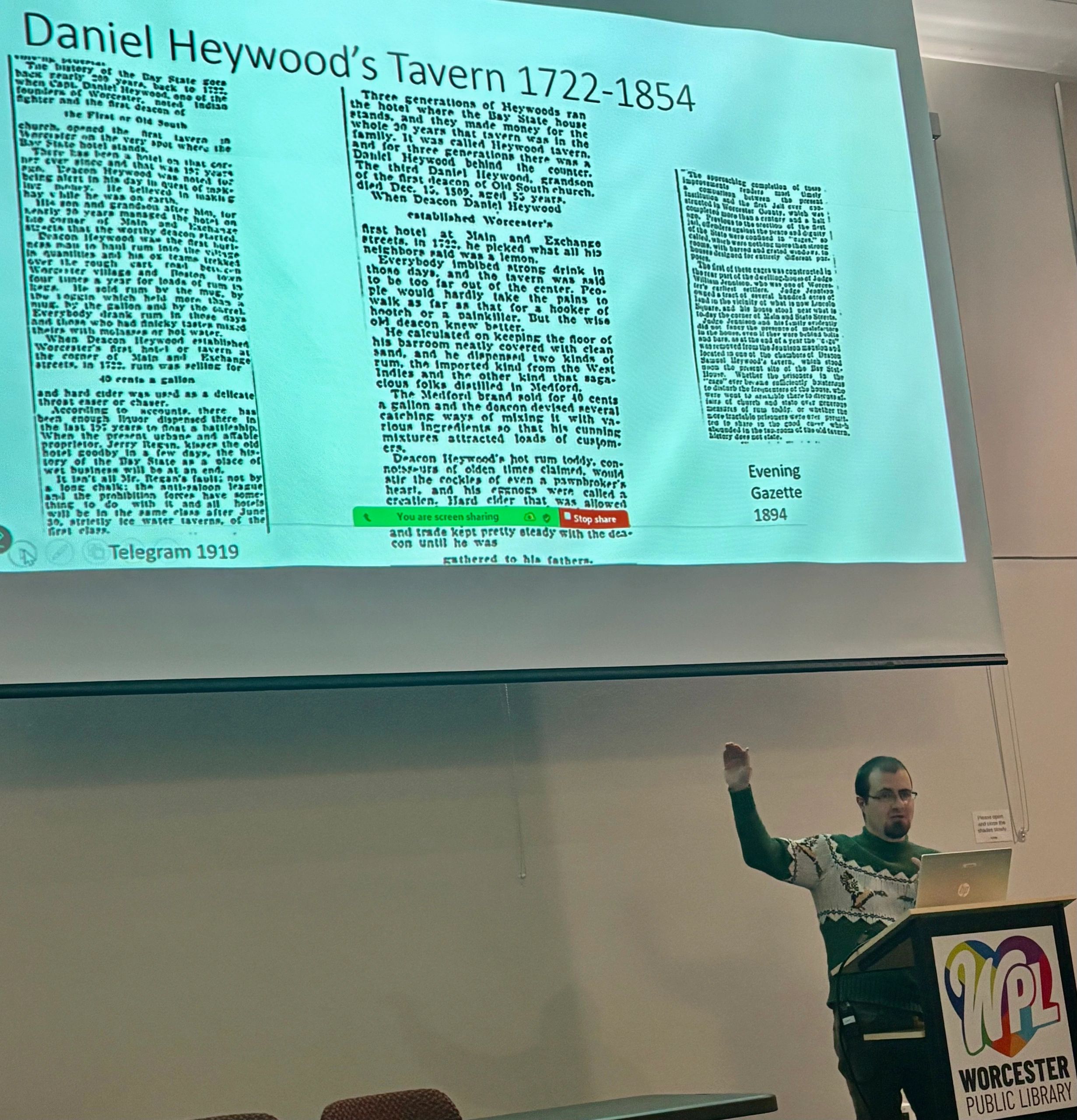
Curious locals were treated to an intriguing presentation called “Worcester History Deep Dive: The Worcester Catacombs” on Saturday, Jan. 24, at the Worcester Public Library (WPL). This free, public lecture was given by WPL’s Alex London, the genealogy and local history librarian.
London’s “Worcester History Deep Dive” series is typically presented once a month at the library’s main branch on Salem Street. For his next topic he’ll explore the Worcester Galleria in “Rise and Fall of the Mall” on Feb. 21 at 3 p.m.
So what exactly is a catacomb? Merriam-Webster.com defines it as “a subterranean cemetery of galleries with recesses for tombs” as well as “an underground passageway or group of passageways.” Some of the most famous catacombs can be found in the European cities of Paris and Rome where scholars believe they were used as overflow burial grounds.
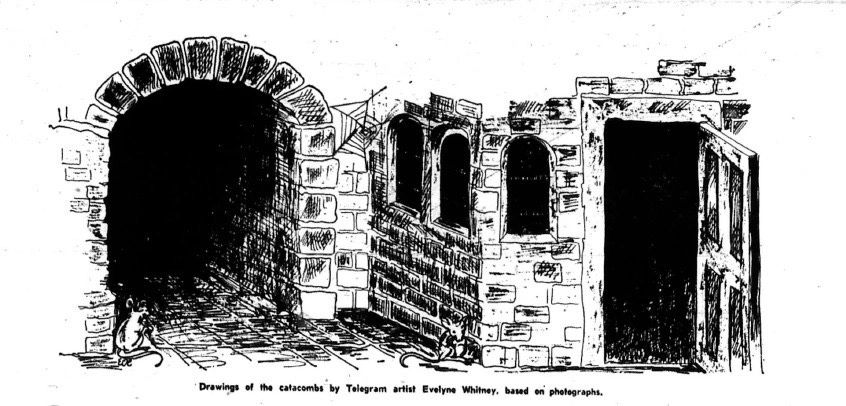
Local fascination with the Worcester catacombs reached new heights when the Telegram published the article “Network of Underground Chambers Revealed Her” by Walter M. Merkel on Feb. 19, 1930. The Telegram’s art critic, colorfully described the catacombs as “an amazing labyrinth of subterranean rooms and passages” located “forty feet underground” off Exchange Street accessed via an entrance in the basement of the Bay State Hotel.
Today, the site described by Merkel is a parking lot located behind the building that houses the Dead Horse Hill restaurant at 281 Main St. In addition to functioning as a parking lot, the space has also been used as a venue for summer concerts in recent years as part of the Palladium Outdoors series.
Merkel’s article also featured three photos of the brick, arch-like structures and tunnels taken by a Telegram staff photographer. To date, these are the only known photographs ever taken of the Worcester catacombs.
“This story in 1930, aroused a lot of attention,” noted London. “Merkel definitely had a flair for the dramatic.”
While captivating, Merkel’s piece also raised suspicion in terms of its authenticity as he failed to use any named sources. By March 1930, the Telegram publicly debunked most of the information provided in Merkel’s article.
Although Merkel’s piece may not have been completely accurate, theories on the Worcester catacombs continued to thrive. Some of the theories claimed the catacombs were built in the 1700s, later used as part of the Underground Railroad in the fight against slavery.
Others noted that these unique underground chambers were part of an old colonial jail or perhaps even the foundations of houses buried by street regrading. Darker theories describe the catacombs as the site of a clandestine “50 round boxing match,” a place where murders were committed and a haven of drinking and gambling activity.
London refuted most of these theories during his presentation. It seems unrealistic that such structures could really be built a whopping 40-feet underground with the inefficient equipment of the time. The air quality at that depth would also be extremely poor–which makes the possibility of hosting a boxing match in such an ill-ventilated space seem ridiculous.
In addition, the manufacturing of individual bricks was not industrialized in the 1700s which would have made getting the amount of bricks to build such structures nearly impossible. As mass production techniques improved into the 1800s, it seems more plausible that this time period would have been a more conceivable period of construction.
Worcester was also very well known for its anti-slavery sentiment at this time so it doesn’t seem like a secret passageway being used as part of the Underground Railroad would be prudent or necessary here as explained by London. This passageway also did not connect to any larger network of tunnels leading to a specific destination.
The keystone of London’s presentation came when he showed a slide of a blueprint of this area from the 1892 Sanborn Atlas. Behind the Bay State Hotel building sits another non-adjoining structure just to the left that appears to depict two rooms–the first, a workshop containing coal, and the second, two large black structures labeled “hotel heaters.” Between the hotel and this structure is a dotted line labeled “passage under ground.”
London noted that this “passage under ground” between the “hotel heaters” or boilers in the non-adjoining building and the hotel seems to be a channel or path used as an underground heating system. The heat would have traveled from the boilers, through the passageway and then into the hotel.
To further support this idea, London showed an additional slide depicting both Mechanics Hall and the Worcester Insane Asylum from around the same time period. Both blueprints show very similar underground heating systems to that of the Bay State Hotel with heat delivered to the main buildings via a connected, underground passageway.
After all the theories and all the speculation, the mystery of the Worcester catacombs may simply be explained as a structure that once facilitated an old underground heating system for a hotel. But even so, without a thorough excavation of the area, the real truth remains obscured from public view.
“There might still be something underneath that parking lot,” noted London.
Without a doubt, there will always be something underneath that parking lot–something for Worcesterites to talk about and debate for the rest of time.
For those looking to explore this topic even further, check out a book written by Worcester native Charles W. Longeway Sr., “Worcester’s Forgotten Catacombs: History of Worcester’s Underground World (published in 2015).”
Mike Vigneux is a freelance writer in Worcester with more than 20 years of experience in the fields of municipal government, communications, and public relations. An avid fan of all sports, Mike enjoys telling the stories of local athletes and their teams. He holds two degrees from Clark University, a bachelor of arts in Communication and a master of science in Professional Communication. He can be reached at Mikevigs@gmail.com
