
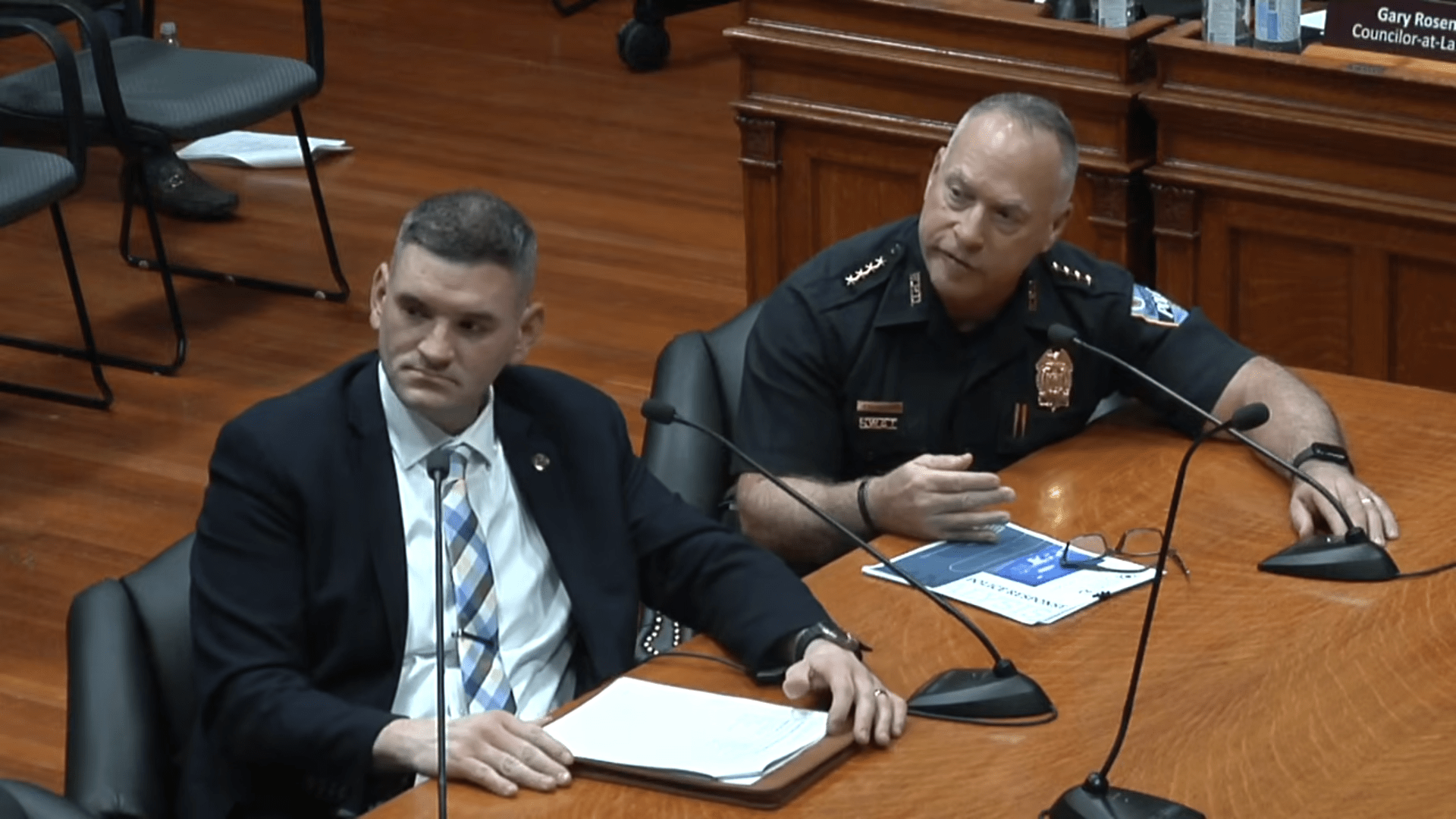
WORCESTER—Worcester police respond to 911 calls in an average of 9.65 minutes, according to a new city report that councilors say offers a clearer picture of how resources are deployed—and challenges some long-held assumptions about response times in high-demand neighborhoods.
The analysis, presented to the city council on April 14, reviewed 157,993 calls from 2024 and 2025 and examined geographic patterns in both call volume and response performance.
Councilor Kathleen Toomey, chair of the city’s public safety committee, called the report “excellent.”
The city’s Main South area saw the highest volume of calls, but also some of the fastest response times.
“That high demand area also benefits from statistically faster than average response time, demonstrating that the Worcester Police Department is effectively aligning resources with the need,” Toomey said.
Department of Emergency Communications Commissioner Charles Goodwin said the report is intended to guide future adjustments, including potential changes to patrol routes, staffing and how different types of calls are handled.
The data also showed that officers spend an average of just over 40 minutes on each call.
“An officer could be tied up for that amount of time, and that takes away from officers throughout the city to respond to the next call,” Goodwin said.
Police Chief Paul Saucier said the department is continuing to analyze ways to improve efficiency, including how officers are assigned and how patrol areas are structured.
“If we have 57.6-percent of calls occurring in two districts, then why do we have people in other areas, where we could shorten it up?” Saucier said. “It would be safer for the officers and more efficient.”
Saucier added that while police respond to every call, response times can vary depending on priority level.
Councilor Jose Rivera said the report helps dispel a common perception that neighborhoods with higher call volumes experience slower response times.
“I think that’s amazing, and it’s important for the City of Worcester’s residents to know that those districts are not being shunned or ignored,” Rivera said, noting that districts 2 and 4 account for roughly 60% of calls while maintaining the shortest response times.
Councilor Tony Economou said the report reflects a data-driven approach within the department.
“I think this report, as specific as it is from various angles, is a perfect tool to use in our department,” he said.
Still, some councilors raised questions about what the data does not show. Councilor Luis Ojeda said he would like more information about the quality of responses, particularly in cases such as domestic violence calls.
“Some of these lower level calls turn into a level one (highest priority),” Ojeda said. “How is it determined when it comes in?”
Goodwin said call priority is based on information provided by the caller and established protocols, which assess potential threats to life and safety.
“It’s all based off of the threat to life and safety, all the way from those urgent calls where someone may have a firearm or someone might be trying to actively harm somebody, all the way down to those administrative things like serving a notice or making a connection with a neighborhood group,” Goodwin said.
Ojeda also raised concerns about how officer availability is affected when calls require extended time, such as transporting individuals to hospitals. Saucier said the department monitors those impacts closely and adjusts staffing as needed.
“If there are 20 officers out there in their routes, and two or three call in sick, now you have five at the hospital, you look at what you have for a number of officers that can respond to calls,” Saucier said, noting that overtime is sometimes used to fill gaps.
Council Vice Chairman Khrystian King said the report provides useful information for both officials and residents.
“What’s helpful for us to share, in order to extend the fact that there is a responsiveness, we need communications like this,” he said. “The more information we have, the more we’re able to convey real-time data that can speak to these concerns.”
