
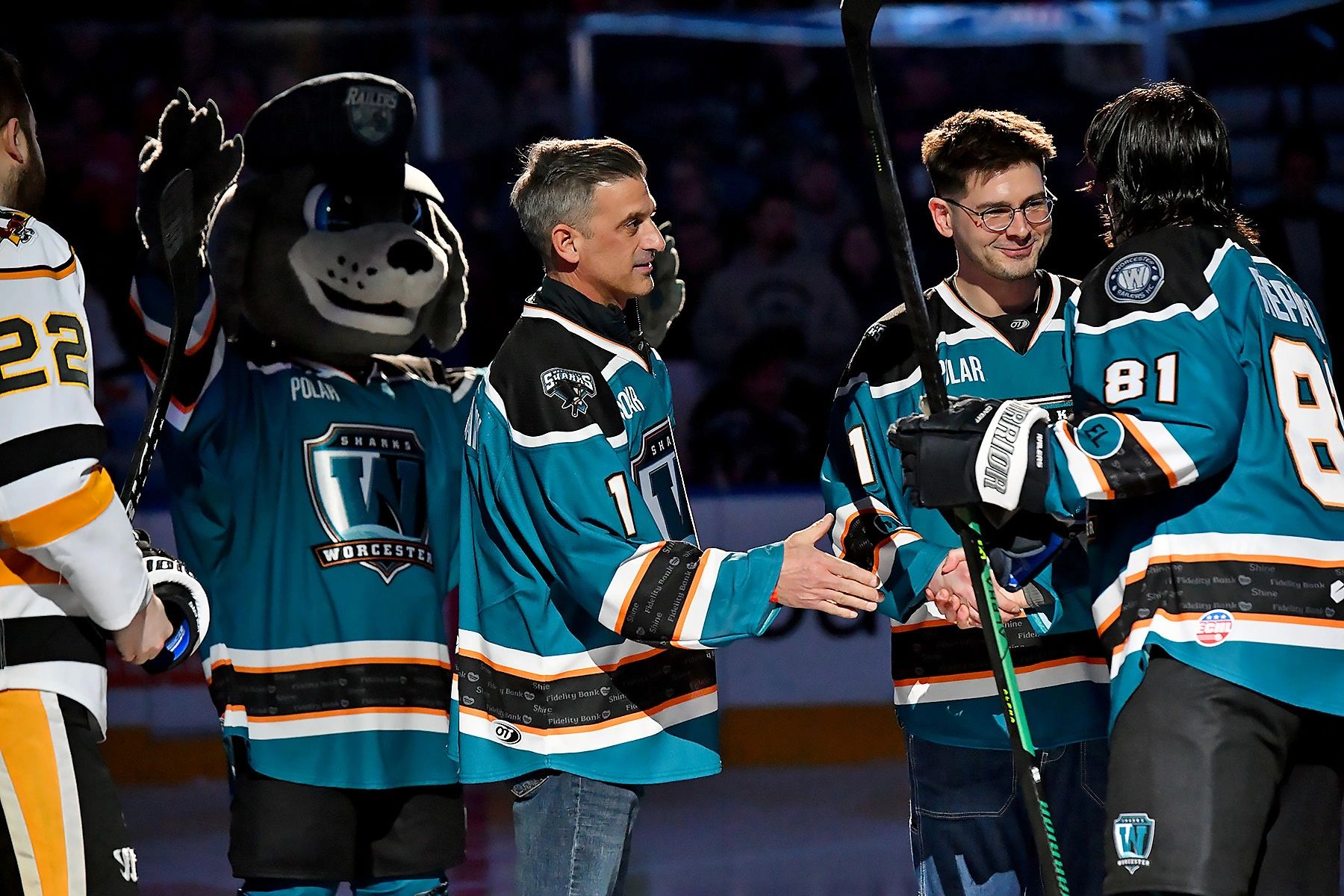
WORCESTER—The Railers are a dynasty when it comes to the ECHL’s Organization Community Service Award.
They do not win it every year but when they don’t, it is news.
One reason for that is their relationships with local nonprofits such as the Shine Initiative, based here on Portland Street with a mission to promote conversations about mental health with young people.
“We work towards reducing the stigma around mental health,” said Executive Director Charisse Murphy. “We do that through education. We work with middle schools and high schools all around Central Mass. We provide mental health literature, have workshops in schools, talk about suicide awareness.”
The Shine Initiative was recognized when the Railers had their Sharks Night recently. As part of that event, there was a pre-game moment of silence for the late Eric Lindquist, the team’s longtime broadcaster, and the late Tom Cavanagh.
Jake Watkins, Shine program associate, was part of the ceremonial first puck drop.
Cavanagh was an original Sharks player who committed suicide in January 2011 by jumping off the top of the parking garage at the Providence Place Mall. He had been diagnosed with schizophrenia.
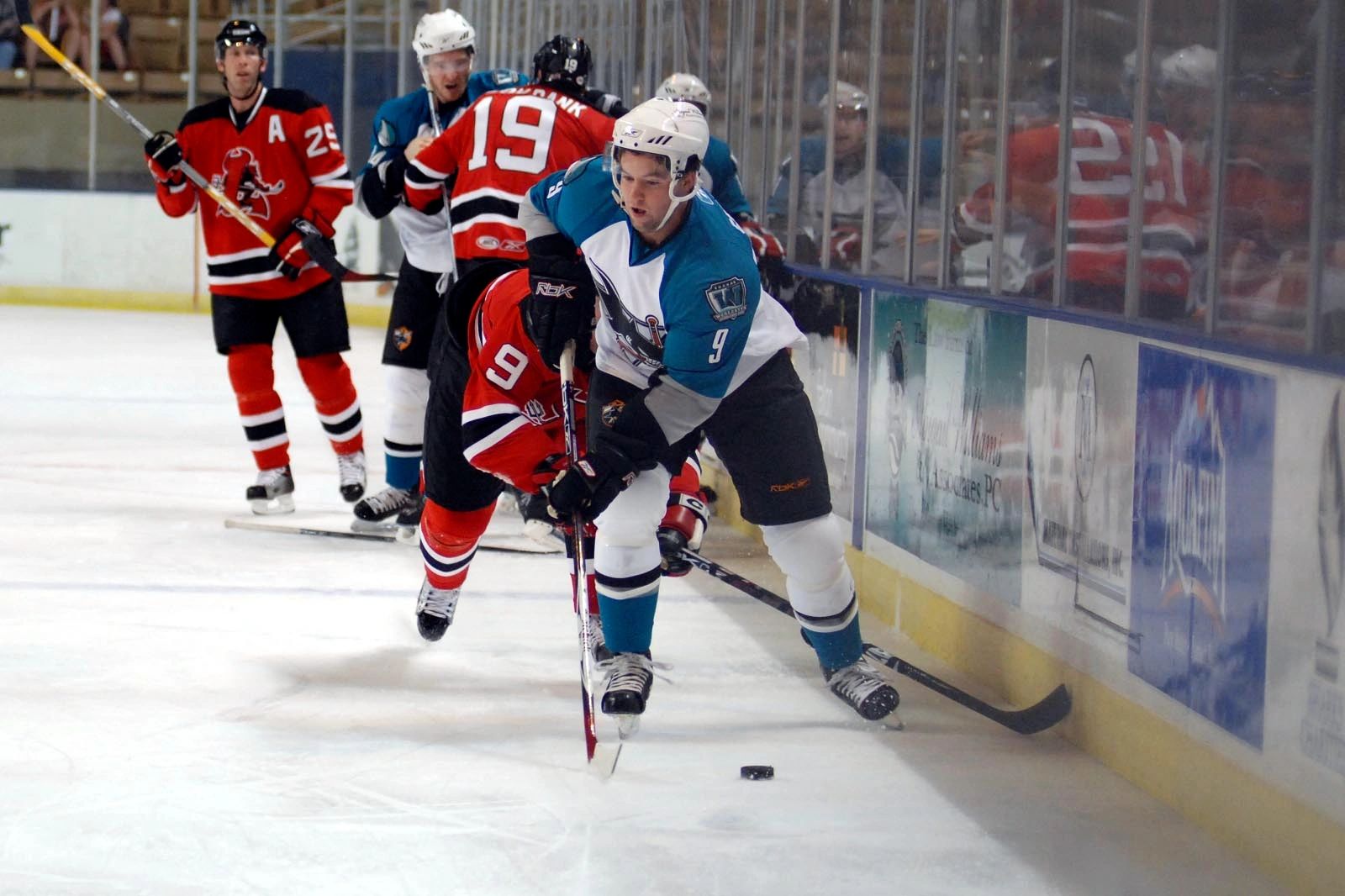
In recent years, athletes have become more open about dealing with mental health issues. Sharks defenseman Adam Comrie, who played here in 2012-13 and 2013-14, was open about some of his prior mental health issues and said that he had gotten past them.
His career lasted until 2020 when he died in a motorcycle accident.
“We have been partnered with Shine since 2011,” Railers Chief Operating Officer Mike Myers said. “We help them from an awareness standpoint, having them on the jersey, getting proceeds from the jersey auction, and they have one gala a year and we support them there as well.”
Shine is focused on young people, not athletes old enough to be professionals. The organization does not provide counseling for Railers players or school age young people.
“They don’t provide services directly,” Myers said. “It is more about opening up the dialog and how to get to the services.”
Pro hockey is all about numbers. It is about wins and losses, goals and assists, saves and penalty minutes.
Mental health is not a numbers game. That can make it hard to measure how successful programs like Shine are.
“We run into this all the time,” Murphy said. “We get asked, ‘How many kids’ suicides do you help prevent?’ There is no way to answer that. Each year we touch around 5,000 or so kids and families.
“Our main goal is to promote the conversation, how to have the conversation, and everything we do we try to keep anonymous.”
Myers was a psychology major at Assumption when he wasn’t playing goal.
Still, Cavanagh’s suicide blind-sided him.
“I was shocked,” Myers said, “maybe even more shocked than most. I had spent a lot of time with him. He was quiet, not the easiest nut to crack, but for me there was no sign.”
He added that team trainer Matt White was the only person in the organization who was aware of the medication Cavanagh was taking when he was playing here. Eventually, it stopped working.
The Shine Initiative was founded by Fidelity Bank of Leominster in 2004. It has remained heavily involved since then.
Unlike the Railers, Shine’s record does not show up in the daily standings but the two of them have been partners in trying to make things better for years.
Bill Ballou covered the Red Sox for the Worcester Telegram from 1997 through 2018. He has covered pro hockey in Worcester since 1994 and currently does a weekly column for the Worcester Red Sox. Ballou can be reached at vetgoalie@aol.com
