

Worcester Public Schools is putting a number on one of its biggest challenges this year: 35%.
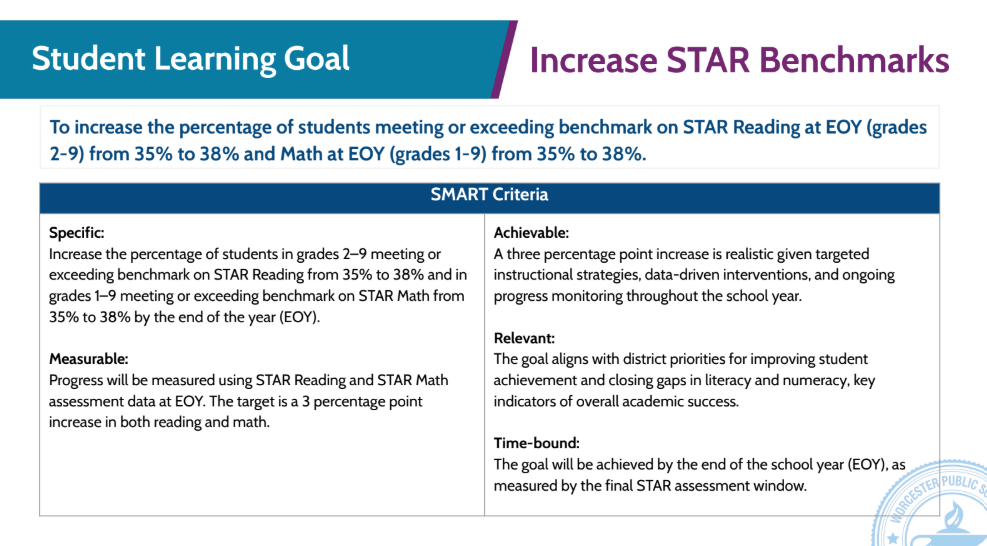
That is the share of students currently meeting or exceeding the district’s STAR benchmarks in both reading and math, according to Superintendent Brian Allen’s proposed goals for the 2026-27 school year. By June, the district wants to push both figures to 38% — a three-percentage-point gain that would become one of the central measures of academic progress this year.
The goals, which go before the Worcester School Committee Thursday, stretch beyond test scores. Allen is also tying his annual objectives to the district’s ongoing school boundary overhaul, changes in how educators work together and an effort to build a pipeline of future principals and other school leaders. Meanwhile, another report on the agenda shows that although more Hispanic and Latino students took Advanced Placement courses last year, they remain substantially underrepresented compared with their share of Worcester’s student population.
The committee also takes up proposed revisions to career technical education admissions, consider $595,000 in state and cultural grants, review how middle school students are introduced to vocational programs and consider annual recognition of Mental Health Month.
Reading and math gains top superintendent goals
Allen’s student achievement target calls for the percentage of students meeting or exceeding STAR reading benchmarks in grades 2 through 9 to rise from 35% to 38% by the end of the school year. The same increase is targeted in math for grades 1 through 9.
The district plans to measure progress through end-of-year STAR assessments, with targeted instruction, data-driven interventions and ongoing progress monitoring throughout the year.
Allen’s goals also put the district’s increasingly consequential school boundary realignment squarely within his performance objectives.
By June, the district aims to reduce overcrowding in at least 85% of schools currently over capacity while increasing use of under-enrolled schools to at least 85% of their building capacity. The work includes reviewing enrollment trends, feeder patterns, program locations and the future of citywide and magnet designations.
A final boundary plan is expected to reach the School Committee for adoption in December, although the district acknowledges some recommendations could take longer than the 2027-28 school year to implement because of budget constraints.
Another goal would increase the share of school-based collaborative teams consistently using district practices for planning, analyzing data and tracking student progress from 70% to 85% by June.
Allen is also proposing a “grow your own” leadership initiative with four pathways for developing instructional coaches, assistant principals and deans, new principals and existing principal leaders. The district says the effort is intended to improve retention, succession planning and workforce diversity.
His professional development goal includes participation in Harvard University’s Public Education Leadership Program and development of a revised district strategic coherence plan by June.
More Hispanic/Latinx students take AP courses, but gap remains
A separate district report offers a mixed picture of Hispanic and Latino students’ participation in advanced coursework.
The number of Hispanic/Latinx students enrolled in Advanced Placement courses increased to 533 during the 2025-26 school year, up from 445 the previous year and 484 in 2023-24.
But representation has barely moved.
Hispanic and Latinx students accounted for 46% of the district’s student population in each of those three years. Their share of students taking AP courses was 28% in 2023-24, fell to 25% the following year and returned to 28% last year.
District administrators said Hispanic students remain underrepresented in AP coursework across all high school grade levels and in nearly all schools and demographic groups, with exceptions among English learners and at Claremont Academy.
The district found no consistent pattern of over- or underrepresentation by AP subject, with one notable exception: Hispanic students were more heavily represented in Spanish language and culture and Spanish literature and culture courses.
The report was prepared in response to a request from member Vanessa Alvarez seeking enrollment and participation data and possible steps to increase access to advanced coursework. No districtwide enrichment data was available, according to the administration.
Career technical admissions policies face another revision
The district is also proposing another round of changes to the admissions policy governing Worcester Technical High School and career technical education programs at the city’s comprehensive high schools.
Worcester offers 32 CTE programs across four high schools—23 at Worcester Tech, four at Doherty Memorial High School, three at South High Community School and two at North High School.
Under the proposed policy, Worcester Tech would continue to allocate seats among the district’s middle schools based on their share of Worcester’s eighth-grade enrollment. But the revisions spell out how students attending schools outside the district’s six designated middle schools would be assigned to the lottery: they would be counted with the middle school corresponding to their home address.
The proposed revisions also change the weighted lottery from a maximum of four entries to three. The current policy lists potential additional weight based on attendance, certain serious disciplinary records and demonstrated interest in career technical education, along with completion of an application. The revised document reduces the maximum lottery weight, although the packet’s side-by-side redline contains overlapping language that makes the precise treatment of individual criteria less clear in the material provided.
The proposed policy is headed first to the School Committee’s Operations and Governance Standing Committee rather than a final vote Thursday.
A companion policy on middle school career exploration is also up for review. It takes a look at how students in grades 7 and 8 are exposed to vocational options through counseling, classroom programming, information sessions, open houses and school-day tours.
The district pays transportation costs for those tours, and participating students do not receive an unexcused absence. Information about CTE options is also provided through middle school presentations, ParentSquare and district social media.
Nearly $600,000 in new grants
Three grants totaling $595,000 are up for acceptance Thursday, with the largest aimed at expanding access to college courses while students are still in high school.
A $525,000 Early College Support Grant from the state Department of Elementary and Secondary Education would cover college courses, books and transportation as well as stipends for teachers and staff supporting participating students. Worcester’s program involves WPS high schools, Worcester State University and Quinsigamond Community College.
The district says the goal is not only to increase Early College enrollment, but to increase the number of students successfully completing courses and earning college credit.
A $50,000 Massachusetts Cultural Council grant funds projects at 11 Worcester schools, including chamber music performances, visual arts instruction for special education students and a student-created fashion show.
Another $20,000 from DESE will support professional development in early literacy across the district’s elementary schools.
Other highlights on the agenda
- Mental Health Month: Member Kathleen Roy is asking the district and school committee to establish annual recognition of May as Mental Health Month. The proposal would use the month to raise awareness of mental illness, reduce stigma and promote mental health education and resources.
- Cybersecurity preparedness: Member Susan Mailman wants the administration to explain how Worcester Public Schools is prepared to keep schools operating during a cybersecurity incident. Her request specifically asks how essential day-to-day functions—including student attendance and school transportation—would continue if district computer systems were disrupted.
- Woodland and Claremont staffing: A district update confirms that Woodland Academy and Claremont Academy each have a principal, two assistant principals and a focused instructional coach for the 2026-27 school year. The update follows FY27 budget deliberations in which the principal position at Woodland was restored.
- Awareness days and months: Member Dianna Biancheria is asking administrators to review national awareness days and months that could be recognized by the district. Her request calls for consideration of additional opportunities for visibility, celebration, education and advocacy around a range of issues.
- Coats for students: The committee considers two donations from Operation Warm. The organization is offering approximately 500 coats for students at Norrback Avenue School and jackets for about 240 students at Clark Street Community School—roughly 740 items between the two schools.
- Labor negotiations: The committee is scheduled to meet behind closed doors at 5 p.m. for contract negotiations involving several Educational Association of Worcester bargaining units, including teachers, paraeducators, aides, monitors and drivers, therapy assistants, parent liaisons and ESL tutors. Members are also scheduled to discuss negotiations with School Committee Administrative Clerk Kristi Turgeon and review executive-session minutes from Aug. 13 and Sept. 3.
The Worcester School Committee meets Thursday, Sept. 17, at 6 p.m. in the Esther Howland Chamber at Worcester City Hall. An executive session begins at 5 p.m. The public meeting can also be viewed and attended remotely through the Worcester Public Schools Zoom link provided with the meeting agenda.
