
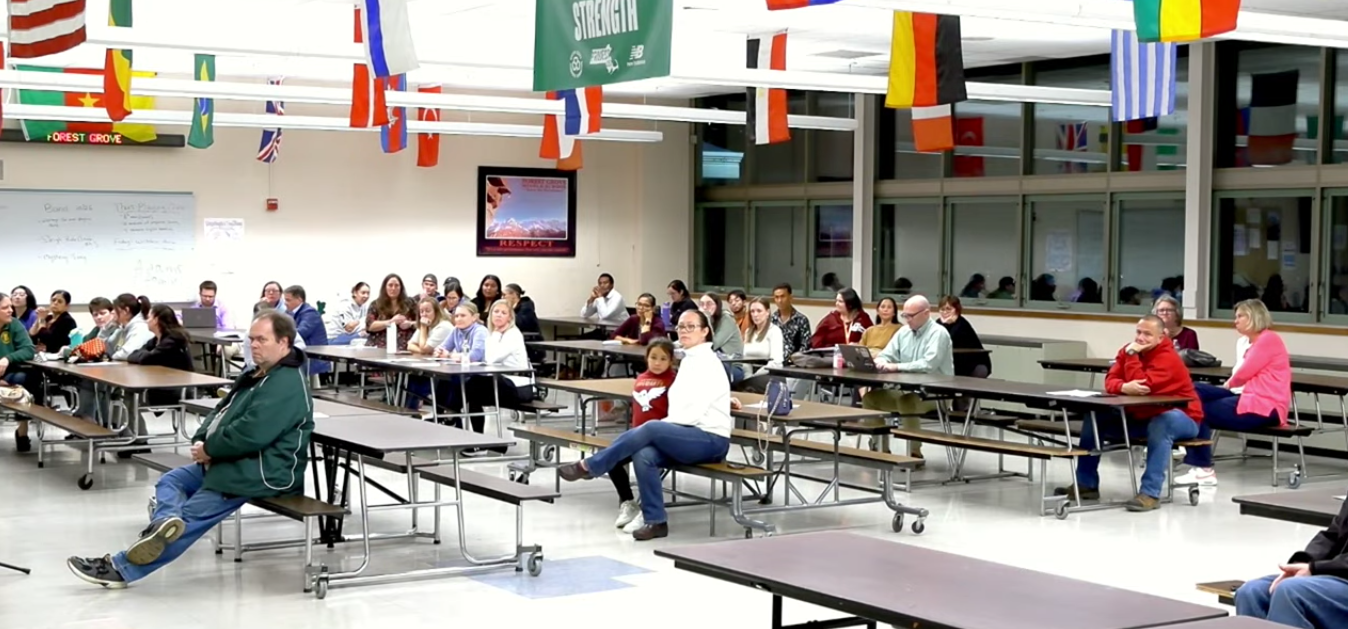
With a final decision on school realignment just weeks away, parents, teachers and residents urged school officials Monday to preserve existing programs and provide greater clarity about proposals that could reshape the district.
So far, three options have been presented for Worcester Public Schools’ realignment. The Oct. 26 meeting did not include a fourth proposal but instead provided an opportunity for residents to weigh in on the models presented to date. Twenty-five speakers voiced concerns, many of whom focused on the fate of specific schools and programs.
With a final vote expected Dec. 3, residents also questioned whether the district is moving too quickly toward decisions that could reshape school assignments and programs across Worcester.
Residents urge preservation of existing programs
Among the biggest concerns of the night were the futures of University Park Campus School (UPCS), Worcester Arts Magnet School and the Greendale Head Start program, all of which have been subject to possible changes in the different drafts.
Numerous supporters of UPCS opposed potential changes to the school or its programs, with many arguing that residents have not been given enough time or opportunities to weigh in on the proposals. The latest draft identified a “co-location under exploration” or “potential merger under evaluation” for UPCS and Claremont Academy.
Logan Satalino, a teacher at UPCS, summed up the concerns of many who said they were uncertain about what was being proposed for the school.
“There’s a lot of confusion and frankly a little bit of frustration about what exactly the plan is,” he said. “We haven’t had very much clarity into what’s going on.”
Supporters of Greendale Head Start urged the district to keep the program at its current location rather than relocate it under a proposal in Draft 3 that would eventually convert the building into a school serving kindergarten through sixth grade.
Christine Lindberg, a Greendale Head Start teacher, said the facility is well suited to its current students.
“We built these classrooms particularly for our youngest citizens, little three- and four-year-old children, and I really can’t see how it would work for kindergarten and sixth grade in that location,” she said. “We hope to keep Greendale Head Start and keep our community and the children who come to us. It’s a great place.”
Although the idea of relocating Worcester Arts Magnet School has not appeared in a proposal since the first draft, supporters renewed calls to keep the school at its current location.
Other concerns raised during the meeting included potential traffic problems associated with proposed changes to school start times, unanswered questions about staffing and whether current students would be allowed to remain at their schools. Several speakers also renewed calls to extend the realignment process beyond the end of the calendar year to allow more time for public review.
Final decision expected in December
Following public comment, the Operations and Governance Committee delivered a clearer picture of the remaining steps and the competing priorities shaping the realignment process. Committee Chair Jermaine Johnson said residents’ input would be valuable as members prepare to bring recommendations to the full school committee. He said all proposals, both past and future, would be examined closely to determine the best approach for the district.
“As a school committee, we need to ensure and make decisions on what is right for the whole district moving forward in the future and what makes sense as we continue to expand and grow,” Johnson said. “There are numerous schools throughout the district that are over capacity and there are many that are underutilized.”
Nick Stellitano, managing director and co-founder of Dillinger Research and Applied Data, the nonprofit organization developing the realignment proposals, acknowledged that no single plan would satisfy every concern. The district is attempting to balance school capacity, enrollment growth, equity and fairness, he said, and each potential configuration involves trade-offs.
“We are going to try to come up with a set of scenarios that show the different tradeoffs that need to be decided upon when it comes to the elementary zones and the middle school and high school zones,” Stellitano said. “There is no perfect solution. There is going to have to be something that gives.”
Stellitano also sought to reassure residents that the proposals do not call for closing schools or eliminating programs, although changes to locations or configurations may be necessary.
He reiterated his opposition to extending the realignment timeline, noting that a final decision would help guide the district’s next budget. The process now enters its final weeks. The Standing Committee on Operations and Governance is scheduled to hold another forum Nov. 16, when several scenarios are presented for consideration.
On Nov. 30, the committee is expected to select two options from the proposals for consideration by the full School Committee.
Final deliberations and a vote are expected Dec. 3.