
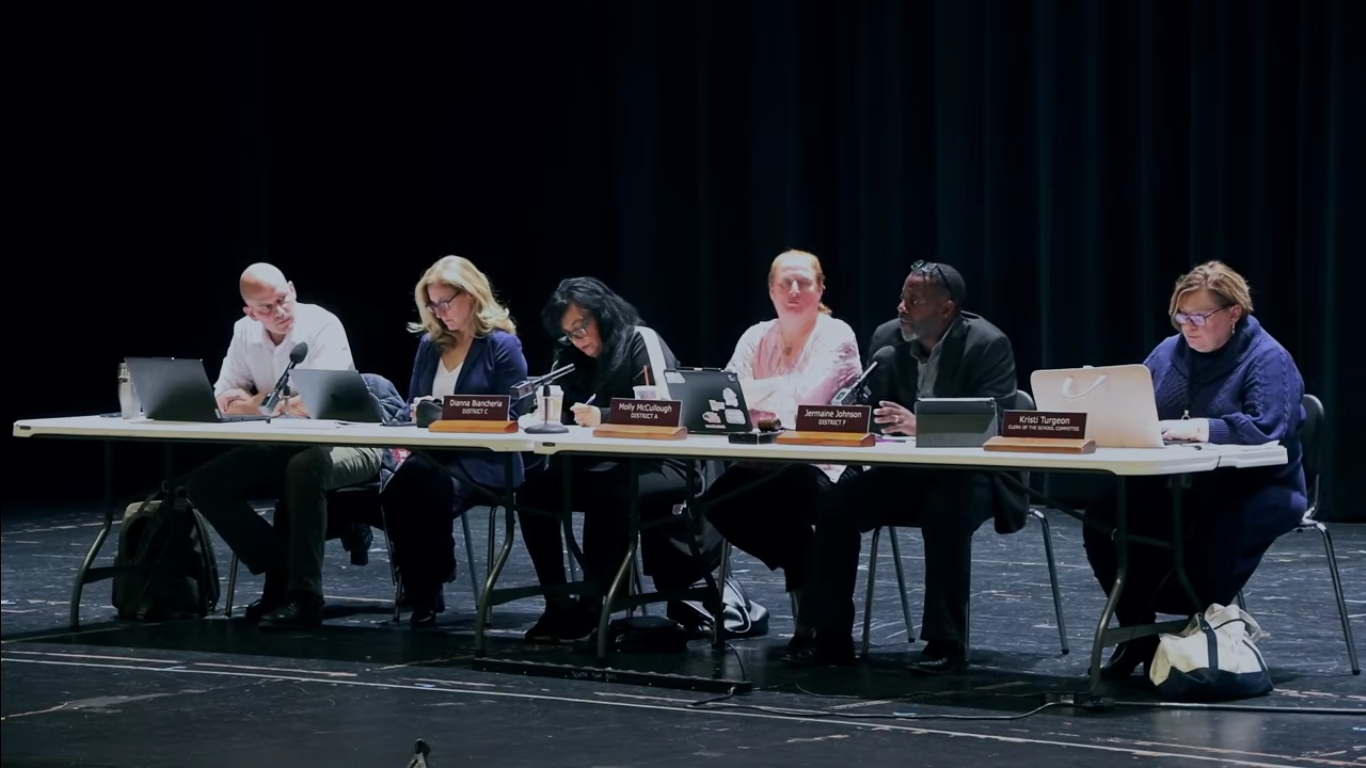
The Worcester School Committee’s Standing Committee on Operations and Governance is moving closer to making a recommendation on districtwide school realignment, but new proposals suggest the process could take a phased approach, beginning with elementary schools.
After months of discussion involving three proposals that explored large-scale realignment across the district, recommendations presented at a Nov. 16 public meeting focused first on elementary school attendance boundaries, potentially delaying changes to middle and high schools.
Nick Stellitano, managing director and co-founder of Dillinger Research and Applied Data, a nonprofit organization charged with developing realignment proposals, presented seven recommendations to the committee. The recommendations reflect longstanding priorities of the project as well as public feedback gathered throughout the process.
The latest proposals maintain expanded prekindergarten access as a major priority, with two new drafts calling for changes to elementary school attendance boundaries beginning in the 2028-29 school year.
Stellitano said elementary schools have become a priority because of significant differences in enrollment and building capacity across the district.
“Five elementary schools exceed the 95% capacity. There are utilization ranges between 57% and 113% meaning that there are many schools that are half empty to bursting at the seams,” Stellitano said. “We’ve engaged in the idea that there’s an unequal Pre-K distribution. To realign pre-K distribution throughout the district we need to realign geographical boundaries to better balance enrollment.”
The two new proposals, Drafts 4 and 5, would introduce prekindergarten programs in most schools.
Draft 4 would convert the Greendale Head Start building into a new K-6 elementary school by 2032, subsequently relocating the Head Start program. Draft 5 proposes converting Worcester Arts Magnet School into a neighborhood school and transitioning McGrath into a new magnet school.
Committee member Jermaine Johnson requested that the administration bring recommendations concerning both drafts to the committee’s Nov. 30 meeting.
Changes to middle and high school boundaries, meanwhile, could be delayed as district officials work to resolve questions about enrollment, programming and long-term priorities.
Stellitano acknowledged that postponing secondary school realignment would amount to “partially kicking the can down the road,” but said the district has yet to identify a solution that adequately addresses competing concerns.
Among the challenges are an uneven distribution of career technical education programs and a lack of clarity about the administration’s priorities for middle and high schools.
“I can change and adjust a thousand different elementary, middle school and high school boundaries so that kids are going every which way, and I can maybe make the overall capacity and utilization work at the middle school and high school, but parents and staff would rightfully feel that it’s so confusing and making the problem worse,” Stellitano said.
He said the district needs to establish a clearer strategic vision for its secondary schools before his organization can develop appropriate recommendations for attendance boundaries and school assignments.
Other recommendations presented during the meeting included creating a centralized process for districtwide program applications, limiting voluntary student transfers, establishing a three-tiered bell schedule and revising transportation schedules.
Flex zones, a controversial option introduced in more recent drafts, have been dropped from Dillinger’s proposals.
The Operations and Governance Committee is scheduled to continue discussing the recommendations Nov. 30, with a final proposal expected to go before the full School Committee on Dec. 3.
A vote on realignment is anticipated Dec. 17.
