
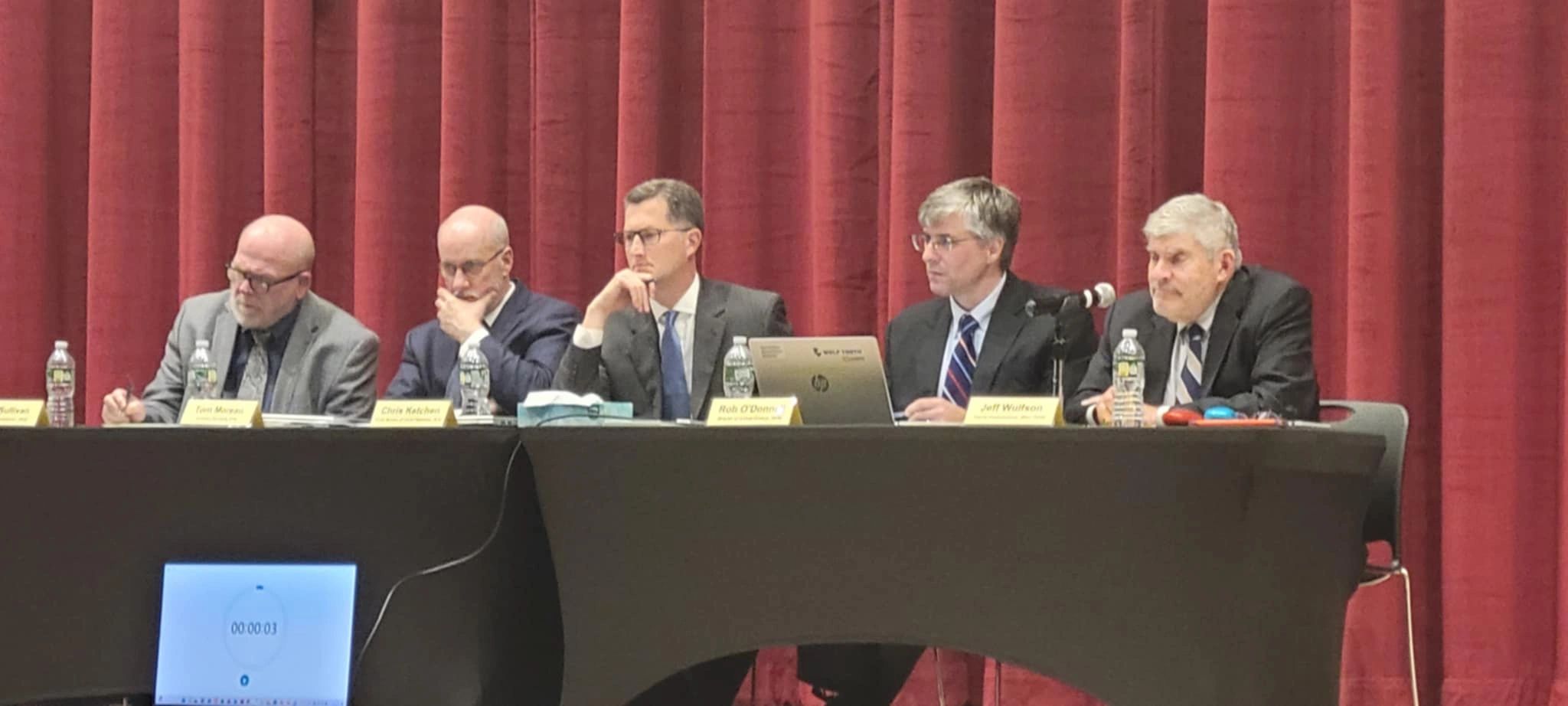
WORCESTER—Doherty Memorial High School played host to the second in a series of listening sessions organized through Governor Maura Healey’s Office as part of a study that could lead to recommendations regarding possible changes in education cost sharing.
Doherty was the only stop in Worcester for representatives from the Department of Elementary and Secondary Education (DESE) and the Department of Revenue’s Division of Local Services (DLS) as they gather input from town and city officials, residents and school leaders to better inform state lawmakers on the financial constrains felt by schools throughout the Commonwealth.
The Worcester session on Oct. 30 featured speakers from a variety of communities and local groups throughout the region contributing their input and recommendations for consideration.
The sessions are part of the FY 2026 Chapter 70 Local Contribution Study, which examines how school funding is split between communities and the state. Chapter 70 refers to the Commonwealth’s state aid formula that distributes funds to help districts meet their foundation budget – their recommended spending target.
Among the focal points of the study are the methods used to determine each municipality’s target local contribution. With school budgets getting tighter and costs going up annually for both taxpayers and the districts themselves, lawmakers are seeking a clearer picture of what changes could be explored to this system.
Jeff Wulfson, the retired deputy commissioner of DESE and a spokesman for the listening panel, said the legislature tasked DESE and the DLS with gathering input to issue a report that, at the earliest, could impact how the state approaches the FY 2028 budget.
“Funding education in Massachusetts has always been a shared responsibility, certainly since the Education Reform Act back in 1993,” said Wulfson. “It’s become increasingly difficult for districts to balance their budget and still meet the full needs of the school systems.”
Among the highlights of the night’s contributing speakers were concerns about Proposition 2 1/2 (a tax levy ceiling for Massachusetts’s towns that limits increases to 2.5% of the value of taxable property), the need for increased investment in pre-school access, questions of the adequacy of foundation budgets, and a need for increased attention to the different needs of each community.
Wulfson admitted their job is not to directly enact change, but to produce a report from the study that reflects the wider perspectives of the different municipalities to better inform lawmakers on how they might proceed in the future.
“A suburban district with growing enrollment and high property values is very different from a rural community that’s seeing enrollment drop,” said Wulfson, “and what we call minimum aid each year and perhaps have difficulty passing their budgets because they’re part of a region. I think our report and our analysis is going to have to be cognoscente of those different circumstances.”
The situation will not be a “quick fix.” Even after the report is filed it’s up to the legislature to enact any changes based on the findings.
“There’s no obvious silver bullet,” added Wulfson. “It remains to be seen if we can come up with some recommendations that will address the problem. That’s certainly our goal.”
The full report is expected to be completed by the middle of next year. Three more listening sessions are scheduled for November: Nov. 6 at Greenfield High School in Greenfield, Nov. 19 at Apponequet Regional High School in Lakeville and a virtual hearing on Nov. 18.
Jason Bleau, a seasoned reporter from Connecticut’s Quiet Corner, has more than 11 years of news media experience. He has worked as a news anchor for WINY 1350 AM, contributed to Stonebridge Press publications, and covered racing as a Press Box coordinator at Thompson Speedway. Outside journalism, he is a movie enthusiast, freelance film reviewer, banker, and solo musician. He can be reached at bleau.jason@yahoo.com