
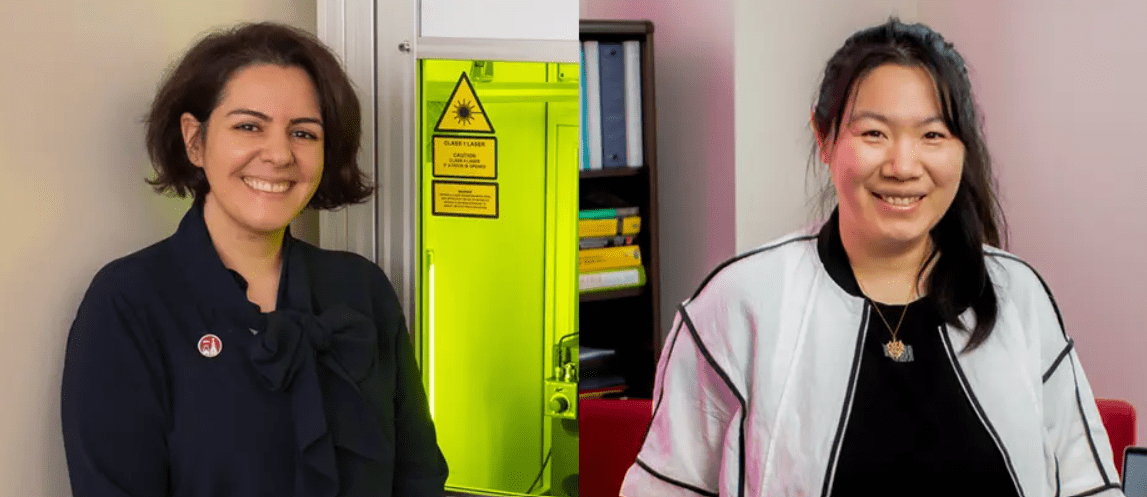
Two Worcester Polytechnic Institute researchers have received more than $1.26 million from the National Science Foundation to tackle challenges at opposite ends of the artificial intelligence spectrum: keeping sensitive information secure on increasingly ubiquitous AI-powered devices and using AI to help turn captured carbon dioxide into useful products.
Fatemeh Ganji and Fanglin Che, both associate professors at WPI, received five-year grants through the NSF’s Faculty Early Career Development, or CAREER, Program, the university announced Thursday.
Ganji, an associate professor of electrical and computer engineering, received $624,083 to investigate vulnerabilities in the specialized hardware that powers artificial intelligence in devices ranging from home security cameras to wearable health monitors.
Che, an associate professor of chemical engineering, received $637,801 for research combining artificial intelligence, computer simulations and electrochemistry to better understand — and ultimately improve — processes used to capture carbon dioxide and convert it into fuels and other valuable chemicals.
The CAREER Program supports early-career faculty whom the NSF identifies as having the potential to become academic role models in both research and education. More than 40 WPI faculty members have received the awards, according to the university.
“CAREER Awards recognize the promise of early-career researchers and provide critical support as they cement their credentials as experts and innovative thinkers in their fields,” Bogdan Vernescu, WPI vice president and vice provost for research and innovation, said in the university’s announcement. “I am delighted to congratulate Fanglin Che and Fatemeh Ganji on this recognition.”
Protecting private data at the edge
Ganji’s work focuses on a growing cybersecurity problem accompanying the spread of AI beyond massive data centers and into everyday devices.
Many of those devices use hardware known as AI accelerators to perform computationally intensive tasks locally, or at the “edge” of a network. That can include devices handling particularly sensitive information, such as wearable health monitors and equipment used in hospital treatment rooms.
Ganji will study privacy-preserving neural networks, which are designed to operate on AI chips without exposing sensitive information to unauthorized users.
Her research focuses on three potential forms of attack: backdoor attacks, in which malicious functions are inserted into AI chips; side-channel attacks, which exploit information inadvertently revealed by hardware, such as its power consumption; and fault-injection attacks, which physically manipulate hardware in an effort to extract data.
“AI accelerators are in devices everywhere, from home security cameras to hospital treatment rooms,” Ganji said in the announcement. “Privacy-preserving accelerators on those devices have been considered secure and private, but research at WPI has uncovered potential vulnerabilities that should be explored and addressed so that users can be assured of privacy.”
Ganji joined WPI in 2020. Her research combines machine learning and cryptography in the design and evaluation of security-sensitive hardware. She earned her doctorate from the Technical University of Berlin and previously conducted postdoctoral research in Berlin and at the University of Florida.
Using AI to improve carbon conversion
Che’s research applies artificial intelligence to a different problem: understanding the complex chemistry involved in capturing carbon dioxide and converting it into something useful.
Her $637,801 project will develop an AI-enabled simulation framework to examine how small organic molecules attached to metals affect catalytic reactions during carbon capture and electrochemical conversion.
The goal is to better predict how molecular interactions affect the performance of catalysts — potentially allowing researchers to discover better catalysts and optimize reactions more efficiently.
“The overarching goal of this research is to develop a physics-integrated and interpretable AI framework that can predict how molecular interfaces control carbon capture and conversion reactions,” Che said in the announcement. “Simulations, when validated by real-world experiments, can help researchers find the materials and processes that will accelerate catalyst discovery and reaction optimization.”
Che joined WPI in 2025 and researches the use of AI to design energy-saving catalysts and catalytic technologies. She earned her doctorate from Washington State University and conducted postdoctoral research at the University of Toronto and University of Delaware.
Research extending into the classroom
Both five-year projects also include educational components extending from K-12 programs to graduate-level study.
Ganji plans to work with students in grades 9 through 11 through existing WPI programs, involve undergraduates in research and publishing, and advise undergraduate capstone teams.
Che plans to create hands-on demonstrations for K-12 students and develop a graduate course in applied machine learning for engineering. She will also produce lectures on computational electrocatalysis and machine learning for her YouTube channel.
The awards arrive as WPI continues expanding research that combines artificial intelligence with fields well beyond computer science — in this case, using the technology both as something that needs to be secured and as a tool for tackling a complex environmental challenge.
Have a story tip, community concern, or insight to share? Email Editor Charlene Arsenault at carsenault@theworcesterguardian.org.
The Worcester Guardian is a nonprofit newsroom serving Central Massachusetts. Help keep independent reporting alive by making a donation today.
