
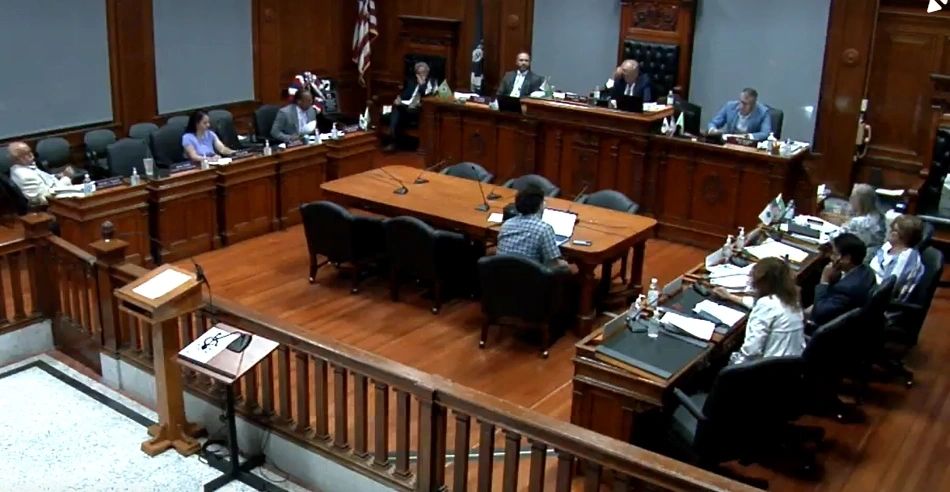
Not surprisingly, the recent announcement by WPI took center stage at council’s Tuesday meeting, as councilors expressed anger over WPI’s plan to convert hotels into dorms, citing potential loss of jobs, hotel capacity and city revenue
WORCESTER — Any community with a healthy college presence is bound to encounter occasionally fraught town-and-gown relations, but the current imbroglio over WPI’s plan to buy two hotels near the Gateway Park development on Prescott Street is one of the most intense in recent memory.
On Tuesday night, the plan was criticized by an angry Worcester City Council, fired up over the potential loss of jobs, hotel room capacity, and almost $2 million in city revenue posed by the conversion of these buildings into college dorm space.
An example of the council’s ire echoed in a note of betrayal in the words of Candy Mero-Carlson, District 2 councilor and chair of the Standing Committee on Economic Development.
“The city has always had a partnership with WPI,” she said. “This [the hotel purchases] was certainly no partnership. For the city manager and for myself to find out about this last-minute, after [WPI] had already gone through the process, really speaks volumes as to the partnership.”
Both Mero-Carlson and Mayor Joseph M. Petty recounted the difficult gestation of the Gateway Park project, the $170 million collaborative effort that brought massive redevelopment to the Prescott Street area, turning a blighted former industrial corridor just off downtown into an incubator of research, entrepreneurship and academia.
“There were a lot of people at the table to make Gateway Park happen,” Mero-Carlson said, “which certainly was great for our city.”
Petty reiterated that sentiment, and said WPI’s intended purchase of the hotels — the Hampton Inn & Suites at 65 Prescott St., and the Courtyard by Marriott at 75 Grove St. — “isn’t a good plan for the City of Worcester.”
Petty recalled many difficult votes and work with local, state, and federal officials in conjunction with the city and the college to get the project passed, and how the late U.S. Sen. Edward M. Kennedy attended the project’s ribbon cutting.
“When we think of projects that were the impetus of the city’s success,” he said, “you want to go back 20 years ago, this was one of those projects.”
Petty pointed out that Gateway Park “elevated that part of the city” and helped Worcester’s nascent bioengineering and research efforts “compete with [those in] Cambridge and Boston.”
“I’m not sure what happened,” Melo-Carlson remarked, “that all of a sudden an institution like this, someone who had a relationship with the city … didn’t think that we needed to know they were about to take $1.6 million off our tax rolls.”
City Manager Eric D. Batista told the council he continues to be in communication with WPI officials and hopes to find a solution that’s not as devastating to the city’s economic growth as the loss of these hotels.
Estimates by a group composed of city and local business leaders suggest the loss of the two hotels could remove $850,000 in hotel tax revenue and another $780,000 in property taxes for the two buildings (which would be exempt from those same taxes if purchased by the college).
Additionally, converting the hotels to dorms would erase a quarter of the city’s entire hotel room capacity and result in the loss of 100 jobs.
Meanwhile, WPI has said it wouldn’t convert the Hampton Inn site to a dorm until 2026, while the Courtyard site would remain a hotel until 2030. Also, thanks to a tax increment financing plan (TIF) from 2014 with the hotel’s original owners, WPI may be on the hook for the full value of the Hampton Inn site’s property taxes through June 29, 2029.
At Tuesday’s city council meeting, Petty requested a report from Batista’s office on the precise impacts of the purchase on the city, as well as research into any other agreements regarding the properties that might exist.
Councilors Morris Bergman and Mero-Carlson requested similar inquests into the ramification of the purchase, and Etel Haxhiaj, District 5 councilor, asked for a report outlining every property purchase by the city’s colleges since 2019 and which one remain on the tax rolls.
Ted Flanagan is a journalist, novelist, and paramedic from central Massachusetts. During his time as a newspaper reporter he covered courts and crime for the Eagle-Tribune in Lawrence and was a general assignment reporter in the Fitchburg Bureau of the Worcester Telegram & Gazette. He can be reached at ted@tedflanagan.com
As the Worcester Guardian marks nearly a year of delivering free, independent digital news to our city, our dedication to this mission strengthens. Please consider a tax-deductible donation to support our ongoing commitment to providing hyperlocal news coverage to Worcester. Scroll to the bottom of our home page to sign up for our daily newsletter