
WORCESTER—Worcester homeowners can soon add accessory dwelling units (ADUs) to their properties by right if they fall within certain dimensions and are owner-occupied.
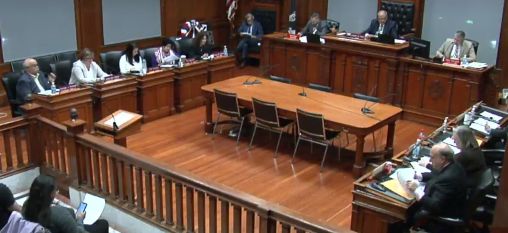
The Worcester City Council voted 9 to 2 at its meeting Tuesday to amend the city’s zoning ordinance to allow for ADUs (commonly known as in-law apartments) by right, but opted not to accept the city planning board’s recommendation to remove an owner-occupancy requirement.
District 5 Councilor Etel Haxhiaj and Councilor At-Large Thu Nguyen cast the two dissenting votes, stating after the meeting that they did not want to include the owner-occupancy requirement in the ordinance and were in favor following all of the planning board’s recommendations when it came to ADUS.
The zoning ordinance amendment has to be advertised before it can go into effect, which the council voted in favor of.
A motion made by District 3 Councilor George Russell that would require homeowners in single-family neighborhoods go through a special permitting process to construct ADUs failed in a 5 to 6 vote, with Haxhiaj, Nguyen, Councilor At-Large Khrystian King, District 1 Councilor Sean Rose, District 4 Councilor Sarai Rivera, and Mayor Joseph Petty casting the dissenting votes.
When the draft zoning amendment went before the Economic Development Committee, the committee voted in favor of recommending the full city council adopt it with all three recommendations of the Planning Board.
In addition to removing the owner-occupancy requirement, the Board recommended allowing ADUs in all zoning districts where there are existing residential units and eliminating a 50 percent of gross floor area size cap on the ADUs in favor of a 900 square foot limit. The draft ordinance amendment allowed for ADUs by right in all zoning districts except for manufacturing zones or the airport zone.
Rose, who chairs the committee, moved away from that recommendation Tuesday, motioning for the council to only accept the Planning Board recommendations about zoning districts and a size cap. The council ultimately voted with Rose.
Rose explained that since the Nov. 29 Economic Development Committee meeting he’s spoken to dozens of his constituents.
“A vast majority of the folks I spoke to are very, very much in favor of this ordinance, but their concern is over the owner-occupancy requirement being taken out of the plan,” Rose said.
Those sentiments were shared by several speakers during the public comment portion of the meeting. By not having the owner-occupancy requirement, Greater Hammond Heights Homeowners Association President Gordon Duncan said the door is wide open for cash-rich investors from Boston to compete with residents’ children and grandchildren in purchasing homes.
The city’s administration had originally recommended including an owner-occupancy requirement for that reason. However, the Planning Board suggested removing it because of questions of how it would be enforced and what would happen if the owner decided to move out at a later point.
King said he was in favor of removing the owner-occupancy requirement, but noted that the “votes weren’t there” to do that and said the council could come back to the council floor and make a motion to remove it following the same process it took to get the initial zoning amendment passed.
Russell raised that he was the councilor that initially suggested the city allow ADUs on the council floor, but said what was proposed Tuesday was very different from what he had in mind.
Russell motioned to require special permitting for ADUs in single family zones because he said the zoning amendment as it was written would allow “two families in a single family zone without any hearing.”
That is a mistake, according to Russell, who said allowing ADUs in single family zones would change the look and character of areas like College Hill. He said he is always dealing with occupancy issues in that neighborhood and has fought to keep zoning in place to allow for no more than three unrelated occupants in a unit.
“Families have made their lifelong goal to be in a single family neighborhood…they should have the ability to have the conversation before a special permit granting authority…we owe that to those folks who have built their life around that single family zoning,” Russell said.
Russell’s comments were echoed by Councilor At-Large Morris Bergman, who said comments related to the best utilization of land sounds like socialism or communism to him. He said if you buy a single family home you should have the expectation that your neighbors homes will remain single family except through a permitting process.
Petty asked Chief Development Officer Peter Dunn if in his research there was any evidence that allowing ADUs changed the character of neighborhoods.
“One of the things that the data doesn’t support is that when you adopt this in whatever form, even if there’s no restrictions at all, that you’re going to see some proliferation of units,” Dunn said. “There’s a lot of data about the production of these units across the commonwealth in communities that have a variety of different approaches to the framework and even in those in the least restrictive we’re talking about not a huge production.”
Dunn said any worry about major changes to the character of single family neighborhoods “hasn’t really manifested” and a low number of units ends up getting produced.
Rivera recalled that in some discussions surrounding ADUs there’s been callback to a different era.
“For some other people the ‘good ol’ days’ wasn’t so ‘good ol’ days’, right?” Rivera said. “During that time there was actually legal segregation and there are issues of redlining…there are issues of predatory lending.”
The zoning amendment is helping eliminate some of the barriers to home ownership, according to Rivera. She called the amendment another tool in the toolbox to help address the city’s housing crisis.
In addition to owner occupancy, the zoning amendment requires that the ADUs cannot be located in the front yard, must have a maximum height of 20 feet if they are detached from the main structure on the property, cannot have more than two bedrooms, and do not need to be occupied by a relative.
Kiernan Dunlop is an award-winning journalist who has spent the past five years reporting in Worcester, New Bedford, and Antigua and Barbuda. Her work has been published in Bloomberg, USA Today, Canary Media, MassLive, and the New Bedford Standard Times, among other outlets. She can be contacted at kdunlop@theworcesterguardian.org