
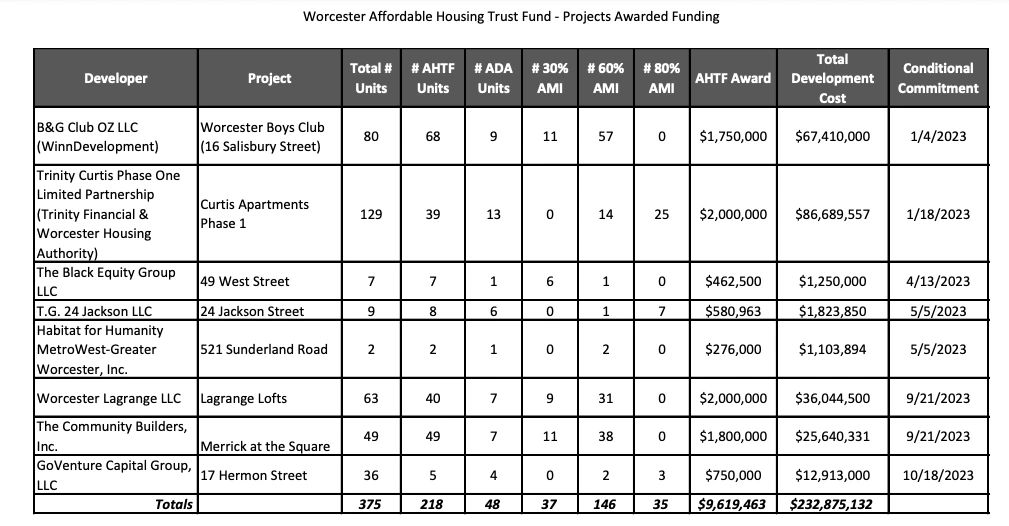
WORCESTER—Since the Worcester Affordable Housing Trust Fund started accepting applications in October 2022, it has awarded more than $9.6 million in funding to eight projects with affordable housing units, according to city documents.
When the projects are completed, this will have created 375 total units of housing, 218 of which are deemed affordable. The total development cost of all the projects is nearly $233 million.
When asked if the trust fund is doing what it set out to do, James Brooks, the director of Housing Development & Healthy Homes for the city, said “Yeah…within a year, year and a half, there’s 218 units. Obviously, you know, we need a lot more units throughout the city, but it’s a great start within a pretty limited amount of time.”
The projects range in affordability. Across the eight projects 37 are reserved for 30 percent area median income earners, 146 for 60 percent AMI earners, and 35 for 80 percent AMI earners. Forty eight of the units will also be ADA accessible.
When developers present projects to the trust fund’s board, Brooks said the board negotiates with them to get as many affordable units as possible at a deeper level of affordability that will still make financial sense for the developers.
“There’s a little bit of give and take there, but we are always trying to get that deeper level of affordability in those units,” Brooks said.
The projects are subject to an Affirmative Fair Housing Marketing Plan, according to Affordable Housing Trust Fund Manager Jeanette Tozer, meaning when it comes time to select tenants for the units the developers are required to use a lottery process.
As for when the projects will be completed, Brooks said it depends on how large and complex they are, but they are all required to be completed by the summer of 2026 or they will lose the funds from the trust.
The fund was started with $15 million of the American Rescue Plan Act funds the city of Worcester received, which it has until December of 2024 to allocate, according to Brooks.
The first project the trust fund awarded, Winn Development’s redevelopment of the former Worcester Boys Club on Lincoln Square, broke ground on Nov. 2 and is expected to take about two years to construct. When it’s completed, it will have 80 units total with 68 affordable housing units. In addition to being affordable, the units will be restricted to tenants with a head of household who is 55 years old or older.
Smaller projects that the board has provided funding— such as the nine units planned for 24 Jackson St. that includes eight units of affordable housing and two affordable housing units Habitat for Humanity MetroWest-Greater Worcester is planning—are either in the financial finalizing stage or under construction, according to Brooks.
On Nov. 2 District 5 Councilor Etel Haxhiaji in a press release raised her concerns about Winn Development’s receiving of $1.75 million from the fund since they are not being monitored for worker safety, workforce diversity or tax fraud.
In the release, Haxhiaj relayed her call to pass a new Responsible Development ordinance “to hold big developers that receive million-dollar subsidies from taxpayers accountable to those of us picking up the bill.”
Peter Dunn, the city’s chief development officer, told the Worcester Guardian on Nov. 2 that the Affordable Housing Trust Fund is not a tax credit or break like the Tax Increment Financing agreements the city offers some developers and therefore does not have the hiring and oversight requirements TIF agreements do.
The trust fund purposefully doesn’t have those requirements for funding from the Affordable Housing Trust Fund, according to Dunn, because the city wanted it to be open to anyone.
Smaller businesses and nonprofits may not have the administrative operating capacity to live up to those requirements, Dunn said, and if those requirements were in place, the trust fund may only be accessible to big developers such as Winn. Dunn then pointed to the smaller projects the trust fund has awarded, such as to Habitat for Humanity.
As for the rest of the $15 million in the trust fund, Brooks said there are a lot of potential projects in the application process.
Before a project is presented to the trust fund’s board it has to go through an application process to make sure the project has the financial capacity, technical expertise, and project management to move forward. There are multiple projects that are going through those underwriting stages now.
When asked if the trust fund board is moving at the pace he would like it to, Brooks said it is.
“We don’t want to rush these projects,” Brooks said. “We want to make sure that they’re feasible and that the end product is the best product from both an affordable rate, but also the best product for the neighborhoods they fit into.”
He said the board is doing a good job of balancing due diligence alongside moving the money as quickly as possible.
Additionally, with the difficult financial environment caused by high interest rates, Brooks said the trust fund is filling a key gap and allowing projects to move forward that might not otherwise be able to.
After the ARPA money runs out, the fund with continue with money coming in from the Community Preservation Act – a 1.5% property tax surcharge that can be used to fund open space, historic preservation and community spaces, and payments in lieu from developers that don’t want to include the affordable units they are required to through inclusionary zoning.
“We’re looking forward to continuing to work with local developers, we are (reaching out) to local DEI investors and developers,” Brooks said. “We have one project with them right now. So we’re looking to diversify our developer pool also.”
Kiernan Dunlop is an award-winning journalist who has spent the past five years reporting in Worcester, New Bedford and Antigua and Barbuda. She’s been published in Bloomberg, USA Today, Canary Media, MassLive, and the New Bedford Standard Times, among other outlets. She can be contacted at kdunlop@theworcesterguardian.org