
One was Worcester’s first true skyscraper. Another poured drinks when Salisbury Street was surrounded by farmland and orchards. Three others represent a housing style so closely tied to Worcester that the city is widely considered its birthplace. And scattered across the city, 27 Victorian-era gas lamps are all that remain of a network that once numbered 2,000.
They have something else in common now: Preservation Worcester says their futures are at risk.
The nonprofit organization has released its 2026 Most Endangered Structures List, an annual inventory of buildings, landscapes and other historic resources threatened by deterioration, neglect, demolition or development. This year’s list reaches from a boarded-up downtown high-rise to an 18th-century tavern, a Carpenter Gothic cottage, historic three-deckers and the dwindling collection of gas lamps that have illuminated Worcester streets for more than a century.
There is also an unusual bit of good news on the list. A Montague Street house previously considered endangered has been restored, giving Preservation Worcester a chance to point not only to what the city could lose, but what can still be saved.
For more than 30 years, the organization has used the annual list to draw attention to properties it considers significant to Worcester’s architectural, cultural and historical identity. Inclusion is not intended as criticism of property owners, according to the announcement, but as a way to spur discussion, investment and potential partnerships before buildings reach a point of no return.
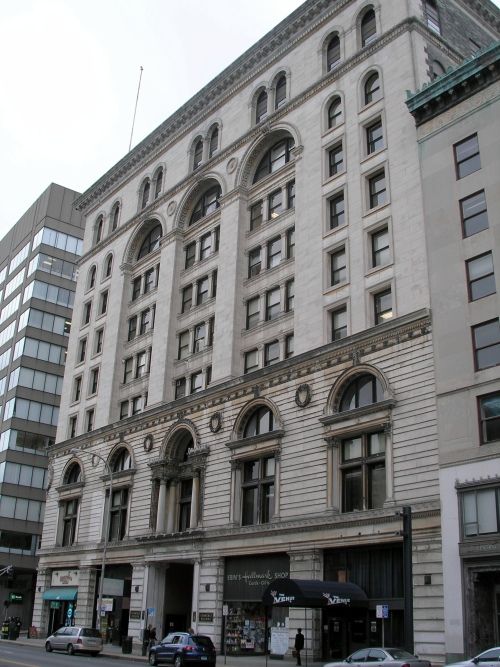
Perhaps the most conspicuous entry this year is the Commerce Building at 340 Main St., a nine-story landmark that has watched downtown Worcester change around it for 135 years.
Built in 1891 as the headquarters of State Mutual Life Insurance—the predecessor of The Hanover Insurance Group—the Beaux Arts building was designed by prominent architectural firm Peabody & Stearns and constructed by Norcross Brothers. Preservation Worcester describes it as the city’s first true skyscraper.
Its arches, columns, pilasters and elaborate Corinthian capitals once made the building a symbol of a booming downtown commercial district. State Mutual remained there until 1957, when the company moved its headquarters to Lincoln Street. The building continued as office space for state agencies, law firms and other businesses for decades and was sold in 2021.
More recently, its condition has become considerably harder to overlook.
Preservation Worcester cited deferred maintenance, vandalism, graffiti and debris, particularly around the rear annex and alley. The building has been shuttered and windows boarded over. Although redevelopment has been discussed, the organization said no substantial plan for stabilization and reuse has yet emerged.
“Once a proud symbol of Worcester’s commercial prominence, 340 Main Street now presents as a highly visible and troubling reminder of downtown disinvestment,” Preservation Worcester said in its announcement.
Across the city, the list tells much older stories.
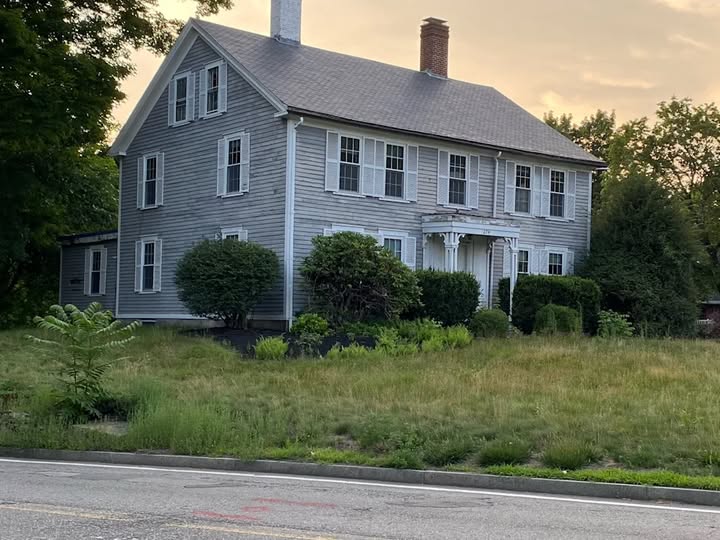
Cow Tavern at 274 Salisbury St. dates to about 1780, when the surrounding landscape bore little resemblance to the busy residential corridor there today. The Federal-style timber-frame building, with its symmetrical facade, center entrance, twin chimneys and granite foundation, operated as a tavern until about 1830.
Now vacant, it is among the properties Preservation Worcester describes in the most urgent terms. Broken windows, holes in the clapboard siding and serious foundation problems have left portions of the building exposed to the weather.
Without intervention, the organization warned, demolition may eventually become unavoidable.
At 155 College St., near the Auburn line, the Joseph and James Cooney Cottage offers another glimpse of Worcester before the city grew around it. Built around 1870, it is believed to have been the second or third house constructed on College Street, which took its name from the nearby College of the Holy Cross.
The Queen Anne cottage was occupied over the years by farmers, florists and gardeners, reflecting the agricultural history of the Mount St. James area. Original stained glass and decorative shingle work remain, but Preservation Worcester reported rot in the windows and shingles, a sagging porch and a crumbling chimney.
The Nellie W. Lincoln Cottage at 22 Dayton St. also made the list. Built around 1880 on land associated with the Lincoln Estate and Sever Farm, the Carpenter Gothic Revival house is part of the Elm Park Local Historic District. Its facade has changed significantly over the decades, including the loss of its cupola and decorative gingerbread trim, and Preservation Worcester says its wooden porch, Tudor arches and exterior woodwork have deteriorated.
The organization called it the Lincoln family-associated house in the district most in need of intervention and warned that continued deterioration could ultimately lead to its demolition.
Then there are the three-deckers, a form of housing that is pretty much architectural shorthand for Worcester. The “triple-deckas!”
The Arthur C. Perry Three Decker at 86 Vernon St., built around 1900, is considered an unusual 4½-story variation on the familiar form. Its Queen Anne design includes a flared-roof tower with a copper finial, a fourth-floor Palladian window, stained glass and three porches with different arched designs.
The building also reflects the Irish-American history of Vernon Hill. Early occupants included a postal clerk and a Green Street saloon operator, followed over the years by families including the Hickeys, McSheehys, O’Rourkes and Keenans. Today, Preservation Worcester says the building suffers from substantial rot, missing siding and water damage to its porches.
Three more three-deckers—at 135 and 137 Providence St. and 5 North Woodford St.—were grouped together on this year’s list.
Known as the Hyman Zive Three-Deckers, the buildings were constructed between 1926 and 1930 and are among the later examples of the housing form that came to define entire Worcester neighborhoods. Located in the Providence Street Historic District, they retain Colonial Revival and Craftsman details, including three-story porches, decorative gables and traditional wood-clad facades.
Their inclusion, Preservation Worcester said, is about more than individual buildings. The three-decker helped provide relatively affordable housing for generations of Worcester’s working- and middle-class residents and became entwined with the city’s immigrant and economic history.
Another property faces a more immediate possibility of disappearance.
The Cooney Block at 10 Washington Square, also listed as 211-213 Summer St., was built around 1883 by saloon keeper James Cooney. The brick Victorian Gothic building originally contained apartments above street-level businesses and survives today between the restored Mission Chapel and the Washington Square rotary.
Its arched windows and stone keystones remain, though vegetation has encroached and parts of the exterior have deteriorated. Preservation Worcester believes the structure remains architecturally sound and could be rehabilitated, potentially for housing, given its proximity to Union Station, Saint Vincent Hospital and downtown amenities.
Its owners, however, petitioned the Worcester Historical Commission in July for permission to demolish it and are likely to do so again within the next year, according to Preservation Worcester.
At One New Bond St., the concern is as much about what is inside a building as the building itself.
Norton Hall, inside the former Norton Company Administration Building, contains murals installed in 1927 by noted artist Arthur Covey chronicling the history of one of Worcester’s most important industrial companies. The artwork depicts everything from bauxite mining and kiln firing to grinding wheels used in automobile manufacturing. An ornamental tree traces the company’s history, while employees with 25 years of service are memorialized in painted script. Two panels honor Norton workers who died serving in the military.
Preservation Worcester, Saint-Gobain Abrasives, the Worcester Business Development Corp. and Worcester Art Museum are working to preserve that history. A Community Preservation Act grant has been awarded to relocate and restore the murals at the Worcester Art Museum if the building itself cannot be reused, but additional money is still needed, according to the announcement.
Not everything on the endangered list has four walls.
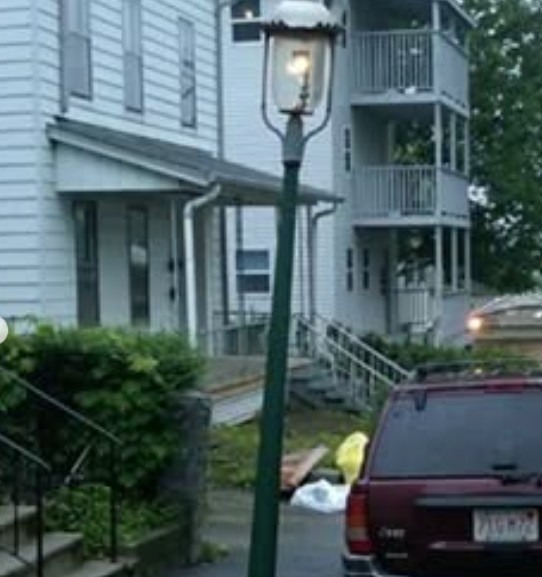
Worcester’s surviving gas street lamps have collectively made the 2026 roster — all 27 of them.
The city contracted with the Welsbach Company of Baltimore in 1897 to install and maintain gas lamps, which eventually numbered about 2,000 at their peak in the 1920s. Electric lighting steadily pushed them aside. By 1967, only 68 remained.
Today, the last 27 are scattered around Worcester, vulnerable to development, construction, vandals, snowplows, vehicle crashes and the increasingly difficult task of finding replacement parts.
The lamps are more than decorative relics. Their glass globes and gas mantles sit atop roughly 400 pounds of Victorian iron, small surviving pieces of infrastructure from a city that otherwise disappeared around them.
And then there is 27 Montague St.
The Beulah Perry Foulder and Alexander Foulder House — a Prairie-style American Foursquare built in 1915 — appeared on Preservation Worcester’s endangered lists in 2022 and 2024. At the time, windows were boarded, the side porch was deteriorating and the shingles and roof had been neglected.
This year, it is back on the list for an entirely different reason.
The house has undergone an extensive restoration that Preservation Worcester says remained faithful to its original architectural style. The organization is highlighting the property as a preservation success and an example of what can happen when an endangered building gets another chance.
It is not the first. Preservation Worcester points to previous endangered properties including Crompton Loom Works on Green Street, Chestnut Street Church, the Rogers Kennedy Memorial in Elm Park and the Worcester Five Cents Savings Bank street clock on Front Street as examples of resources ultimately restored or preserved.
That is, after all, the peculiar purpose of an endangered list: The best outcome is eventually having no reason to be on it.
