
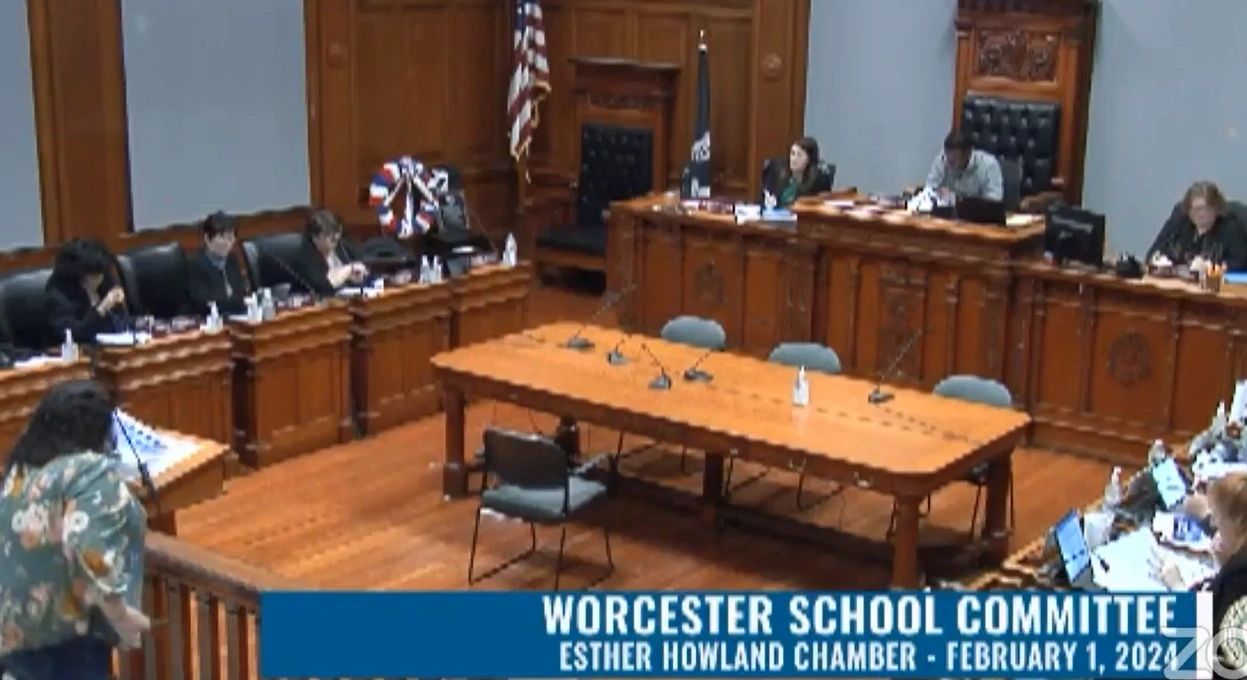
Thursday’s Worcester School Committee meeting largely focused on the FY25 budget, which suffers a large budget gap. The meeting also touched upon school traffic issues, the EMT program at North High, drug prevention program, and the redesign of Worcester East Middle School
WORCESTER—The Worcester Public Schools will be tackling a significant budget shortfall for FY25, the school committee was informed at its Thursday meeting.
In prefacing a report to the committee from CFO Brian Allen, Superintendent Rachel Monárrez said projections for Worcester are based on Gov. Healey’s proposed state budget. The superintendent acknowledged “some challenges” because of the expected budget gap and “transitioning out” of federal Elementary and Secondary Emergency Relief (ESSER) funds, but added, “We are looking at ways to rectify these. Thankfully, we believe this is a one-year challenge.”
WPS’s stakeholders will be involved in dealing with this predicament, she said.
Allen told the committee his summary provides “a good sense of expected budget levels for next year.” He began his presentation by asserting that a five-pronged FY25 budget blueprint “is deeply rooted in achieving the objectives of the system’s new strategic plan.” The five-year plan was recently adopted.
Enrollment, which is “level,” the inflation rate, which is “low,” the Student Opportunity Act (SOA), which is being “phased in,” ESSER funds, which are being “phased out,” and new staffing and resource needs are the driving factors in shaping the FY25 budget, Allen said.
Taking into consideration the numbers for all of these factors, the system is facing an initial budget shortfall of $22.1 million, Allen said.
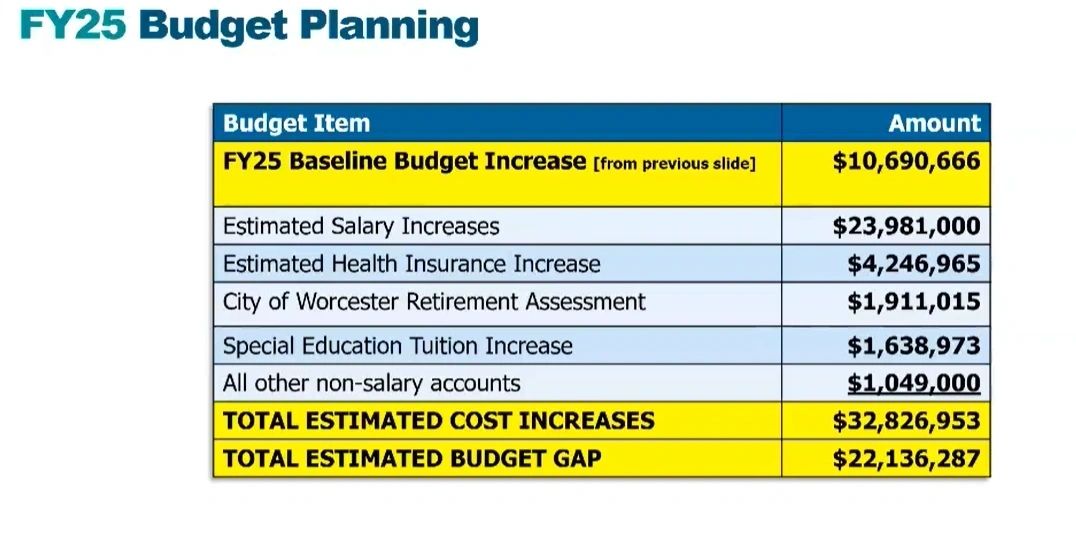
Allen told the committee that increases in estimated salaries, estimated health insurance, Worcester retirement assets, special education initiative tuition, and all other non-salary costs total $32.8 million, which, coupled with pre-spent Student Opportunity Act (SOA) allocations, accounts for the $22.1 million budget gap. Mayor Joseph Petty noted: “We have been here before, with a pre-budget shortfall.”
To a question from committee member Susan Coghlin Mailman asking whether a comparison of student-funding data across the state is available, Allen pointed out that spending for administration and instructional leadership in Worcester is “below average” against peer communities and “I’m not sure that’s a good thing.”
The district’s total budget for FY25 is $525 million, up $26.8 million from $496 million for FY24.
The budget will be completed and submitted by May 10, he said.
It received unanimous initial approval.
Allen’s remarks highlighted the Thursday school committee meeting, which also included praise for former school committee member Jermoh Kamara for spearheading the redesign for Worcester East Middle into a full-service educational innovation STEM school with components of the WPS SPARK program to include project-based learning.
Kamara told the committee that such a restructuring would take into account the Grafton Hill area’s largely immigrant population and ensure that students at Worcester East Middle can thrive as learners in today’s competitive educational environment.
An item under general business referenced the Turn It Around drug-prevention program or TIA, as it relates to the extent of teen vaping for cigarettes and marijuana, for instance.
Committee member Molly McCullough requested a status report going back several years. The superintendent responded that the number of students referred in 2022-23 was 132 and this year from August to January just 29, a dramatic decrease.
“Parents must give consent for their student to participate in the program,” she said. Work done to date “is changing how our students are behaving.” The item was filed by unanimous vote.
Dianna Biancheria asked for an update on safety support programs. McCullough in turn requested data on the benefits of the district’s safety centers, which was referred to the administration.
Kathleen Roy’s petition for a feasibility study to find a way to resolve traffic congestion at Quinsigamond Elementary School prompted McCullough to ask for an evaluation of traffic congestion at all schools. The superintendent said the new safety plan addresses this. The matter was sent to Finance, Operations and Governance.
Maureen Binienda asked whether the EMT program at North High has been discontinued because of a lack of recruitment of kids to be involved. “Can we keep this?” she asked.
The superintendent responded that “it is not about recruitment, but staffing.” Because of a staffing shortage, the program has been changed to an “emergency medical services” program, giving seniors the chance to attend evening courses at Quinsigamond Community College. Binienda said that in the Quaboag district, off-duty firefighters are used for the EMT program. She asked if this could apply similarly in Worcester. The superintendent said the administration would look into this possibility.
By unanimous vote, it was decided that the Durkin auditorium be named in honor of Dr. Helen Friel for her many years of service to the Worcester Public Schools as clerk to the School Committee.
Rod Lee is a career journalist, a veteran of the media scene in Central Massachusetts and the author of seven books including the recently published “Gil Cristopher,” a novel about the difficulties associated with aging. He can be contacted at rodlee1963@gmail.com
