
WORCESTER—The Worcester Regional Research Bureau held its 40th annual meeting on Nov. 19 at the DCU Center.
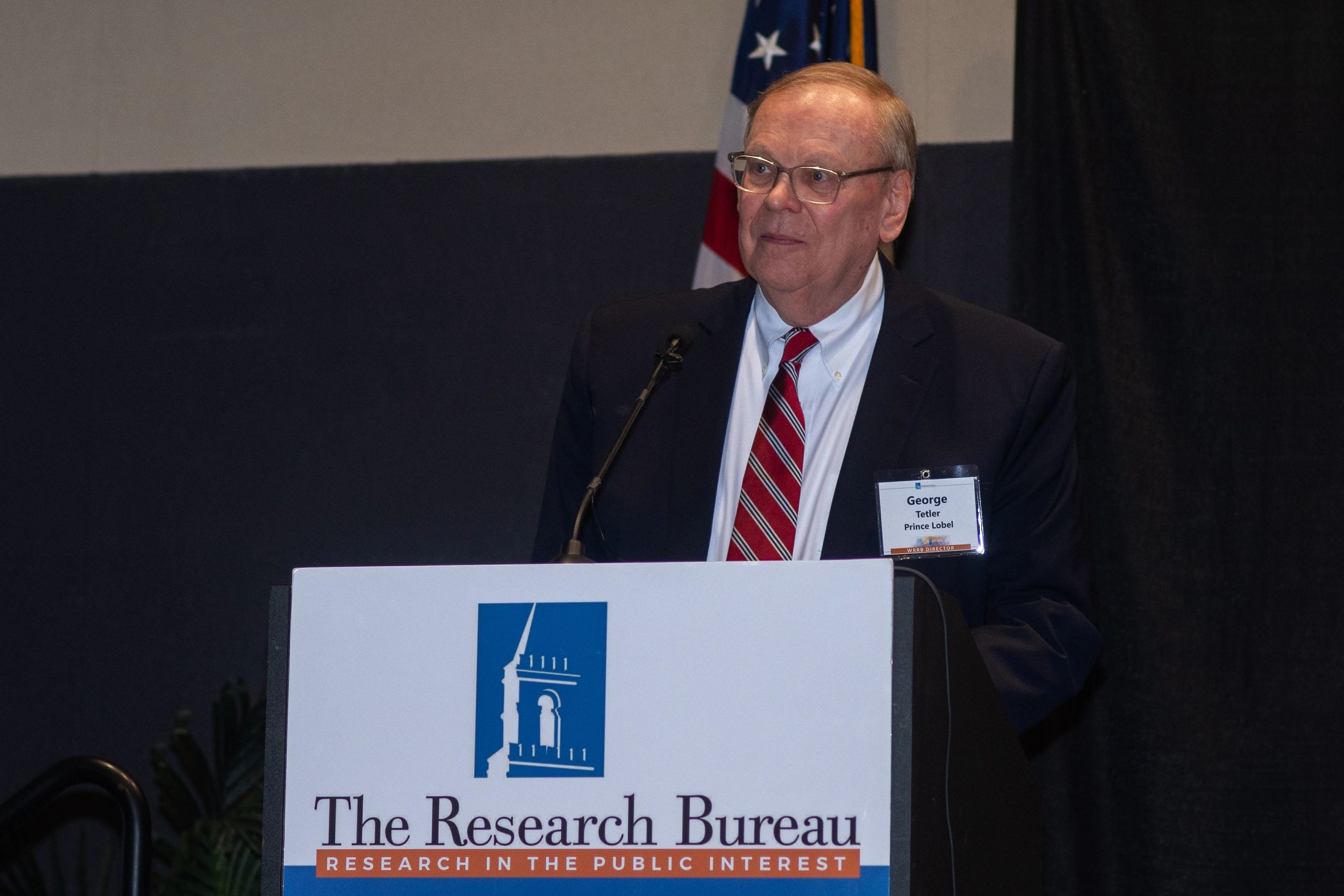
Founding chair of the WRRB George Tetler said that in preparing for the event, he did an AI search of what was happening in 1985, when the city was still trying to recover from decades of de-industrialization, which had weakened the local economy. To his surprise, the creation of the WRRB was mentioned as one of the signs the city was positioned to rebound.
“The founding of the Worcester Research Bureau in 1985 marked a significant effort by business leaders to support more effective municipal government through independent research,” he said, quoting the search.
In its 40-year history of countless research projects, reports and data collection, the bureau has gone through changes in leadership, launched local political candidate debates, and helped implement the annual State of the City address by the city manager.
Paul Kelly, the bureau’s outgoing chair, said the WRRB has been a gem in the community and plays an important role in the civic life of the city.
“For 40 years, it has provided in-depth research and analysis of the pressing issues in the community. It works by diving deep into the data and builds on common factual understanding. It’s a cutting-edge leader in the field of non-government research,” Kelly said. “The Worcester Regional Research Bureau continues to be recognized by its national organization for its work.”
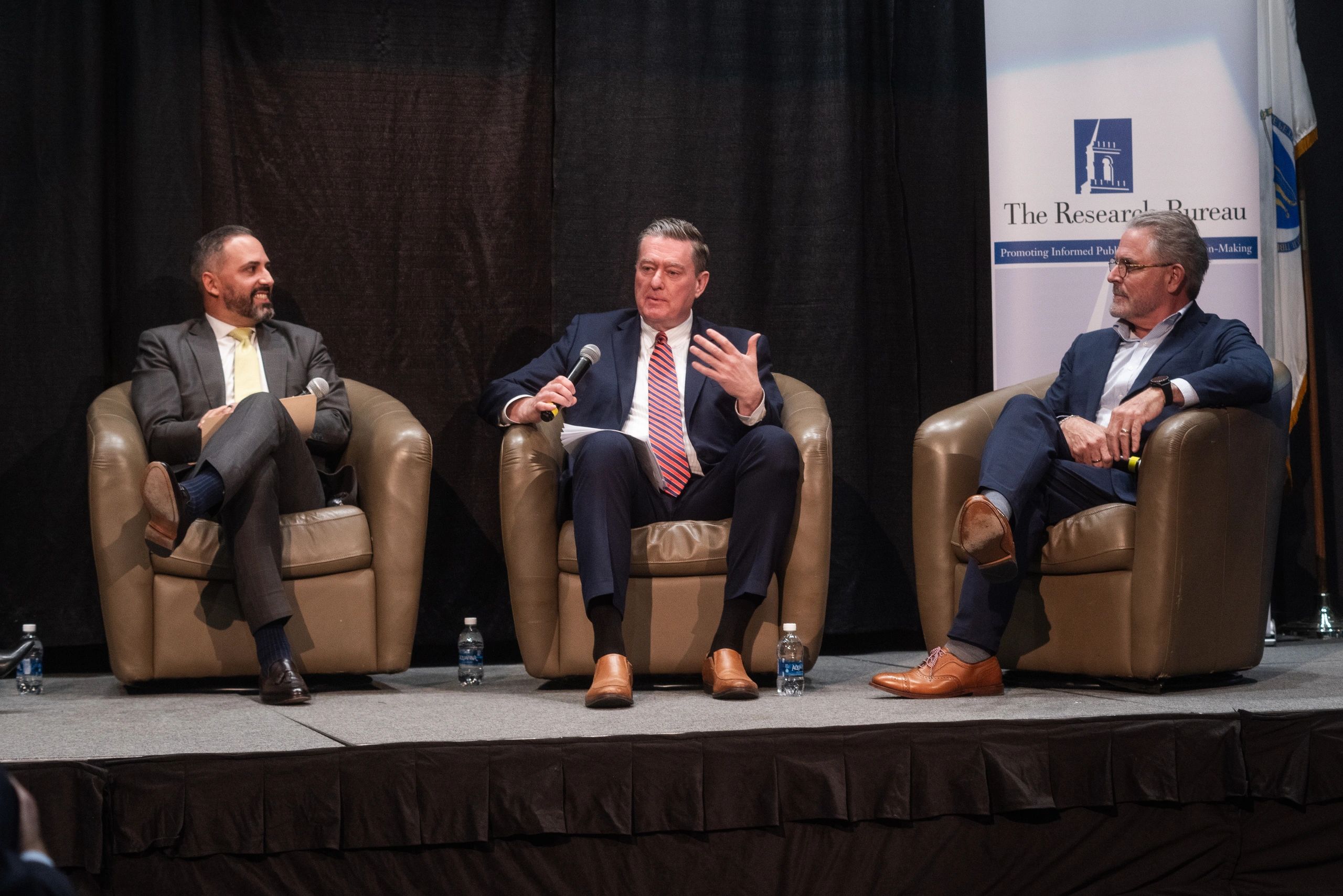
Highlighting the bureau’s role in shaping Worcester’s changes and growth over the past four decades, the keynote panel of City Manager Eric Batista and former City Managers Edward Augustus and Michael O’Brien discussed the challenges they faced during their tenures, the WRRB’s role, and how the bureau helped the city.
O’Brien, the current executive vice president of Winn Companies, managed the city from 2004 to 2014 and said the bureau is a bedrock foundation of the community and the city’s government, providing useful information throughout his time behind the desk.
“You need perspective. You need input and data,” he said. “You’ve got a talented team around you to do that work, but external is as important as internal feedback.”
O’Brien said he worked on reviewing how the city’s emergency services responded to incidents, including whether sending the fire department to every call was necessary. Part of the dialogue was about the cost of sending more vehicles and personnel, as well as the increased risk of injuries to first responders.
“The Research Bureau’s effect was they were able to provide that type of data and information, unbiased, and so it was added to the conversation and the discussion and in debate,” O’Brien said.
Augustus, the current Massachusetts Secretary of Housing and Livable Communities, said he appreciated the partnership with the bureau during his time as city manager and in other roles he’s held, including as a State Senator. He recalled the bureau’s help in assessing the fire department’s safety following two line-of-duty death incidents, including the warehouse fire that claimed the lives of six firefighters.
“That’s an astronomical number of firefighters for a city this size to lose in that period of time,” he said. “We really needed to get our arms around what else could or should we be doing to make an inherently dangerous job as less dangerous as humanly possible. The Research Bureau provided a lot of good guidance that allowed us to go forward with pursuing accreditation and making some changes that I think have allowed the fire department to continue to be an effective part of our emergency response system here in Worcester, and hopefully taking some of the danger out of a very dangerous profession.”
Batista said that since taking over in 2022, the bureau’s reports on the city’s schools, their infrastructure, and their financial structure have been very helpful.
“We’re going through really tough economic times — inflation, costs, everything. The question is, ‘How do we figure out a way to build, maintain and sustain our current infrastructure?’ And I think having that outside perspective and having the bureau play a role at the state level to advocate — to bring that voice — plays a big role, because often we feel like we’re by ourselves.”
Moderator Kim Salmon, president of the Hanover Insurance Group Foundation, asked O’Brien about the redevelopment of downtown Worcester and the early stages of the Canal District revival between 2004 and 2014.
“At that point in time, there was kind of a rudderless focus on who we are, what we are and what we can be,” he said. “First we had to get the city’s finances in order, and that was a lot of work. We had been through a period of boom-and-bust, and those budget cycles created a real strain. Getting that set was really important. If you want to project success, if you want to project opportunities to others, you have to be able to point to the fact that the city government is here, it’s stable, and it’s certainly ready for business.”
O’Brien said the economic development of downtown included grappling with the former Galleria Mall as a deterrent, and the city began looking for developers. He said the bureau’s information was helpful in shaping a new vision for that area and the rest of downtown.
Augustus oversaw the Polar Park project and investments in housing and schools. He said a major challenge was a sense of “self-deprecation” in the city, with residents doubting that projects of that scale could succeed here. The ballpark effort, he said, required overcoming psychological barriers so Worcester could lift itself up.
“That’s hopefully the spirit we brought to pursuing Polar Park,” he said, adding that pulling together all of the different partners for the project created momentum for other developments and a renewed spirit of optimism.
“Hopefully we got a sense of ‘Hey, this is Worcester’s time. Worcester can do it,’” he said.
Batista was asked about his own challenges and the solutions he hopes to bring forward. He said that, having been hired by O’Brien and having worked under Augustus, he learned important lessons, including how his predecessors enlisted business leaders to become more involved.
“All of you who are sitting here, from the higher ed community to the commercials to the banking industry — all of you have played a role in CitySquare, in Polar Park and all of the development.”
Housing, Batista said, has become one of the city’s biggest issues.
“How do we build more housing? How do we provide more access and opportunity for growth, development and housing in the city?” Batista said. “How do we also provide space for the commercial to develop in the city, and bring bio manufacturing, and bring the life sciences into the city to create the jobs that we need for people to be well-employed and have the good salaries to live in the city? Those are the things that we are trying to understand and create a vision for.”
Steve Smith, a veteran reporter with 17 years at The Hartford Courant, now brings his passion for photojournalism to Worcester. An award-winning photographer, he has covered major events like U.S. soccer, pro football, and UConn basketball. He is also the official photographer for the Miss Massachusetts competition and works as a realtor. Contact him at steve@stevephotographysmith.com
Have news, tips, or a story worth telling? Reach Editor Charlene Arsenault at carsenault@theworcesterguardian.org—because good stories (and great scoops) deserve to be shared.
The Worcester Guardian is an independent nonprofit news organization. Support local journalism by making a DONATION today.
