
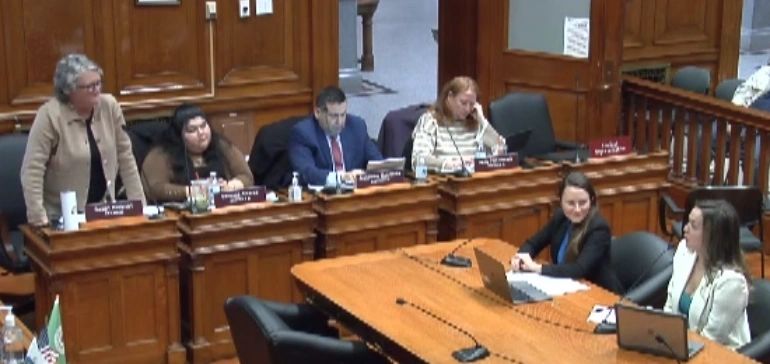
WORCESTER—Dual language education is an ever-evolving part of Worcester Public Schools, but an initiative is well underway to help establish some consistency and growth as the program seeks to expand. The Worcester School Committee’s Jan. 16 meeting solidified the popularity of the program as leaders from the district’s multilingual education department provided an update on the growth of dual language education as a district-wide initiative.
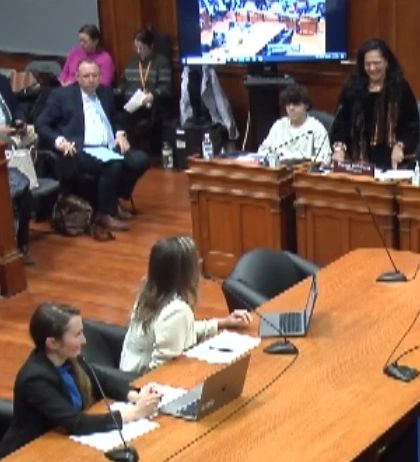
The committee hosted a special presentation by the district’s Director of Multilingual Education Jessica Mandes and Assistant Director Juliana Kessler Marcos. Mandes and Marcos shared the history, progress, and future of dual language education in the city. Even before their presentation kicked off, numerous citizens took to the microphone to express their support for increased investment in dual language programming.
The focus on these initiatives is considered part of the district’s larger strategic plan, with Superintendent Dr. Rachel Monárrez calling it a significant part of “equitable resource and educational programs.” She noted that while dual language programs aren’t new to Worcester, the district lacks a clear path to help that education transition from elementary learning to higher grade levels. Mandes and Marcos have embarked on the mission to create a more comprehensive and structured approach.
“The purpose of this dual language program focus group is to develop a full Pre-K—or at least Kindergarten through 12th-grade—program of what dual language will look like in Worcester Public Schools,” said Monárrez.
She explained that the district repeatedly heard concerns about the lack of a clear path for dual language courses at the secondary level. “We were leaving it up to schools, the middle and high schools,” said Monárrez, “to find staffing to teach whichever class they might be able to offer the students. So we needed to put a pause because that’s not the optimal way to offer dual language programs.”
Monárrez praised the efforts of Mandes and her team, noting they have brought together a diverse group to evaluate the program. “They are identifying what’s really good that we want to continue to grow, where there are opportunities for improvement, and what is not working,” she added.
Currently four schools in the Worcester district offer dual language programs: Worcester Dual Language Magnet School, Woodland Academy, Burncoat Middle School, and Burncoat High School. The first dual language class graduated from Burncoat High School in 2024 and currently 618 students have enrolled in dual language programs that includes a variety of courses including language allocation, literature, and even a medical interpreters college course, ranging from pre-kindergarten through high school.
Several approaches have been implemented including additive bilingual immersion – which sees students learn English and Spanish simultaneously, a one-way dual language model designed for English learners, and a two-way dual language model where English and non-English speakers learn together in both languages. Data presented by Mandes and Marcos revealed that the one-way and two-way dual language approaches have resulted in higher test scores, indicating an educational benefit beyond simply understanding another language.
With so much success to celebrate, the district wants to continue to expand and succeed in its approach to dual language education with the goal of creating a blueprint for a kindergarten through 12thgrade program by the end of the school year. This all starts with creating powerful community partnerships, which has been a major focus of Mandes’s and Marcos’s research. Mandes explained how engaging with focus groups and stakeholders throughout the city will play an important part in helping shape the future of the program.
“I’ve had the privilege of engaging in enriching conversations with many members of our dual language community, hearing first-hand about their reasons for choosing dual language for their children what they value most about the program and their hopes for its future,” Mandes shared. “We’ve conducted focus groups with a diverse range of partners including principals, teachers, families, and students at the middle school level engaging over a hundred participants in total. This allows us to hear a variety of perspectives and insight. Following the focus groups, we analyzed the feedback and received and sought further clarification. However, it doesn’t end here. We are committed to ongoing follow-up with these groups to continue to refine our plan moving forward.”
Marcos added that their goal is to create a program that isn’t just about education but also helps to cultivate better communication skills beyond the classroom.
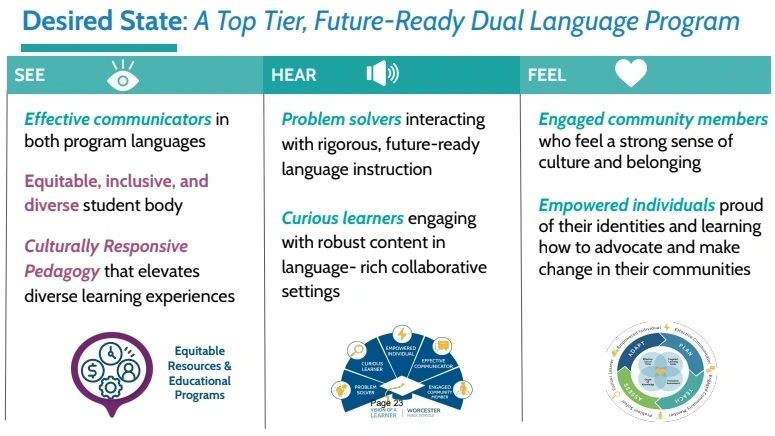
“We hope to see inclusive and diverse enrollment,” said Marcos, emphasizing the importance of ensuring equitable access for students from various linguistic and cultural backgrounds. She also highlighted the goal of fostering culturally responsive teaching that affirms student identities, lived experiences, and the socio-political context of their learning.
Marcos described the vision for students in the dual language program as future-ready problem solvers and curious learners who engage with robust grade-level content in collaborative settings. “We hope that dual language students will become engaged community members who feel a strong sense of culture and belonging with their school, peers, and their own identities,” she said.
Ultimately, the program aims to empower students to create change in their communities, helping them build a strong sense of identity and self-esteem.
The Worcester School Committee praised the dual language program for continuing to strive towards allowing access for a wider range of students to eliminate language barriers and enhance communication but acknowledged there is still plenty of work to be done.
Although dual language education in Worcester has come a long way, the goals of creating an expanded, stable, and robust program that covers multiple grade levels will take time, commitment, and investment. If the comments and feedback heard from the public and the School Committee offer anything, it’s a sense that there is plenty of supporters who want to see the program succeed to its fullest.
Jason Bleau is a longtime reporter from the Quiet Corner of Connecticut with more than 11 years of experience working in news media. He can be reached at bleau.jason@yahoo.com