
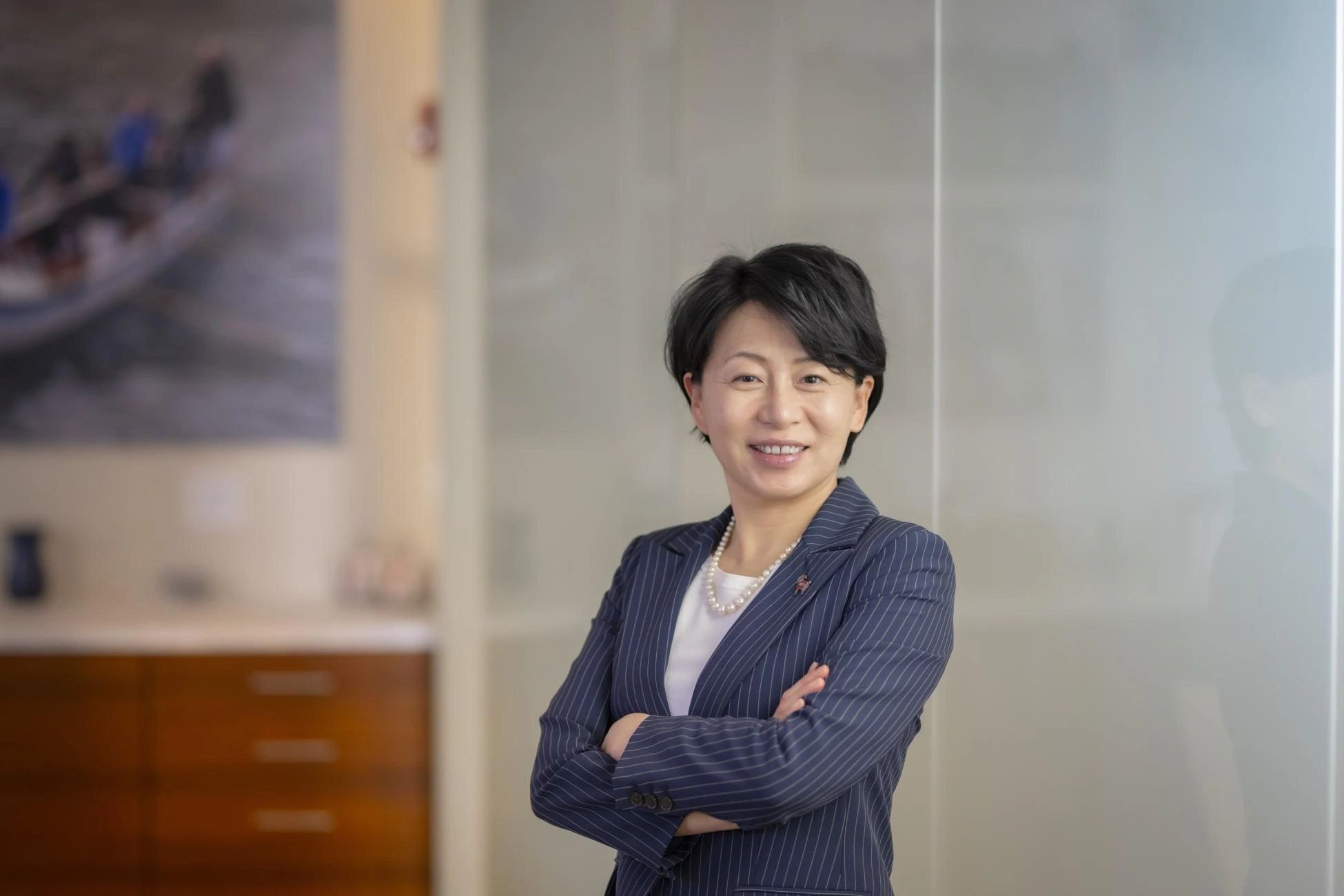
WORCESTER—On Friday, March 22, “Grace” Jinliu Wang, Ph.D., was officially inaugurated as president of Worcester Polytechnic Institute.
Wang, a materials scientist, was selected as the 17th president of WPI on Nov. 7, 2022, and began her role on April 3, 2023.
Friday’s theme, “Impact Driven: Honoring Tradition, Innovating the Future,” recognized the university’s 158-year-old history. The ceremony also featured a procession of WPI community members, delegates, and other special guests, as well as an inaugural address by Wang and the presentation of WPI’s seal to its newest president.
Before her appointment at WPI, Wang served as the executive vice president for research, innovation, and knowledge, as well as a professor in Materials Science and Engineering at Ohio State University (OSU). Her tenure at OSU was marked by substantial growth in the university’s research and innovation sphere, with R&D expenditures reaching $1.38 billion annually.
Wang was also a force in nurturing a supportive environment for faculty, staff, and student researchers, innovators, and entrepreneurs. She led initiatives to foster curiosity-driven research, secure external funding for interdisciplinary research centers, stimulate campus-wide entrepreneurial efforts, and enhance experiential learning opportunities.
Before OSU, Wang held progressively senior roles at the State University of New York (SUNY), initially as vice chancellor for research and economic development, later advancing to senior vice chancellor. She oversaw SUNY’s research endeavors, managing about $1.7 billion in annual R&D expenditures, enhancing the research and economic development strategy, and significantly growing SUNY’s research capabilities in key areas.
Wang says her love for collaboration grew throughout her prior experiences in academia. Now, she says WPI is the ideal place for her to apply her expertise and knowledge to benefit students. “I love to deliver impact and work with people, collaborating and empowering people to deliver that impact,” she said.
Her career before WPI also included significant roles at the National Science Foundation.
“I had multiple roles, including leading engineering at National Science Foundation,” she said. “That really helped me to broaden my horizons and learn about how to enable different opportunities at the interface of different disciplines.”
“Working with her has been incredible,” Kola Akindele, WPI’s associate vice president of external relations and partnerships, told the Guardian. “I think she comes in with a vision and a focus for WPI that will bode well for the institution and a place like Worcester. The great thing about President Wang is that she took some time early on to assess the strengths of an institution like WPI and then to get an understanding of the region. Many people would come in and just narrowly focus on the institution, but she understands that the fate of the city of Worcester and WPI is inextricably tied.”
Wang said that in academia, her positions have always been focused on leading research and how to better get to know and support faculty, students, and staff.
“I have a deep appreciation for STEM education and what a STEM education can do for students,” Wang said.
Akindele echoed Wang’s thoughts. “She really values transformative STEM education,” said Akindele. “She understands that the unique education WPI provides allows our students to apply their knowledge in real-world settings and helps them become great leaders with agile mindsets.”
Wang said that WPI has one of the most distinctive STEM programs in the country.
“We offer project-based learning, where our students are highly immersed,” she said. “They work at one of our over 50 global project centers. They form interdisciplinary teams and work in the real world on current problems. They learn how to think critically and how to be creative to come up with a solution.”
She emphasized what she considers a particularly unique journey that students experience at WPI.
“WPI students learn how to communicate, when to lead versus follow, and how to be a problem solver and team player,” said Wang. “[WPI and I] are purpose driven. Our faculty and staff are very innovative and think about the future. We want to create the most exciting career pathways and enable new ways of thinking for our students. That way, they can go out and deliver that impact.”
Wang highlighted recent program launches as a testament to WPI’s forward-thinking approach, including those concentrating on artificial intelligence and financial technology.
“I love talking to our faculty and staff, as well as our students,” Wang said of her time so far at WPI. “Everyone is so passionate, and we have a fantastic community. WPI alumni are very distinguished as well.”
Wang looks forward to WPI’s potential to impact the regional ecosystem: “We are at another inflection point with science and technology. We are already a technology and talent hub, but how can we make sure we further that and serve as the hub in our regional ecosystem? That’s exciting for me to think about as I look towards the future of WPI.”
Matt Olszewski is a freelance content and news writer based in Boston, MA. In his free time, Matt enjoys running, hiking or skiing. Matt is currently finishing up the MPH degree program at Tufts University. He can be reached at mattoskier@gmail.com
