
If the Declaration of Independence were written today, the news would spread to millions of people within seconds as cell phones around the world lit up with texts, emails, and breaking news alerts.
In the summer of 1776, however, American colonists had to rely on slower communication methods. Immediately after the Continental Congress approved the Declaration on July 4, 1776, its official printer, John Dunlap, set the document’s 1,320 words into type and worked through the night to print some 200 single-sheet copies on a hand-operated press. Two days later, printer Benjamin Towne published the Declaration in The Pennsylvania Evening Post, the first newspaper to include the complete text. Post riders distributed both the sheets, called broadsides, and the newspapers to the thirteen colonies—a journey that took days, or even weeks. By July 18, twenty-four colonial printers had published the full text of the Declaration of Independence in their newspapers, sharing the historic words that permanently severed political ties with Great Britain.
From New Hampshire to Georgia, people heard the Declaration read in town squares, taverns, homes, and churches. The Revolutionary Council of the State of Massachusetts ordered that a copy of the document be sent “to the Ministers of each Parish, of every Denomination, within this State.” The text of that order appears on a broadside edition of the Declaration that Salem printer Ezekiel Russell issued less than two weeks after it was approved in Philadelphia. Reverend Caleb Curtis received a copy and read it to his congregation from the pulpit of his Charlton church on July 17, 1776. That copy is now in the American Antiquarian Society (AAS) collection.
Disseminating the Declaration throughout the thirteen colonies was essential to building public support around the ideals behind forming a self-governing nation. “The Declaration enunciates the famous founding principles of liberty and justice, and it expresses the grievances of the colonies about mistreatment by the mother country, written in inspiring terms by Thomas Jefferson,” said John Bidwell, curator emeritus at the Morgan Library & Museum in New York
City and author of The Declaration in Script and Print: A Visual History of America’s Founding Document.
As time went on, however, the Declaration evolved into an iconic symbol and commercial product. “During the nineteenth century, Americans looked at the Declaration as a precious relic, something to be read and revered. Artists, printers, and publishers gave them what they wanted: engravings, lithographs, and letterpress broadsides adorned with patriotic emblems intended to evoke the moral values and living presence of the founding fathers,” Bidwell explained. Examples of these materials are part of a new online gallery created by the American Antiquarian Society to commemorate the Declaration’s 250th anniversary.
The gallery features 16 different printed iterations of the document, showing its transformation during the first hundred years of the United States. “Although the words remained the same, the forms they took reflected changing ideas about patriotism, technology, and national identity,” said AAS’s Vice President of Collections Lauren Hewes, who curated the online exhibit.
The Declaration first captured the public imagination as something more than a political document in 1816, according to Bidwell. “That’s when Philadelphia newspaper publisher John Binns first announced―grandiloquently, I would say―that he would produce a giant engraved Declaration with all sorts of illustrations and patriotic emblems, as well as facsimiled signatures, and sell it for $10―a lot of money at the time.”
Before Binns completed his elaborate engraving, however, opportunistic competitors took his design, undercut his prices, and beat him to the marketplace. As new printing technologies emerged throughout the century, printers repeatedly adapted earlier designs, including Binns’s. “It’s a story that repeats itself over and over throughout the century. One Declaration is copied from another,” said Bidwell.
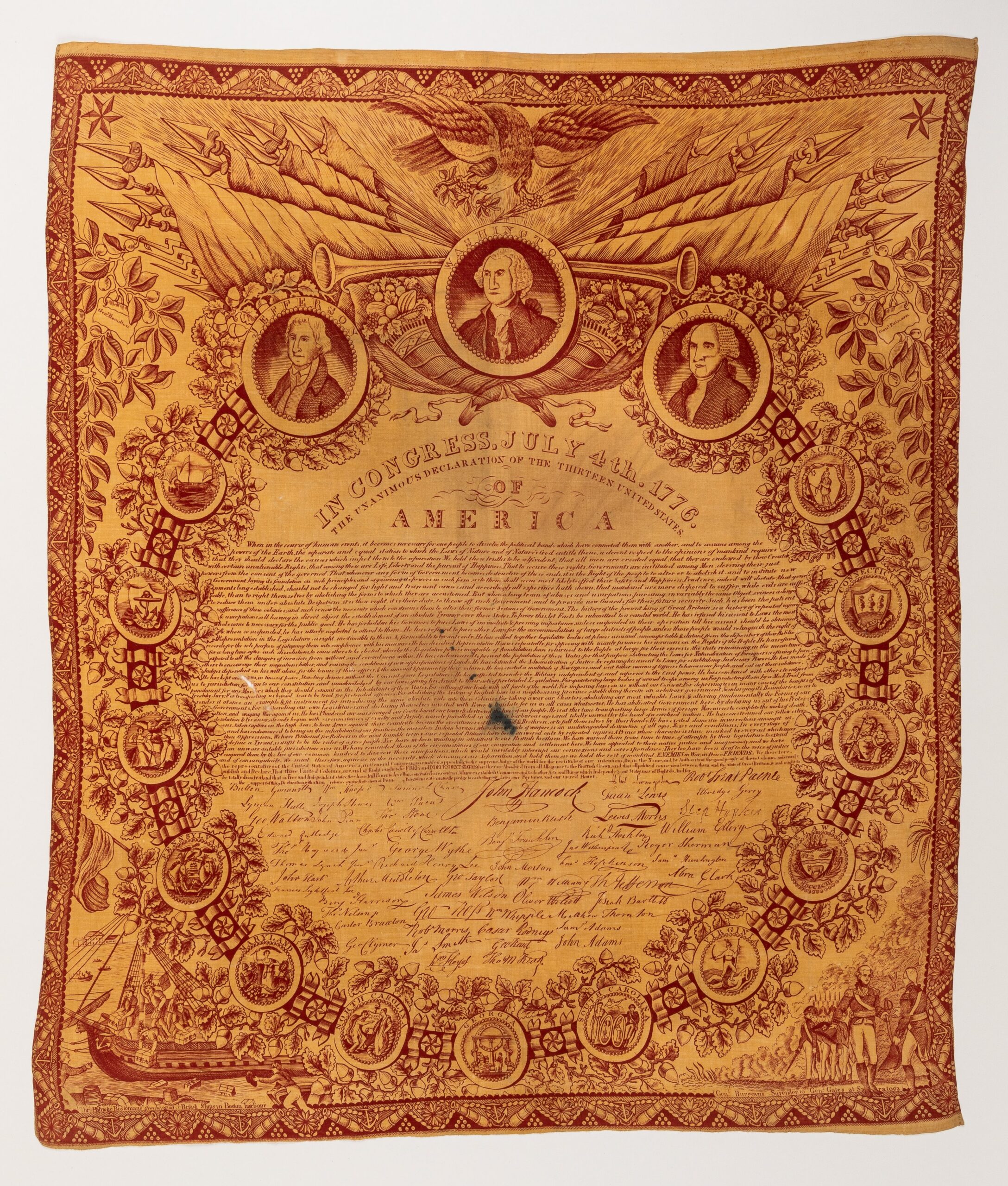
This extended beyond the United States. Textile printers Robert and Collin Gillespie of Glasgow, Scotland, borrowed imagery from American engraved editions to create products aimed at US consumers. This includes a cambric handkerchief of the Declaration, first printed in 1821. The text is surrounded by the seals of the original thirteen colonies, portraits of George Washington, John Adams, and Thomas Jefferson―copied from Binns’s original 1816 design―along with historical vignettes identified as “Patriotic Bostonians discharging the British Ships in Boston harbor” and “General Burgoyne’s Surrender to General Gates [at] Saratoga.” The Scottish printers issued this textile in red, blue, and black versions, and advertised them widely in American newspapers from 1821 to 1826.
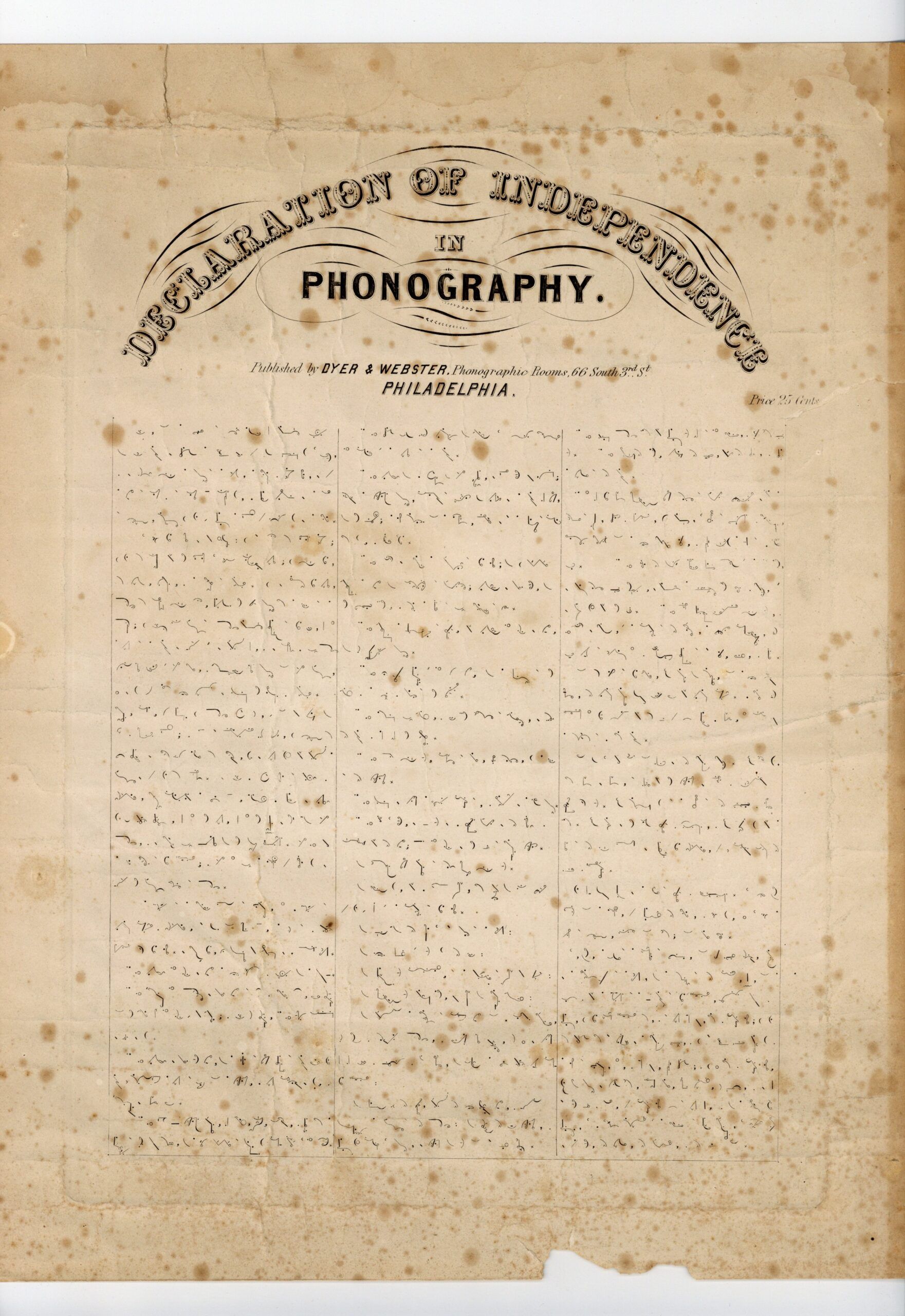
Printers also created versions of the Declaration for specialized audiences, such as an 1848 issue with the text written entirely in shorthand. Published by Oliver Dyer and Epinetus Webster of
Philadelphia, this printing used phonography, a shorthand system invented by Englishman Isaac Pitman in the 1830s. The method employed standardized swoops, dots, and loops to represent sounds rather than letters. Because it was illegible to most viewers, the publishers advertised the print in an August 1848 advertisement in the Philadelphia Inquirer and National Gazette, stating that it would “form an ornament for the parlor of any Phonographer.” It sold for twenty-five cents.
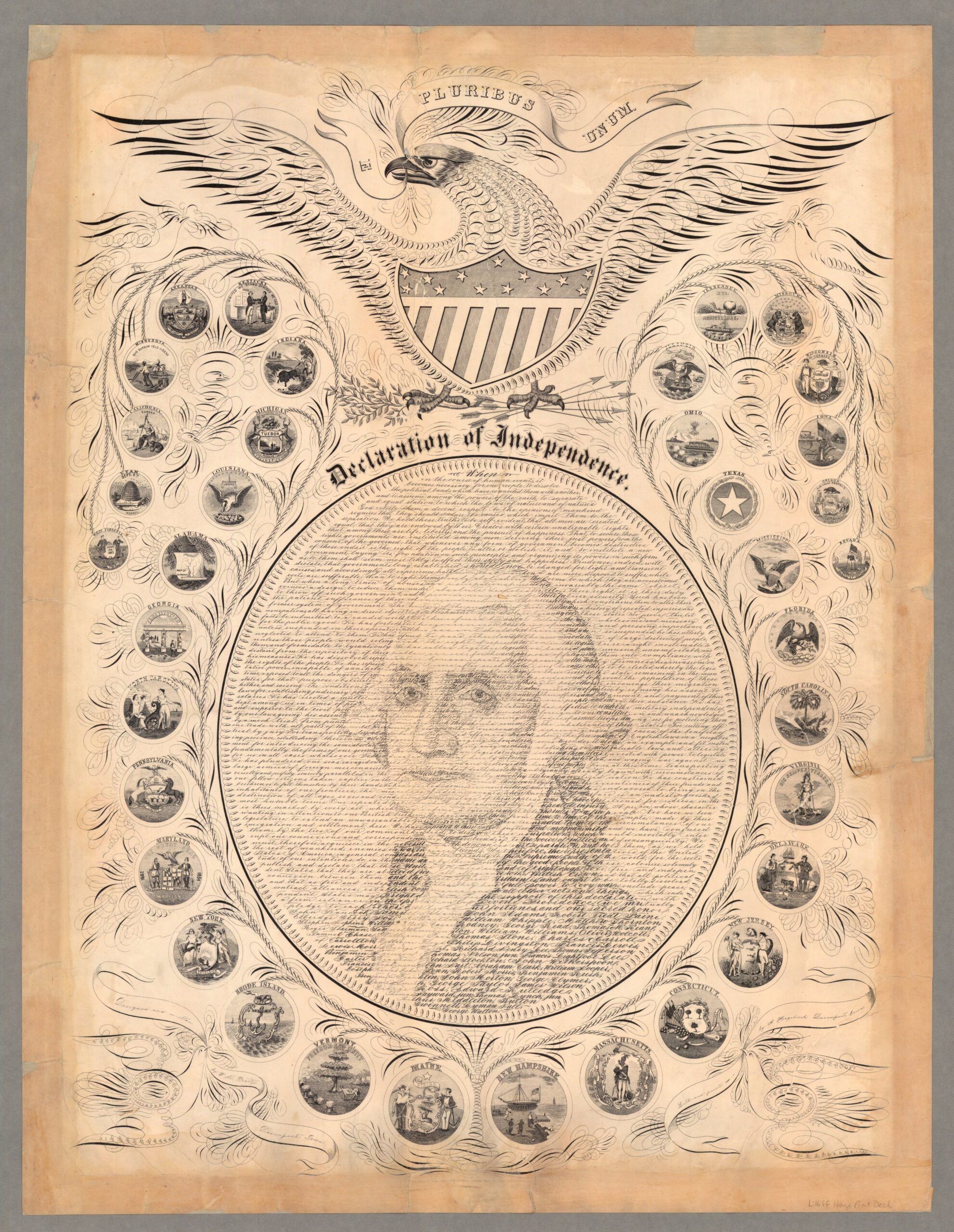
Throughout the century artists and printers demonstrated their skills in new ways as tastes and technologies changed. In one handsome example, an 1865 tromp l’oeil print features the words of the Declaration carefully written to reveal a portrait of George Washington. Penmanship instructor William Henry Pratt created the design by varying the thicks and thins of the letters, so that from a distance viewers see Washington, but up close can read the text. “The metaphor of George Washington, our founding president, embodying the text of our founding document is lovely. It’s kind of a visual pun,” Bidwell said.
In 1840, Charles Toppan, founder of the American Bank Note Company, tapped into a popular nineteenth-century fad of producing extremely small printings when he engraved the entire text of the Declaration of Independence one and a half inches high by two and a half inches wide. His motive was to promote his business, Bidwell explained. “Toppan was demonstrating his skills in engraving bank notes with such intricacy of detail that they could not be forged.” The Company frequently reprinted Toppan’s ultra-mini-Declaration—readable only with a magnifying glass―including the one featured in the AAS online gallery. People attending the 1871 Cincinnati Industrial Exposition could buy a copy for twenty cents.
At the other extreme, William V. Peacon, an Irish American penmanship artist from Brooklyn, New York, drew an extra-large, richly embellished Declaration for America’s one hundredth anniversary in 1876. Displayed at the Centennial Exhibition in Philadelphia and now housed at The Library Company, the original drawing is nine feet tall and four feet wide and features patriotic illustrations, highly stylized text treatments, and ornate embellishments such as foliage, bunting and ribbons. The signers’ names appear on pillars on each side of the text. At the same time, Peacon issued a lithograph printing in a smaller size―forty inches high by twenty inches wide―and advertised it for sale in newspapers from Maine to Nevada. One of those lithographs is in the AAS collection.
Today, people can pull up countless digital iterations of the Declaration of Independence on their screens with just a few keystrokes. Yet for the nation’s first hundred years, people encountered the document through the works of printers, engravers, and artists who continually reinvented its appearance while preserving the original text. “These objects remind us that the Declaration has never been a static document,” said Hewes. “Its meaning has been
shaped not only by its words, but by how generations of Americans chose to print, display, and celebrate it.”
The American Antiquarian Society’s Declaration of Independence online gallery is available at https://www.americanantiquarian.org/library/declaration-of-independence.
Related event:
The American Antiquarian Society, located at 185 Salisbury Street in Worcester, will hold a free community open house commemorating the 250th anniversary of the signing of the Declaration of Independence on Saturday, July 4, from 10 a.m. to 1 p.m. Drop in to view some of the many printings of our nation’s foundational document that are preserved at AAS──from the first printing in a newspaper on July 6, 1776, to a richly embellished lithograph produced for the Centennial Exhibition in 1876──and create a commemorative, take-home copy on a tabletop press. A public reading of the Declaration will take place at noon on the steps of historic Antiquarian Hall. Learn more at americanantiquarian.org.
This article is part of an ongoing, monthly series supplied by the American Antiquarian Society that focuses on the society’s collections and how they deepen the community’s understanding of Worcester’s–and the American–past. Through wide-ranging programs, community engagement, and research support for scholars and students, the AAS works to cultivate a broad community of inquiry―locally and nationally.
- The Worcester Guardian is an independent nonprofit news organization. Support local journalism by making a DONATION today.
