
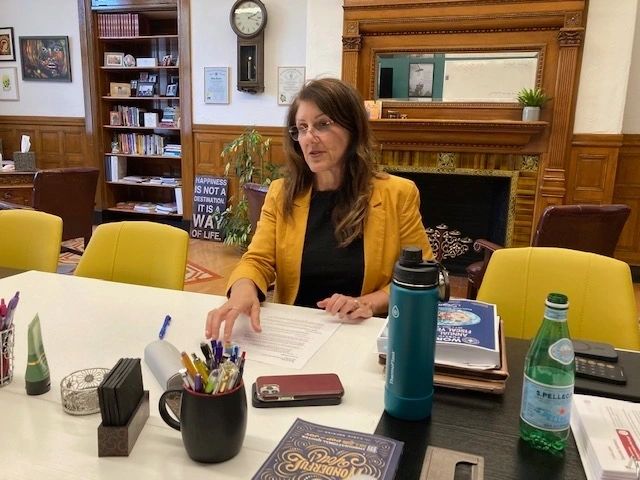
WORCESTER—Superintendent Dr. Rachel H. Monárrez used a roundtable with several reporters on Monday afternoon to summarize pending reductions in the Worcester Public Schools’ FY2025 budget.
The system faces a $22 million deficit for the next school year.
The meeting came ahead of Thursday’s session of the Worcester School Committee and the first of the public hearings that will be held to address the $544,809,849 spending plan. The initial public hearing is scheduled for May 20, with a letter notifying families of this to be mailed.
Monday’s meeting, held in the superintendent’s office on the first floor of the Durkin building on Chestnut Street, also included Brian Allen, deputy superintendent of finance and operations, and Dan O’Brien, chief communications officer for the district.
Copies of a massive 400-page “budget book,” which was posted on the WPS website over the weekend, sat on a table as the conversation ensued. O’Brien noted that the book is “a lot to digest” as he handed out a single-sheet itemization of key points.
In a prior video addressed to the community, Monárrez highlighted the collaborative effort involved in crafting the budget, noting the participation of various stakeholders, including school principals. She emphasized the preservation of essential services, stating “no cuts to wraparound coordinators, high school deans, athletic teams, guidance counselors and climate and culture teams….reductions are being made with precision and not broad swipes,” she said in the video.
On Monday, Monárrez pointed out that in deciding where to begin, “we started at the top,” with 22 positions involving the central office and district support affected. This amounts to “$2.8 million worth of reductions, or 13 percent” of those made toward addressing the deficit, the superintendent said. Nearly 20 percent of cabinet-level positions are impacted.
According to O’Brien, “While administrative positions account for 1.3 percent of the total budget, these positions will absorb 13 percent of the $22 million deficit. WPS has the second-lowest per-pupil spending rate on administrative positions compared with peer urban districts in Massachusetts. WPS spends $524 per student, which is below the peer district average of $752.”
Monárrez and Allen stressed it is important to note that of the 163 classroom cuts being made, “attrition” is accounting for a significant number. This includes “31 resignations, 12 retirements, and 11 non-renewals this school year. As of today, that is about 65 percent of the recommended cuts.”
Reductions at the elementary level total 45, but 15 of these are out-of-classroom, “which leaves 30 in-classroom positions being cut. WPS currently has 33 elementary schools, which equates to an average of about one less position from each school site.”
At the secondary level, recommended budget cuts total 41 middle and high school positions.
Monárrez said no educator with “professional teacher status” will be impacted by the reductions. “This means they have met requirements to obtain permanent teaching status in the system.”
In terms of special education services, despite staffing reductions, the district has reduced the caseload ratio for teachers of moderate special needs. This presently stands at 30 students with an Individualized Education Plan, or IEP, for one teacher of moderate special needs and two para-educators. This is “a decrease of 45 to 1 from the current year” to a ratio of 30:1.
All sub-separate classrooms will remain within the expected class-size ratio, the superintendent said.
While analyzing potential areas to cut, the district discovered it had more staff than it needed to create “a system and an infrastructure” for special education. “Special education is a service that is constantly fluctuating,” she said.
The superintendent was making the point that cuts in spspecial educationervices weren’t as bad as expected because the district had more staff than necessary..
I am not sure that’s any clearer
Percentage-wise, of the 70 positions proposed for reduction in special-education services, “51 percent are from inclusion learning disabled services, 28 percent are behavior supports, which includes BCBA and behavior specialists, 10 percent are positions from sub-separate settings, and 11 percent are from other system-wide programs.”
As she has said in the days leading up to the review of the budget, the superintendent noted in her Summary of Impacts provided by Mr. O’Brien that “WPS will have an average classroom ratio of 21 students to one teacher, not including support staff, such as para- educators.”
“Flat enrollment” and “inflation reimbursements” are factors influencing how the budget is shaping up.
“WPS has not made any reductions in teachers or support staff since the COVID-19 pandemic due to various federal and state relief funds. However, WPS enrollment has 1,100 fewer students since 2019,” the book declares.
While all tutor positions are being eliminated, those involved less than 20 hours per week, Allen said, and tutoring will still occur.
The superintendent compared running a school system to running a business, in the need for administrative positions.
“With 5000 employees, you have to have supervisors,” she said. “They are essential to providing direction crucial to the infrastructure.”
Rod Lee is a career journalist, a veteran of the media scene in Central Massachusetts and the author of seven books including the recently published “Gil Cristopher,” a novel about the difficulties associated with aging. He can be contacted at rodlee1963@gmail.com
