
WORCESTER—Artificial intelligence could displace more than 19,000 jobs in the Worcester metropolitan area over the next several years, putting an estimated $1.55 billion in annual wages at risk, according to projections discussed Wednesday at the Worcester Regional Research Bureau’s 41st annual meeting.
The outlook is less severe than in some other Massachusetts communities, but the potential disruption raises difficult questions about how employers, workers and educators should prepare for an economy increasingly shaped by AI.
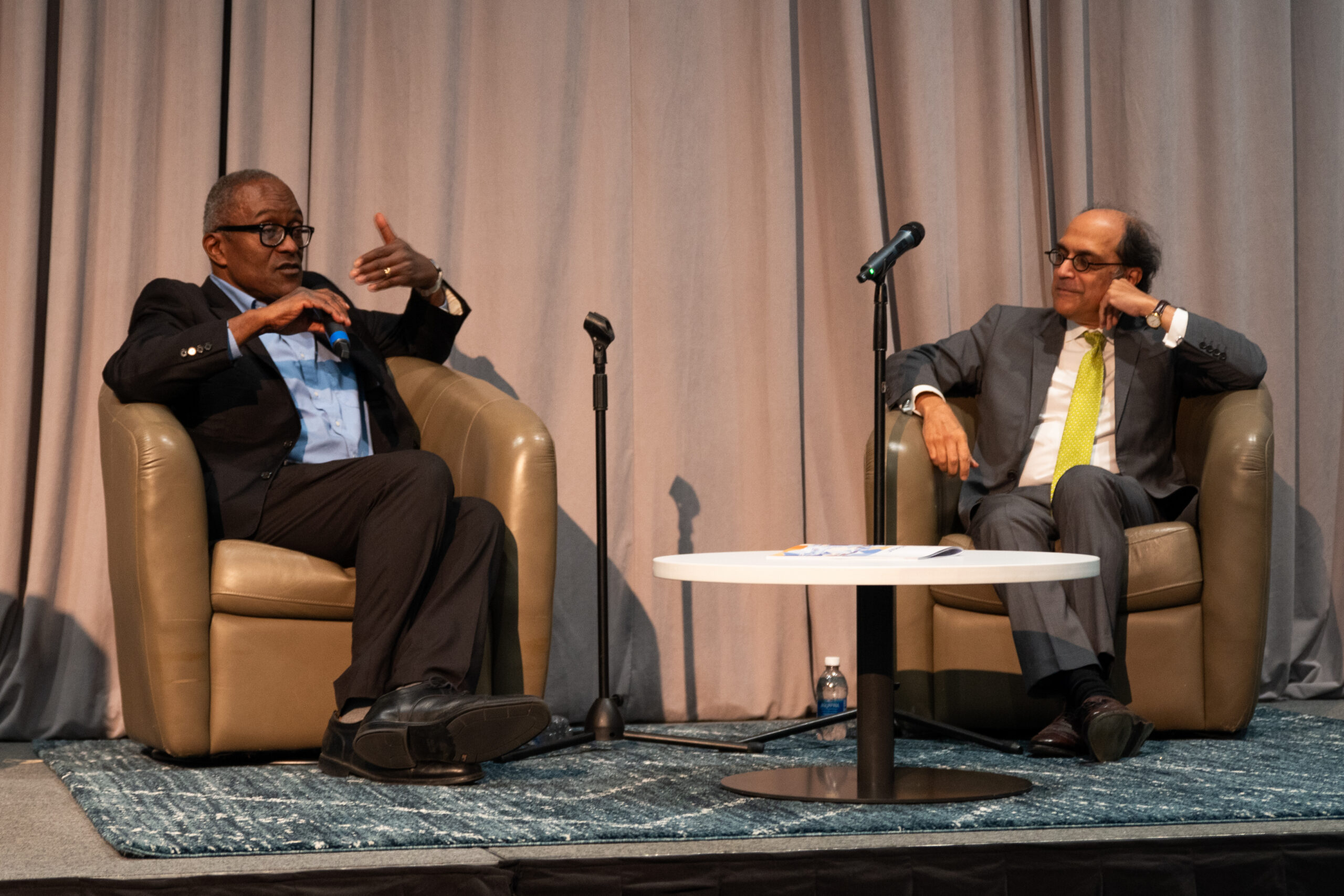
Bhaskar Chakravorti, dean of global business at the Fletcher School at Tufts University, discussed the technology’s potential economic impact during a Nov. 18 conversation with Boston Globe technology writer Hiawatha Bray at the DCU Center.
Chakravorti, who helped develop the American AI Jobs Risk Index, described the current moment as the “eye of the hurricane,” with AI advancing so rapidly that its ultimate effects remain difficult to predict.
The research examines more than 700 occupations, the tasks performed within them and the industries concentrated in different regions to estimate where AI could have the greatest impact.
Under the study’s projections, approximately 9 million jobs nationwide could be displaced over the next two to five years, representing $757 billion in annual wages.
Massachusetts ranks as the most vulnerable state, reflecting its concentration of occupations involving data analysis, writing, technology and other work that AI can increasingly perform.
Chakravorti said Boston faces a projected job displacement rate of 7.8%, compared with a national average of 6.15%. Worcester’s projected rate is 5.6%, ranking it 106th among U.S. metropolitan areas.
“The good news is, relatively speaking, this region is less exposed, less vulnerable, in the industries that are on the firing line,” Chakravorti said. “It’s also over-exposed to industries such as trade transportation, healthcare and social assistance, government and manufacturing.”
The estimates are projections rather than forecasts of confirmed layoffs. Actual job losses will depend on how quickly businesses adopt AI, how they use it and whether new employment opportunities emerge.
Chakravorti distinguished between AI’s ability to augment human work and its potential to replace workers. The technology can help write speeches, refine presentations and analyze information, but it can also reduce the number of people needed to complete certain tasks.
“Despite the fact that it is getting better, it still has problems. It makes mistakes. It doesn’t necessarily have judgement. It requires a human to be steering it, a human to be prompting it. This doesn’t mean that artificial intelligence can go off and do things on its own, it does require the human alongside it. It just might require fewer humans.”
Fewer hires, not necessarily more layoffs
Although widespread AI-related job losses have not yet materialized, Chakravorti said the technology is already affecting hiring decisions.
Employers are under pressure to increase productivity, and some are responding by hiring fewer workers, particularly for entry-level positions.
“It’s not so much a firing economy, it’s a no-hiring economy, particularly at the bottom rungs – fresh graduates from graduate schools – the job market has not fallen off a cliff, but has dropped down significantly,” he said.
Professional services firms, including law practices, consulting companies and information technology businesses, are reconsidering how many entry-level employees they need.
At the same time, Chakravorti said, some firms are willing to pay more for highly skilled workers who can use AI effectively while recognizing its limitations.
“In many of the professional services – consulting, law, and even I.T. — the demand for first year associates or first-year hires, the volume has gone down, but they want the smartest people, because they recognize that the new organization is going to involve a combination of humans and agentic A.I. I need the right humans alongside the agents so that the humans have the right judgment, the right instincts and the right analytically skills to be able to interrogate the A.I., and challenge it, and thereby come up with a better product.”
Who controls the technology?
Beyond employment, the discussion explored the political, economic and ethical questions surrounding AI’s development.
Chakravorti compared the debate to a car with three people trying to steer it.
One group favors caution, raising concerns about security, environmental consequences and the energy demands of data centers. Another is focused on AI’s growing importance to economic activity. A third wants development to accelerate, arguing that the United States cannot afford to fall behind China.
“These are the people who say we are in a race with China,” Chakravorti said. “If we slow down, then China speeds up and they win the race.”
Balancing those competing pressures, he suggested, will be difficult for policymakers.
Bray also raised questions about the values embedded in AI systems, comparing their development to the early internet, which reflected American ideas about the free exchange of information.
“It has, basically, American values baked into it – the whole concept of making information as freely available as possible, lowering the barriers to exchange data – It’s a very American way of thinking about data. I think the same issue arises when we’re talking about A.I. American AIs tend to be trained with American values. If Chinese Ais ended up dominating world markets, you’re going to have people getting their vision of the world by talking to AIs that see the world from a Chinese authoritarian perspective. I think that poses real risks.”
Chakravorti cautioned that American-developed AI systems have their own shortcomings, including biases that can affect decisions about hiring and other consequential matters.
“I don’t really trust A.I. coming from any of these systems, until we have a framework for interrogating them, a framework for figuring out ‘is this safe, is this beneficial, what could the unintended consequences [be]?’”
Preparing workers for jobs that don’t yet exist
Perhaps the most difficult challenge, Chakravorti said, is determining how to prepare workers whose jobs may be displaced by AI.
Past waves of automation prompted retraining initiatives, but those efforts did not always produce successful transitions. AI presents an additional complication: Many of the jobs workers might eventually move into have not yet been defined.
“I will have to find an off-ramp for these people from the jobs they are doing and the activities they are in and put them on on-ramps to new jobs and new activities. It’s just that the on-ramps go where? There is this whole notion that we just re-train people – we’ll have a budget for re-training and that will take care of the problem. The last time we tried re-training was when automation and machinery came in, and that didn’t go that well. This time, the problem is…in this A.I. situation, we don’t really know what we’re going to re-train people towards. Massachusetts should take the lead in figuring out what is the re-education program.”
He also expressed concern about the effects of AI on education, particularly whether students will develop the independent thinking and writing skills needed to evaluate the technology’s output.
“We need to re-educate kids to write a 500-word essay…by starting with a blank sheet of paper – not get a first draft from ChatGPT – get a sheet of paper, cross that chasm, and put some words down on a page. I really worry that we don’t have a plan. It’s not just Massachusetts, we need help from across the country.”
For Worcester, the projections offer a measure of reassurance compared with the outlook for Boston, but also a warning.
The region’s employment mix may provide some protection from AI-driven disruption. Yet thousands of jobs could still be affected, and the challenge for employers, educators and policymakers is preparing workers for changes whose full consequences remain unknown.
