
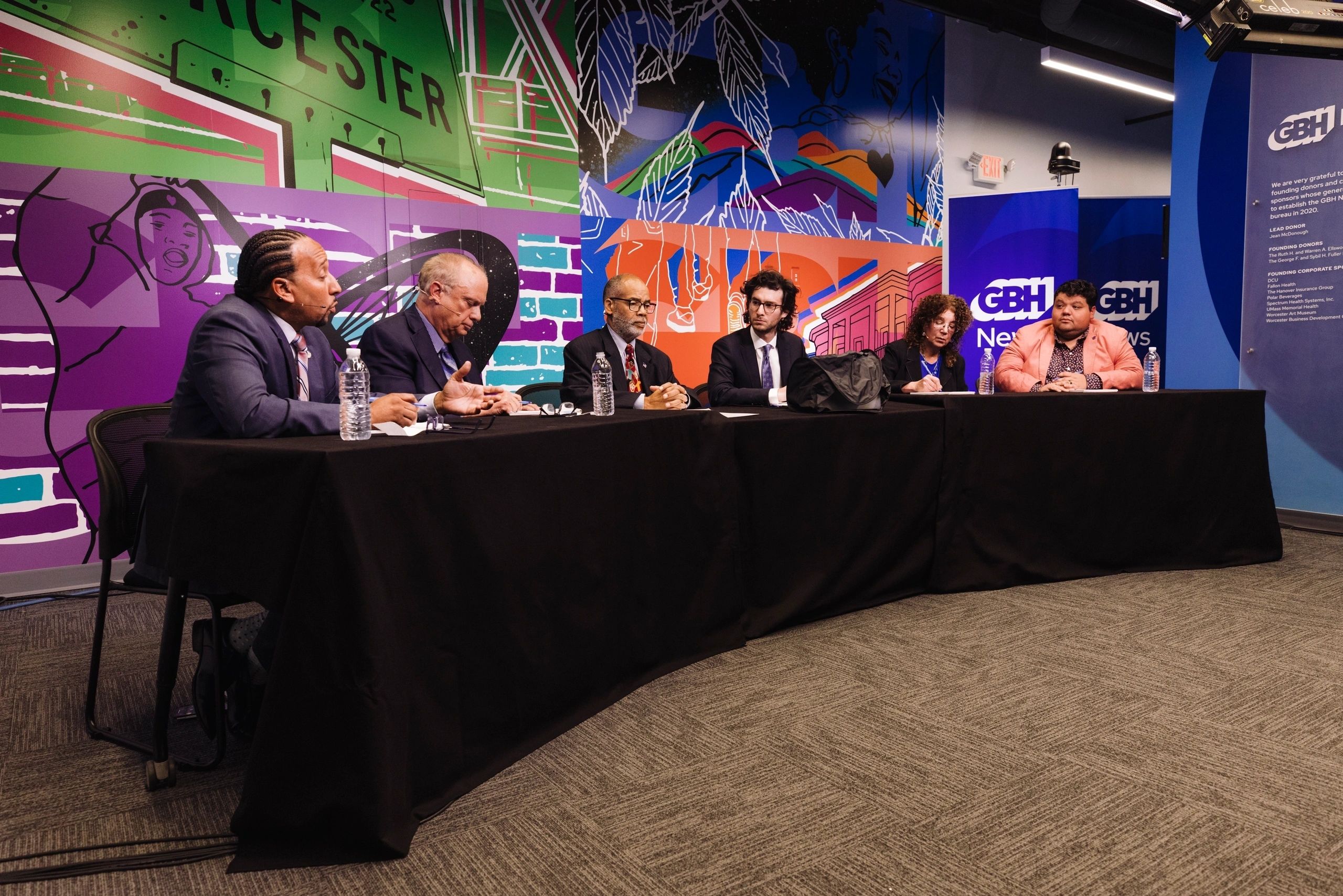
WORCESTER – During Worcester’s first mayoral debate of the election season Monday, candidates were not shy about taking aim at each other as they tackled affordable housing, the federal investigation into the city’s police department and the Plan E form of government.
The sharpest exchanges occurred between incumbent Mayor Joseph Petty and Councilor At-Large Khrystian King. The other candidates are Councilor-At-Large Donna Colorio, Guillermo Creamer, Jr. and Bill Coleman.
The debate hosted by GBH News and moderated by reporter Sam Turken.
King called into question both Petty’s and Colorio’s votes on inclusionary zoning.
“My colleagues here, Donna Colorio and Joe Petty, in the middle of a housing crisis voted for less affordability in our inclusionary zoning and went against housing experts recommendations,” King said.
In April, the council voted to enact an inclusionary zoning ordinance with language that would require developments with 12 or more units to reserve 15 percent of their habitable square footage for renters/buyers who earn 80 percent of the area median income (AMI) for the city or 10 percent for those who earn 60 percent AMI.
Affordable housing advocates called for an ordinance that would require 5 percent of units in the developments that fit the requirements be set aside for 60 percent AMI earners and 5 percent be set aside for 80 percent AMI earners. The advocates said they were in favor of the ordinance being written that way because it would ensure housing would be created for 60 percent AMI and not give developers the option.
In response to King’s comments, Petty said that since the less strict inclusionary zoning ordinance went into effect, Worcester has only had one developer come into the city and even that developer is rethinking their position.
Petty emphasizes need to create balance
Throughout the debate, Petty emphasized a need to create a balance and work with people to get things accomplished.
“People think I’m probably too moderate,” said Petty early in the debate. “However, I think you need to be even-keeled. [It] is the key to success in the city of Worcester, which leads to a welcoming city and a city that listens to diverse voices.”
Colorio also called for balance, arguing councilors should look at issues through a “common sense lens.” She said she voted for the inclusionary zoning ordinance that was ultimately enacted because it was “another tool in our tool box,” but that she doesn’t “think it’s the end all be all.”
King, in response to Petty’s remarks on inclusionary zoning, said Petty waited until 5,000 units were already being built in the city to take action so inclusionary zoning would not apply to them.
Candidates worked to differentiate themselves
Creamer, Jr. and Coleman worked to differentiate themselves from the elected candidates during the debate. Both men have previously run for office, with Creamer, Jr. coming in eighth place for councilor-at-large in 2021, two spots away from earning a seat. Coleman has run several times, coming in third place for mayor in 2019 and 2021.
Creamer, Jr. often emphasized that he was the youngest person on the stage at 29 years old, making him closer in age to the average Worcester resident and therefore someone experiencing the same problems as the majority of residents.
“You know how many of my friends who live here in the city of Worcester are talking about homeownership? None,” Creamer, Jr. said. “It’s not affordable because we’re not pushing our city to ensure that we’re talking to our developers when they come in and (saying) ‘Hey we are a community-first oriented city.”
Coleman called for a “new fresh lens” when it comes to the city council addressing how the police department operates and called for community meetings where the public can share their feelings about the department.
How can the department be trusted?
Coleman was talking in response to Turken, asking the candidates how they would ensure the department can be trusted when it is currently under investigation by the Department of Justice to assess whether it engages in a practice of excessive force or engages in discriminatory policing based on race or sex.
Creamer, Jr. emphasized his experience as a member of the Human Rights Commission, which brings police into its meetings on a regular basis to discuss the future of the department, according to Creamer, Jr.
“I’m glad that I have a good and solid relationship with our police leadership, because I believe that’s where it starts,” Creamer, Jr. said. “But I believe we have to push back as individuals that are elected officials to ensure our department is held to the highest standard.”
Creamer, Jr. did not give specifics as to how he would hold the department to a higher standard, nor did Colorio who said it’s the council’s job to ensure things are done properly within the police department.
King raised issue of racial equity audits
The racial equity audits both the department and the city’s Human Resources and Health and Human Services departments underwent were raised by King who said he brought the request to perform the audits before the council.
King once again called out Petty, claiming he’s been silent on concerns about the police department.
Petty denied the accusation, saying he hasn’t been silent, but met with Black Families Together on a regular basis to create accountability standards. The mayor also said the interim police chief, Paul Saucier, is doing a good job with transparency by posting more public records on the city’s website.
Petty then turned the tables and called out King, saying he voted to defund the police department three times. King said Petty misrepresented his record and that he actually tried to get the council to vote on the police budget, but he failed in that attempt.
Colorio said that she supports the police and she thinks they’re doing a great job, but that there’s room to get better.
City manager or a strong mayor?
Turken also brought up the city’s form of government, Plan E, which leaves the day-to-day operation of municipal government to a city manager who is guided by a part-time council.
King said the community feels like it does not have accountability in the current model and said he would support exploring a strong mayor form of government.
Creamer, Jr. said Plan E doesn’t make sense for the city.
Colorio said she would say “hell no” to a strong mayor form of government.
Coleman said he believes the city manager is doing a good job and called for term limits on the City Council, which he said would infuse a stagnant board with fresh ideas.
“In my mind the Plan E form of government has proven very successful,” Petty said. “It’s very honest.”
Other topics covered during the debate included climate change and the school budget.
The mayoral candidates are set to face off again at Mechanics Hall at 7 p.m. on Oct. 25. Election day is Nov. 7.
Kiernan Dunlop is an award-winning journalist who has spent the past five years reporting in Worcester, New Bedford and Antigua and Barbuda. She’s been published in Bloomberg, USA Today, Canary Media, MassLive, and the New Bedford Standard Times, among other outlets. She can be contacted at kdunlop@theworcesterguardian.org
