
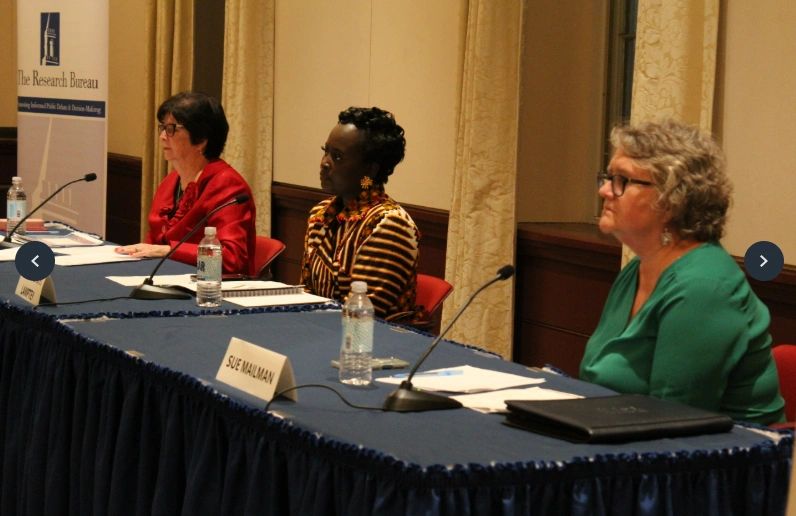
WORCESTER – The first in a series of debates for the 2025 Worcester municipal election was held Sept. 24, spotlighting the School Committee At-Large race, which features three candidates for two available seats.
Incumbents Maureen Binienda and Susan Mailman are seeking reelection, while challenger Adwoa A. Sakyi-Lamptey is making her first run for office. Binienda, a former superintendent of Worcester Schools, is seeking a second term, and Mailman, a local businesswoman and education advocate, is seeking a third. Sakyi-Lamptey, a Worcester graduate, local parent, and higher education professional, hopes to secure her first seat on the committee.
The debate — the first of five hosted at Mechanics Hall — was co-sponsored by the Worcester Regional Research Bureau and the Telegram & Gazette. It followed a traditional format with opening and closing statements and 15 questions covering the district’s strategic plan, budget, school safety, and workforce retention.
The discussion was largely civil, with the candidates often finding common ground but offering different perspectives. Each emphasized a shared commitment to improving outcomes for Worcester Public Schools students.
“Every child deserves access to a strong curriculum, meaningful support,” Sakyi-Lamptey said in her opening remarks, “and opportunities to thrive regardless of the challenges they face in their day-to-day life.”
Mailman stressed the importance of understanding the laws that shape local education policy, while Binienda drew from her years in education, emphasizing accountability, innovation and closing achievement gaps.
“I believe a city our size can achieve great things in the public school system, but we have to be willing to see ourselves honestly,” said Mailman. “Members of our school committee must inform themselves of local, state, and federal laws that impact us here in Worcester.”
Binienda closed out the opening speeches, remarking, “I believe it’s important to have accountability, innovation, and closing achievement gaps so every student has a chance to thrive. Leadership isn’t just about numbers and titles—it’s about community.”
Cell phone use in schools
One of the first truly divisive topics in the debate was the future of student cell phone use in Worcester Public Schools, as state lawmakers continue to refine a proposed ban. All three candidates agreed that some form of restriction might be appropriate, but they diverged on how strict that should be.
The discussion comes as Massachusetts lawmakers advance sweeping restrictions on cell phone use in schools statewide. The Senate’s 38–2 vote in late July set the stage for potential changes affecting Worcester’s 25,000 students across more than 50 schools. The bill, now before the House, would require every district to adopt restrictions, but allows local flexibility in how they’re enforced — such as using phone pouches, secure lockers, or grade-level distinctions.
Worcester is not starting from scratch. The district already bans social media browsing, gaming, and unauthorized recording on school grounds, with devices expected to be silenced or tucked away during class. Students can access phones only for specific educational uses or during non-instructional times. Officials have framed the policy as part of teaching “digital citizenship” rather than imposing outright prohibition.
Against that backdrop, the candidates staked out their positions.
Mailman noted that a statewide ban is still far from finalized but suggested younger students might need limits. “Our policy is our policy, and I think it was developed with a lot of the stakeholders at the table involved. I do think in elementary and probably middle school that cell phones could be banned, but in high school I think that we need to teach our kids how to be responsible and we need to be responsible with our phones as well,” she said.
Sakyi-Lamptey agreed in part but emphasized the importance of keeping lines of communication open in high schools. “We live in a world where sometimes, unfortunately, it pertains to school violence and those are things that could come in handy should law enforcement need to be reached,” she said. “I do not feel they should be in elementary school or middle school, but I can see where it would be potentially needed in high schools.”
Binienda took a firmer stance, arguing there is no value in cell phones at school. “I don’t think we should have cell phone in schools. Research out there now proves that cell phones do not belong in schools,” she said. “Teachers are not for cell phones either in schools. They want to do their job. They want to teach, and they want us to help them to say no cell phones in schools.”
For now, Worcester’s existing policies remain in place, but the topic is almost certain to resurface once the state legislation is finalized — and when the new school committee takes office later this year.
Mastery-based learning
Mastery-based learning is an approach where students are graded on how well they understand a subject, rather than just averaging scores across assignments. It emphasizes demonstrating competency and allows opportunities to redo work to improve understanding.
No candidate expressed full support for the new mastery-based learning proposal currently under review by Worcester Public Schools. The topic has dominated recent headlines, and all three agreed that more work is needed to finalize the policy and determine whether it is the right approach for the district.
The plan — now headed to the full school committee after advancing through the Finance, Operations and Governance (FOG) subcommittee in August — would introduce a new grading system in Worcester high schools this fall, with middle schools to follow in 2026. It has been two years in the making, involving trial runs in classrooms with about 30 educators.
FOG first discussed the plan in July, deadlocking in a 2-2 vote, which stalled its progress. It gained traction in August and ultimately passed the subcommittee 3-2, moving the proposal forward for broader discussion by the full committee.
Under the model, students would still receive letter grades, but how those grades are calculated would change. The system focuses on mastery of subject material, weighting assignments more transparently and giving students opportunities to retake tests or redo work. Supporters argue it offers a clearer picture of what students actually understand, while critics have raised questions about buy-in from both teachers and students, and whether strong performers under the current system would benefit.
Assistant Superintendent Marie Morse Gainas, speaking at a Standing Committee on Finance, Operations and Governance (FOG) meeting, said the goal is to give students more constructive feedback: “So rather than just saying you got a B on this, what we’re trying to do is say, these are the skills that you’re doing really well in, and these are the areas that you really need to focus on.”
Binienda said she still has “a lot of questions” about the proposal, which would allow students to be graded based on mastery of subjects through tests and assignments with opportunities for retakes. She also felt the policy was brought to the School Committee too quickly.
Mailman echoed concerns about the pace, noting that the proposal is still part of ongoing union negotiations despite the district’s goal of implementing it this school year. She said she was in favor of “looking into options” and understanding the rationale behind this particular grading system.
Sakyi-Lamptey offered a slightly different perspective. Unlike Mailman and Binienda, she has had to conduct her own research on the policy. She said exploring a “wider array” of proposals would lead to a “more informed decision.”
ICE and student safety
Concerns about ICE (U.S. Immigration and Customs Enforcement) intervention have long affected Worcester students and families, particularly after the district’s 2023 policy publicly stating it would not cooperate with ICE without a judicial warrant drew national attention. All three candidates acknowledged that the concern is real, but none wanted students living in fear that ICE could remove them or their family members while at school.
“I believe that all children should know they belong and are protected in schools,” Binienda declared.
Sakyi-Lamptey, an immigrant herself, said the school committee needs to clearly state its position to ensure families feel secure. “The school committee should vocally say how protective they will be of every student,” she said. “Education is important and no child should fear leaving their home to go and get that education because they don’t know if they will return or return home to a parent or grandparent not being there.”
Mailman acknowledged the issue is likely to persist, given how central it has become to federal policies. She stressed that the district must remain vigilant in its response.
“I want to make sure this remains a priority,” Mailman said. “This isn’t going away. I imagine we’ll see ebbs and flows. Maybe we’ll just see ebbs, but it is a scary time and it is our job – we need to think about if it gets worse than what we see right now, what do we have in our back pocket to ensure families feel safe and how can we make sure education is delivered if that happens.”
More debates ahead
The Telegram & Gazette will make the full debate available free of charge. Four more debates are scheduled ahead of Election Day, including the school committee Districts C and E race on Oct. 1, city council at-large and district races, and the mayoral debate at the end of the month.
Jason Bleau, a seasoned reporter from Connecticut’s Quiet Corner, has over 11 years of news media experience. He has worked as a news anchor for WINY 1350 AM, contributed to Stonebridge Press publications and covered racing as a Press Box coordinator at Thompson Speedway. Outside journalism, he is a movie enthusiast, freelance film reviewer, banker, and solo musician. He can be reached at bleau.jason@yahoo.com
Have news, tips, or a story worth telling? Reach Editor Charlene Arsenault at carsenault@theworcesterguardian.org—because good stories (and great scoops) deserve to be shared.
- The Worcester Guardian is an independent nonprofit news organization. Support local journalism by making a DONATION today.
