
Before unanimously approving Worcester’s first $1 billion spending plan, several city councilors pushed for a discussion about whether additional money could be directed toward road repairs, infrastructure and other priorities.
The $1.001 billion Fiscal Year 2027 budget represents a 4.7% increase over the current fiscal year’s $957 million spending plan. While councilors ultimately approved the budget as presented, the discussion highlighted ongoing concerns about road conditions, borrowing capacity and the city council’s limited authority to reshape a budget once it reaches the council.
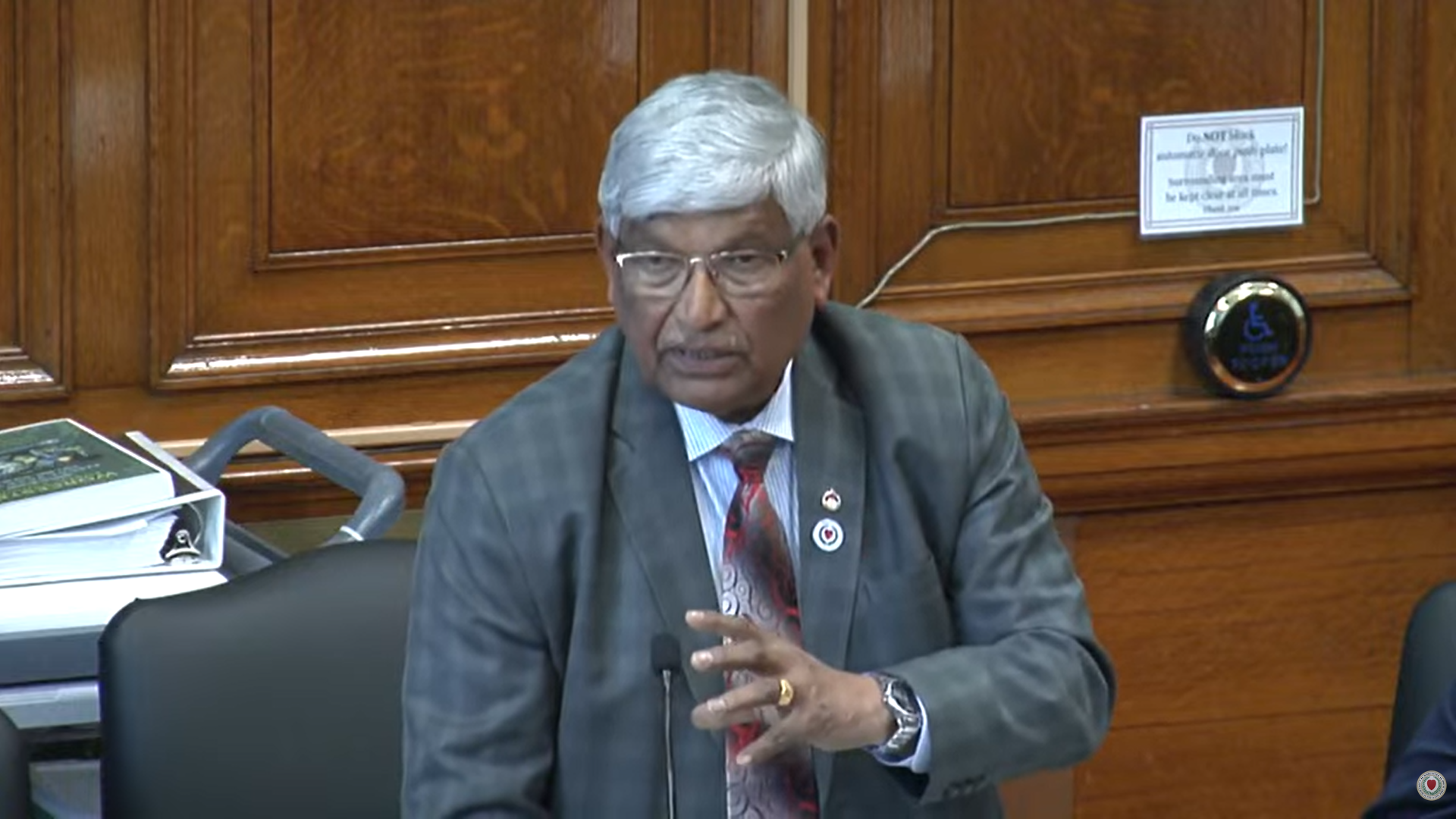
Councilor Satya Mitra sought to explore whether the city could borrow an additional $20 million specifically for roadway and infrastructure improvements.
“I wanted to see that we have a budget for, specifically, some major arteries to be taken care of,” Mitra said, adding that road conditions affect residents, businesses and visitors alike. “I’d like to make a motion that, if we can, add to the loan order, another $20 million, specifically to keep some major arteries fixed in this fiscal year.”
Mayor Joseph Petty ruled the request out of order, explaining that increasing borrowing for projects would still require inclusion in the administration’s proposed budget. He suggested requesting a report on how such a proposal could be pursued in the future.
City Manager Eric Batista said borrowing decisions must be balanced against the city’s ability to repay debt over time.
“I appreciate the passion and sentiment in terms of wanting to increase the budget,” Batista said. “…that then impacts the debt service, which impacts the operating budget and our ability to pay that debt on an annual basis.”
Batista said an additional $20 million in borrowing would affect city finances for years.
“We may not have the capacity to do that, in our operating budget, to pay off that debt, year after year, for the next 10 to 20 years,” Batista said, adding that the need for additional road repairs was already reflected in the FY27 proposal.
“[For the] first time in ten years, we’ve increased the budget for the DPW by 66%,” he said. “That’s $11 million more…That means that the requests that the council has had – better infrastructure, better potholes, better repairs, better sidewalks – is represented in this budget.”
Batista added that roadway projects are planned years in advance and must fit within available funding. He pointed to the last Main Street reconstruction project, which cost roughly $11 million and took more than three years to complete, as an example of how complex infrastructure projects can become.
Council Vice Chair Khrystian King asked what changes had been incorporated into the FY27 budget as a result of council requests over the past year.
Batista said council discussions frequently influence future budgets.
“We’ve had discussions related to the tree inspection process, we’ve had discussions related to potholes and repairing potholes,” he said. “What we often do with this information, we go back, as a department, and we look at ways in which we can continuously improve our efficiency in delivering services.”
He said council priorities often appear in the following year’s budget, unless the council takes formal action directing the administration to consider a specific change.
“Unless there is a directive, or a vote or a motion, in which the entire council body as a whole is seeking, then that would be something we would have to take into consideration for potential adjustments,” Batista said.
Batista also noted that most of the budget is dedicated to maintaining existing services and covering contractual obligations.
“The majority of the budget is mostly status quo,” he said. “There’s very little room in terms of what sometimes we have to add to the budget.”
The discussion then shifted to the city’s borrowing capacity and outstanding debt authorizations.
Batista explained that there is a difference between borrowing authorization and actual borrowing capacity. While Worcester has authorization for roughly $1 billion in additional borrowing, he said the city could not realistically take on that much debt without overwhelming future operating budgets.
Chief Financial Officer Timothy McGourthy said the city’s current debt load is approximately $1 billion. The FY27 budget includes about $159 million in borrowing, while the city is requesting roughly $43 million in new borrowing authorization.
The remaining difference comes from authorizations approved in prior years but not yet fully utilized.
“We look to take that unused authorization and apply it so it no longer sits as a liability on the city,” McGourthy said.
King requested a more detailed report on the city’s debt obligations and borrowing authority and questioned whether existing authorizations could be used to fund projects such as those proposed by Mitra.
“I think there is some movement that could happen,” King said.
He also asked whether the council’s authority could be expanded to allow members to move funding among budget categories.
City Solicitor Alexandra Kalkounis explained that under the city charter, councilors may reduce or reject portions of the administration’s budget proposal but cannot reallocate money between budget lines.
For example, she said, the council could reduce a department’s salary appropriation but could not transfer those savings elsewhere.
King said he would like information about how Boston handles budget authority and whether similar changes could be pursued in Worcester.
“I’d like to see appropriations focused a bit more on safety, traffic and potholes and the like,” he said, adding housing and youth programming.
Councilor Gary Rosen noted that the city’s first $1 billion budget may sound overwhelming to residents and asked McGourthy to explain why relatively few cuts are typically made during the budget process.
McGourthy said approximately 80% of Worcester’s budget consists of fixed costs. About 60% supports education, while another 20% covers debt payments, pensions and health insurance.
That leaves roughly $200 million to fund all other city services.
“The vast majority of the budget is untouchable,” McGourthy said.
He added that even modest reductions could significantly affect city operations.
“If we were going to look at cuts, the only thing I could say is that $2 million of new things we were looking to do this year would be gone, meaning that it would be absolute status quo from FY26 to FY27 on everything we do,” he said.
Following the discussion, councilors unanimously approved the FY27 budget.
“It’s a good budget,” Petty said. “The process was good discussion. The budget is pretty similar every year, and there’s not much of a change.”
Steve Smith, a veteran reporter with 17 years at The Hartford Courant, now brings his passion for photojournalism to Worcester. An award-winning photographer, he has covered major events like U.S. soccer, pro football, and UConn basketball. He is also the official photographer for the Miss Massachusetts competition and works as a realtor. Contact him at steve@stevephotographysmith.com