
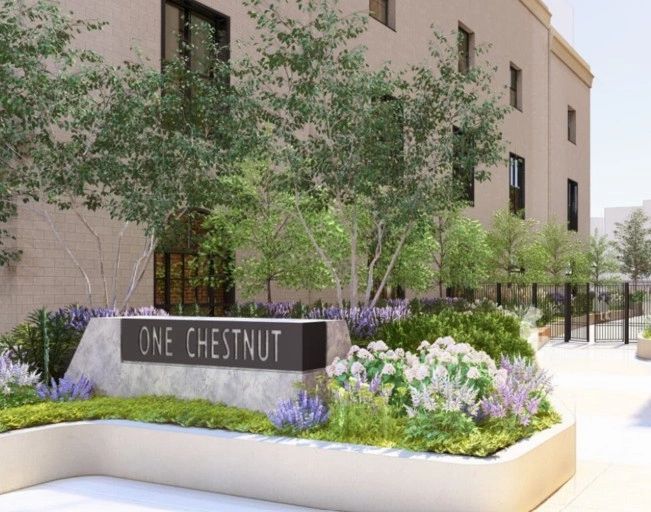
WORCESTER — Not long ago, the buildings at One and Two Chestnut Place were defined by desks, conference rooms and office traffic. Now, they are being reshaped into housing — part of a broader shift in Worcester reflecting changing workplace habits and continued demand for places to live.
The paired redevelopment projects bring 198 market-rate apartments to One Chestnut Place and 22 affordable, for-sale condominiums to Two Chestnut Place, converting underused office space into new residential options in the city’s downtown core.
Together, the projects represent how Worcester is navigating a complex intersection of housing demand, public investment and redevelopment challenges, with both opportunities and trade-offs still taking shape.
Financing a large-scale conversion
The larger of the two projects, at One Chestnut Place, is backed by a $51.17 million financing package announced by MassDevelopment, part of a broader redevelopment expected to cost about $73 million. Private lender Washington Trust is providing $47.57 million, with public financing helping to close the gap.
MassDevelopment is contributing a $3.6 million Housing Development Incentive Program (HDIP) tax credit bridge loan. The state’s Executive Office of Housing and Livable Communities has awarded $4 million in HDIP tax credits and $3.6 million through the Commercial Conversion Tax Credit Initiative (CCTCI). The city of Worcester has also approved a 15-year Tax Increment Exemption, reducing property taxes in the early years of the project.
“There is a lot of public support for this project,” said Joshua Lee Smith, a partner at Bowditch Attorneys. “Earlier this year, EOHLC awarded five projects with the first-ever tax credits under the Commercial Conversion Tax Credit Initiative program. Synergy’s 198-unit office-to-resi conversion project was given the largest tax credit award, by far, with $3.6 million.”
Smith said those incentives are often necessary given the costs associated with converting office buildings into housing.
“Conversion projects present costly challenges with respect to upgrading of electrical, plumbing, HVAC, fire protection and life safety systems,” he said. “Government subsidies like the CCTCI, HDIP and TIE help close the cost gap associated with conversion challenges.”
Haril Pandya, a senior principal at HFA Architecture + Engineering, said public incentives can determine whether a project proceeds.
“Public incentives are often the difference between a project moving forward or not,” Pandya said. “While a figure like $3.4 million in HDIP tax credits may seem modest relative to a $60+ million project, these developments are highly sensitive to margins. It’s not any single incentive — it’s the cumulative impact of tax credits, abatements and financing tools working together.”
He said incentives also signal alignment between municipalities and developers.
“That alignment reduces perceived risk and gives both lenders and developers greater confidence to move forward.”
Design constraints and opportunities
While financing plays a key role, architects say the physical structure of older office buildings can present equally significant challenges.
“In our experience the biggest challenge is the relationship of available floor plate to the exterior exposures,” said Ryan Hagler, a project manager at The Architectural Team. “The ideal dimension for a double-loaded corridor multifamily building is 60 to 65 feet across. However, most office buildings constructed around the turn of the 20th century are considerably narrower … while most built after the 1940s are very deep.”
Those differences can affect unit layouts, access to natural light and how many apartments can realistically be created.
“Maintaining an efficient layout and reasonable total unit number while creating livable space and desirable units is often a challenge,” Hagler said.
At the same time, adaptive reuse can offer design advantages.
“The unit layouts and amenity spaces within adapted buildings are often unique, and this creates opportunity for exciting moments or special spaces that are not always possible in modern developments,” Hagler said, noting that preserved architectural features can become defining elements.
He added that location is also a key factor.
“In our experience working on more than a dozen conversions in Worcester and hundreds in other cities and towns across Massachusetts and around the country, people are very much attracted to this proximity and convenience, and this is a big reason for the enduring appeal of adaptive reuse.”
Policy and local support
The Chestnut Place redevelopment reflects a broader effort at the state and local level to encourage reuse of underutilized properties.
“The City has historically supported conversion projects through approvals by its local boards, commissions and City Council, along with support through government subsidies,” Smith said. “Demonstration of local support is often necessary for a project to obtain certain state-level subsidies.”
He added that Worcester’s zoning ordinance includes provisions designed to support adaptive reuse by allowing increased density and more flexible requirements.
A second building adds affordability
While One Chestnut Place will introduce market-rate rental units, Two Chestnut Place is being redeveloped with a different focus.
The 50,000-square-foot building will be converted into 22 affordable, for-sale condominiums, with an estimated project cost of $14 million. The project is being developed through a partnership between Synergy and the Planning Office for Urban Affairs, with ownership expected to be transferred to the nonprofit.
The combined redevelopment introduces both rental and ownership opportunities in the same downtown area, reflecting different approaches to addressing housing needs.
A competitive housing market
The projects are moving forward as Worcester’s housing market remains active.
Recent Zillow data shows the average home value is about $421,000, with homes typically going under contract in about 18 days. On the rental side, average monthly rents are about $2,100, with one-bedroom units averaging about $1,781 and studios around $1,500.
While rent growth has moderated, overall housing costs remain elevated for many residents.
Different perspectives on growth and affordability
The redevelopment reflects ongoing discussions about how Worcester should approach housing growth.
“I believe communities should really take a wholistic view of housing development,” Smith said. “Market rate projects are easier to get financed as compared to affordable rate projects… it is imperative for communities to be open to a wide variety of housing.”
He noted that Worcester’s policies include a 3% payment-in-lieu fee on market-rate developments that contributes to the city’s Affordable Housing Trust Fund.
Some residents see benefits in bringing more people downtown.
“These types of projects can and should help strengthen downtown,” said Worcester resident Topher Davis. “The more people living there and walking around… is great for everyone.”
At the same time, Davis expressed concern about affordability.
“The concern is that ‘market rate’ housing is still too expensive for many people and families,” he said.
Other residents emphasized the importance of supporting small businesses alongside housing development.
“Give the owners of the building a break on the storefront taxes as an incentive to lower the required rents… to let small business owners survive,” said Worcester resident Duane Papetti.
“There can be a vision for downtown and it can work,” he added, “but the city, building owners and business owners need to work together.”
With similar projects emerging across Massachusetts, the Chestnut Place redevelopment offers a look at how cities are navigating competing priorities — and how former office spaces are being reshaped into new homes.
Matt Olszewski can be reached at mattoskier@gmail.com