
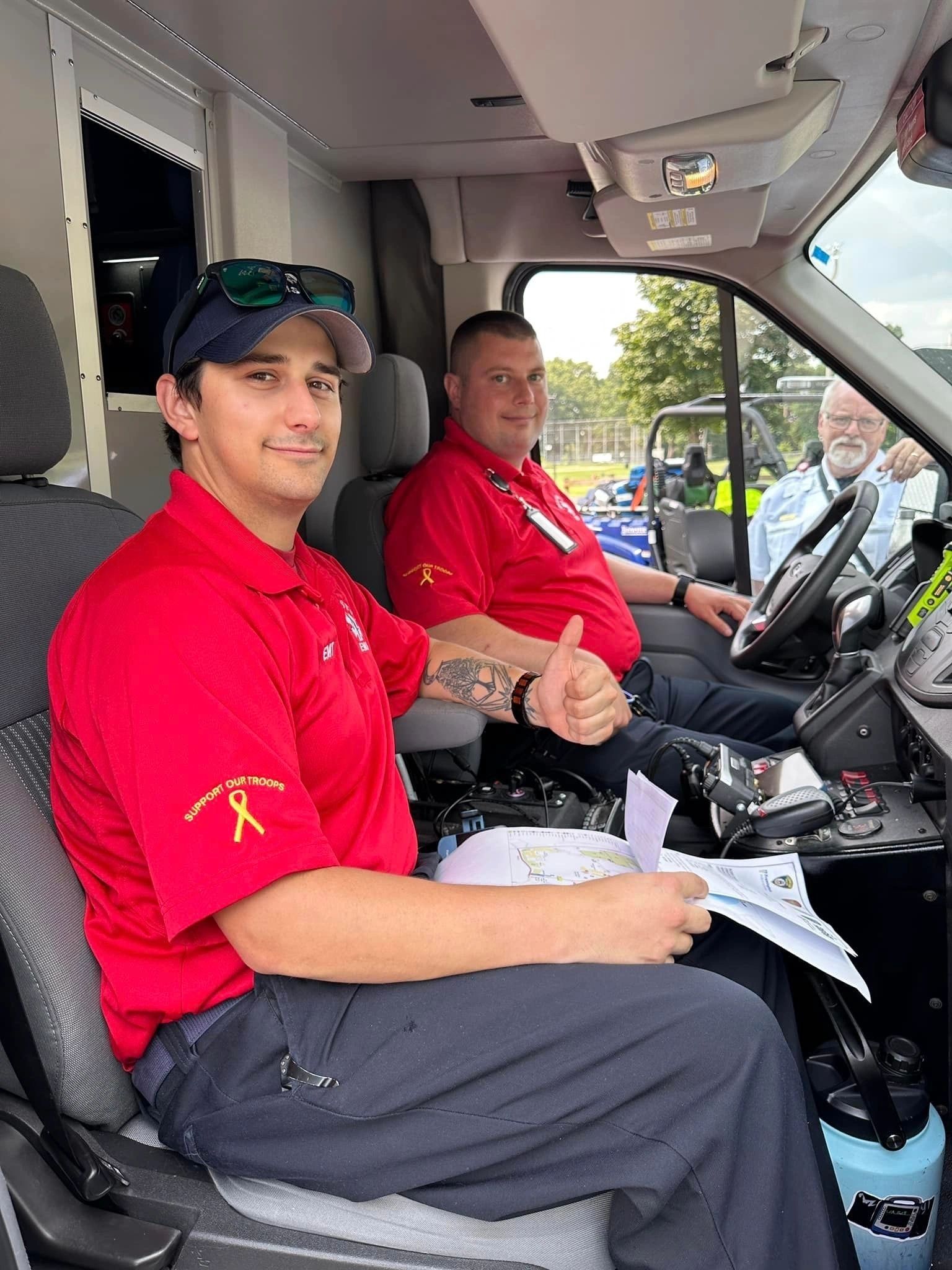
WORCESTER—The EMS industry has been navigating significant staffing challenges, particularly since the COVID-19 pandemic. Companies operating in Worcester such as Community EMS, Brewster Ambulance and Cataldo Ambulance are actively addressing these challenges to try to implement innovative solutions to ensure they’re able to provide essential services to the community.
Brewster Ambulance Service, a family-owned company with a rich history dating back to 1906, reentered the private ambulance industry in 2010 with a modest operation that included five vehicles and 32 employees. Today, the company boasts four communications centers, 200 vehicles, and more than 1,700 employees.
This growth has not been without its challenges. Domenic Corey, director of operations at Brewster Ambulance, pointed out, “EMS before COVID was already an industry that was having trouble with staffing.”
The root of this problem, according to Corey, lies in the financial structure of the industry. “A lot of what drives our staffing challenges is reimbursement from the centers for Medicaid and Medicare,” he continued. “At the end of the day, we need to keep our doors open and pay our bills, and that’s driven by revenue, which is driven by insurance.”
When a rate increase occurs, the ambulance service company does not see that money in their pocket until about a year later. Corey also emphasized that the money goes directly to their employees: “Those rate increases go pretty much directly into our payroll. We need those rate increases to pay our employees more. We’re a family-owned business so our top priority is always to treat our staff well.”
The COVID-19 pandemic exacerbated several issues in the ambulance service industry. “The COVID-19 pandemic was taxing on the 911 system and first responders across the globe,” said Don Charest, operations manager for Community EMS in Central MA. “The call volume increased, and the need for emergency medical responders was greater than ever. EMS first responders were among the first to respond to treat patients impacted by this deadly disease.”
The job was already considered high risk before COVID-19. According to a 2019 study from the National Library of Medicine, “Pre-hospital providers and the patients they serve are at heightened risk for disease exposure and transmission. They face unique challenges with regard to prevention of transmission and decontamination of their workspace environment.” Experts say it was even riskier during the pandemic, particularly before vaccines were introduced.
Financially, rate reimbursements have been a problem for a while. “The challenge we ran into before COVID was that the rate increases before COVID weren’t keeping up with the cost of doing business and the cost of inflation,” Corey said. Although the company would get a 2-3 percent raise in terms of reimbursement, it wasn’t able to keep up with a 5-8 percent increase of inflation and cost of doing business.
The pandemic not only increased the demand for EMS services, but also the workforce. “We had a huge spike during COVID in terms of those who retired,” said Corey. “A lot of those who were close to retirement elected to retire.” This sudden loss of experienced personnel put additional strain on an already stretched workforce.
Dennis Cataldo, president of Cataldo Ambulance, echoed Corey’s thoughts. “Nothing is set in stone, but the biggest driver will be funding,” he said. “Until EMS/Ambulance services are reimbursed at rates that will allow owners/operators to pay wages commensurate with the risk, responsibilities, and expectations of these individuals, staffing will remain a challenge.”
According to Cataldo, wages rose rapidly during late/post COVID and baseline jobs were in the low $20/hour range. Cataldo’s staff were still starting at $18 hourly. This resulted in far fewer applications, and “the reality those individuals faced with escalating expenses,” he said.
Despite these challenges, industry leaders are working on innovative solutions. “There’s a lot of work being done at the state and federal level to lobby and increase those reimbursement rates,” Corey said, “which will help everyone in EMS, whether you’re a fire department, 911 service, working for a hospital, or a private organization like us.”
Companies are also finding creative ways to support staff and attract new talent. Brewster Ambulance, for instance, has implemented a 100 percent employee-sponsored health insurance policy and increased their employee wages. “Our employees spend no money on their health insurance plan, regardless of whether it’s an individual or family plan,” said Corey. “We make sure our employees are taken good care of.”
Community EMS has also focused on employee well-being and stress management, especially given the nature of the job. “Through our GMR Life program, Community EMS provides employees and their families access to a professionally trained Critical Incident Stress Management (CISM) team that is available 24/7,” said Charest. “Community EMS also has a designated therapy dog, Freddie, who is trained to provide emotional support to our team members during their shifts.”
To address the recruitment issues for EMTs, Brewster Ambulance and other companies are eliminating barriers to entry for candidates. Historically, many people have not had the money to afford to go to EMT school. “We created a new position called an Ambulance Transport Specialist,” said Corey. “All that’s required is a driver’s license and no criminal history and we put the candidate through a certification process. This position is low-pressure, and we provide all the training under an EMT who can be a mentor to share insights.”
Corey hopes that word of mouth and eliminating barriers to entry will make the recruitment and hiring process easier. “Anyone looking for a rewarding career in healthcare can apply without any training or experience,” Corey emphasized.
Community EMS also created a pioneering entry-level program dubbed Earn While You Learn. This program enables individuals to be full-time employees and also take the certification courses to become EMTs, allowing for financial stability. “EMTs who graduate from the program receive a commensurate pay increase and become full-time EMTs with Community EMS,” Charest explained.
Their Earn While You Learn program received a national honor from the American Ambulance Association in the best employee programs category. “Similar programs have been launched nationwide as an innovative solution to the burgeoning first responder crisis,” Charest said.
Corey added that keeping EMS workers on staff is just as important as recruiting them in the first place. “Not only do we need to recruit candidates,” he said, “but we need to have strong retention. We value long-term retention and want to value our employees and have them stay for a long time.”
Despite the ongoing challenges, Corey is hopeful. “Our staffing issues post-COVID are still present, but we’re healthier now than we were during COVID,” he added. “We’re on a positive upswing in terms of our staffing picture.”
He also noted that there has been increased cooperation within the industry, with companies stepping in to help each other when needed. Specifically, Brewster Ambulance frequently offers help to Worcester EMS when call volume exceeds staffing, according to Corey.
“A lot of people who only perceive EMS as only a high-pace, high-stress field, won’t decide to work in this field,” Corey said. “But there are many alternatives in this field. We’ve found ways to keep those people involved in a different role.”
He emphasized, for instance, that Brewster Ambulance—like other ambulance service companies—takes care of a lot of non-emergency calls as well. For example, transporting a non-emergency patient from a hospital to a nursing home, or from a patient’s house to a dialysis clinic.
As the EMS industry continues to navigate these challenges, solutions require a multi-faceted approach. Corey emphasized that the road ahead is complex but not insurmountable.
Matt Olszewski is a freelance content and news writer based in Boston, MA. In his free time, Matt enjoys running, hiking or skiing. Matt just graduated with his MPH from Tufts University. He can be reached at mattoskier@gmail.com
As the Worcester Guardian marks nearly a year of delivering free, independent digital news to our city, our dedication to this mission strengthens. Please consider a tax-deductible donation to support our ongoing commitment to providing hyperlocal news coverage to Worcester. Scroll to the bottom of our home page to sign up for our daily newsletter