
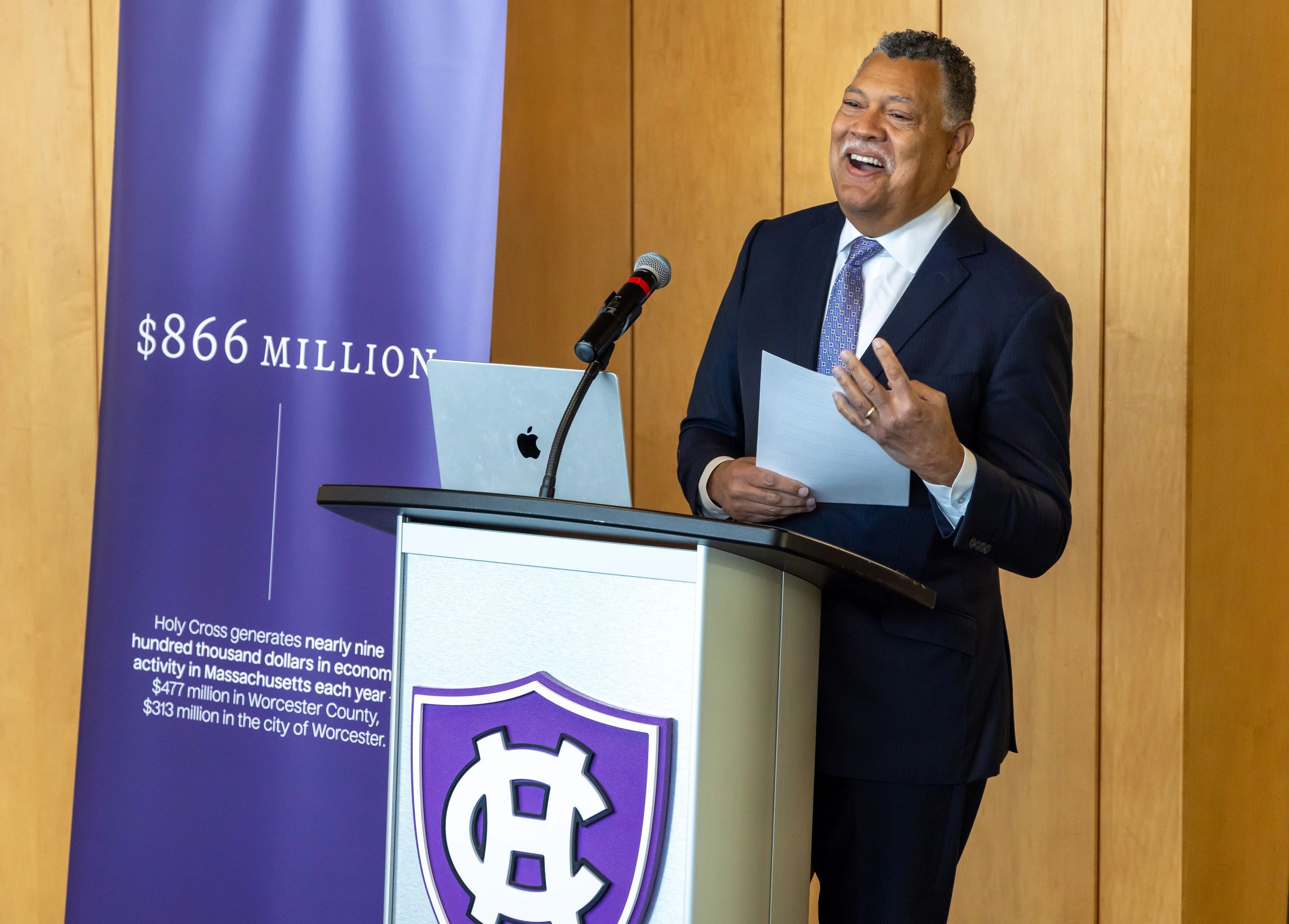
WORCESTER—The College of the Holy Cross contributes nearly $1 billion in annual economic activity across Massachusetts — including $313 million in Worcester alone — according to a new study released by Econsult Solutions, an independent economic consulting firm.
The analysis, People For and With Others: The Economic and Social Impact of the College of the Holy Cross, highlights the college’s dual role as an educational institution and major economic driver for the region. Holy Cross supports more than $866 million in statewide economic output and sustains 4,170 full-time jobs, including 1,560 in Worcester, the report found.
More than 200,000 visitors came to campus over the past academic year, generating an estimated $44 million in economic impact across Massachusetts — $35 million of that in Worcester through student and visitor spending.
The report, commissioned by Holy Cross, comes as part of a broader analysis of higher education’s role in Massachusetts’ economy. A separate study released Oct. 28 by the Greater Boston Chamber of Commerce, also conducted by Econsult Solutions, emphasized higher education and healthcare as foundational pillars of the state’s economic health.
Beyond dollars and jobs, the Holy Cross report underscores the school’s civic and social footprint. More than 1,000 students volunteer over 50,000 hours annually through local partnerships with schools and nonprofit organizations. The college also awarded $85 million in institutional financial aid last year — about a third of its total operating budget — including $4.7 million in scholarships for 108 Worcester students.
“The ESI report makes it clear that Holy Cross not only educates future leaders, it strengthens the civic, cultural, and economic fabric of Worcester and the Commonwealth,” said Holy Cross President Vincent D. Rougeau. “Our economic footprint is substantial, but what matters most is how that strength fuels opportunity, innovation, and growth locally and regionally.”
ESI Principal Lee Huang said the findings reflect how colleges like Holy Cross contribute in ways that extend beyond the classroom. “At a time when higher education institutions face mounting financial and political pressures, it is important to recognize the many ways these benefits are created and felt throughout the community,” he said in the announcement.
The full report is available on Holy Cross’s website.
