
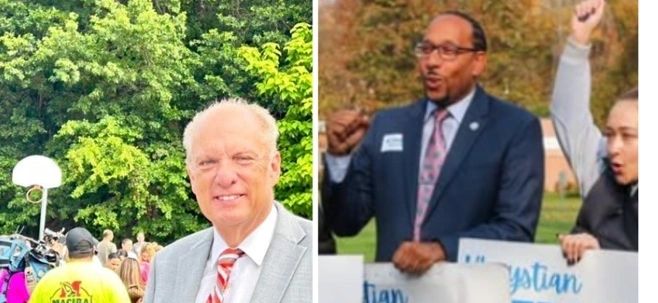
WORCESTER—Worcester voters narrowed the field in two key contests Tuesday, setting the stage for competitive races this fall in both the city council’s at-large seats and the District E school committee seat.
In the 14-way race for six at-large council seats, the top 12 candidates advanced to the Nov. 4 general election. Mayor Joseph M. Petty, seeking both re-election to the council and an eighth term as mayor, finished first with 5,994 votes. He was followed by incumbent Kate Toomey (5,144 votes) and longtime Councilor Morris Bergman (4,685).
The other candidates advancing to the general election, in order of votes received, were former Councilor Gary Rosen (4,646), Council Vice Chair Khrystian King (4,590), Jermoh Kamara (4,052), incumbent Donna Colorio (3,882), Satya Mitra (3,406), Cayden Davis (3,200), Owura-Kwaku Sarkodieh (2,729), Jessica Pepple (2,342), and Edson Montero (1,625). Falling short were Charles Luster (1,396) and Bernard Iandoli (1,340).
Kamara, a former Worcester School Committee member, told the Worcester Guardian in a recent interview that her experience has taught her “to take nothing personally and be open to collaboration to get the work done.” She said her priorities include affordable housing, public safety and creating pathways for young people and small businesses.
“My campaign is dedicated to serving the people of Worcester,” Karmara told the Guardian following the preliminary election. “We’ve been working hard and are committed to continuing to meet with as many voters as possible to hear their ideas for our city’s future.”
Mitra, who has raised more campaign funds than any other candidate this cycle, including Petty, previously told the Worcester Guardian that his long-term vision for the city includes encouraging deliberate, thoughtful leadership and building partnerships with local entrepreneurs to address pressing issues such as housing, safety and economic growth.
“My decision to seek election comes as a natural extension of my long-standing community service and reflects my desire to serve the public on a broader level,” he said. “I believe the city council should be more deliberative and less reactive. With my community experience and financial expertise, I can bring valuable insight to the council.
This is Davis’s first run for public office after putting down roots in Main South following his time at Clark University. A self-described “proud trans man,” Davis told the Worcester Guardian, “At a time when trust in government is increasingly eroding and democratic values are being tested across the country, it’s more important than ever to have local leaders who will fiercely stand up for the betterment of our city — and that means all of our city.”
Following the preliminary election, Davis added that he wants Worcester voters to know “that Worcester can have leaders who put people first — leaders who are truly willing to tackle the everyday challenges working-class residents face and who aren’t afraid to stand up for what’s right.”
He also expressed gratitude for the support his campaign has received: “I’m beyond grateful to everyone who is supporting this campaign. The overwhelming generosity, energy and belief demonstrate that Worcester is ready for leaders who listen, show up, and fight for the community every day. To neighbors who are still deciding on their votes, I look forward to connecting, sharing my vision, and earning your vote on November 4th.” On the broader campaign conversation, Davis said, “That a grassroots campaign centered on everyday people can stand strong in Worcester. Our city doesn’t have to be defined by the status quo and we don’t have to accept business as usual. We can do things differently, put people first and create a city that works for everyone.”
By the city’s charter, every at-large councilor is automatically considered a candidate for mayor unless they formally opt out. That means November’s election doubles as a mayoral contest, with Petty and King expected to face off once again.
Petty, who has held the mayor’s office since 2012, said in a statement Tuesday night that he was “gratified by the continued support of Worcester’s voters” and looked forward to carrying his campaign through the fall. In a recent interview with the Worcester Guardian, he reflected on his long tenure: “Over my years as mayor, I’m proud of the progress we’ve made in building a stronger, more vibrant Worcester,” pointing to new schools, downtown redevelopment and expanded housing projects.
King, who came within striking distance in 2023, told reporters that residents “want more out of their city government” and that his campaign intends to deliver that message heading into November. The Worcester Guardian reached out to King for comment on the preliminary results but did not receive a response.
Rosen, who finished just ahead of King in the at-large preliminary, said in a statement to the Worcester Guardian that he was “thrilled, honored and so thankful to the Worcester voters for putting their confidence and trust in me in the preliminary election.” He added that his campaign has been focused on showing voters his “work ethic” and “energy” and pledged to remain “visible, vocal and accessible” in the weeks ahead.
He said that he is independent from “individuals, groups or donors” and pointed to issues he plans to stress heading into November, including affordable housing, charter review, and addressing aggressive driving. “I have a lifetime of service to the youth, adults and seniors of our city,” Rosen said. “I’m still excited about Worcester’s future and I hope that the voters in November once again will give me the opportunity to serve.”
Turnout in Tuesday’s preliminary was low but typical for Worcester: just 11,489 ballots were cast out of 114,837 registered voters, or about 10%. That’s only slightly higher than the city’s last preliminary election in 2023, which drew 9.1%.
The other race on the ballot was in District E, where incumbent Kathleen Roy topped the three-way school committee contest with 753 votes. She’ll move on to November against challenger Nelly Medina, who earned 597. Noelia Chafoya, who drew 432 votes, was eliminated.
The Nov. 4 general election finalizes Worcester’s political lineup, with voters deciding all six at-large council seats, five district council seats, and contested school committee races, including the Roy–Medina matchup in District E.
Editor’s note: An earlier version of this story incorrectly stated that candidate Jermoh Kamara did not finish in the top six in the preliminary election and that Donna Colorio was “on the bubble.” In fact, the top 12 candidates advance to the general election. The story has been updated to reflect the correct results. We regret the error.
The Worcester Guardian is continuing to reach out to candidates and will update this story as additional reactions come in. This article is part of the Worcester Guardian’s ongoing coverage of the 2025 municipal election. Our reporting spans candidate profiles, in-depth stories on the issues shaping the city, election results, and other coverage to help Worcester voters stay informed ahead of the Nov. 4 election. Charlene Arsenault can be reached at carsenault@theworcesterguardian.org.