
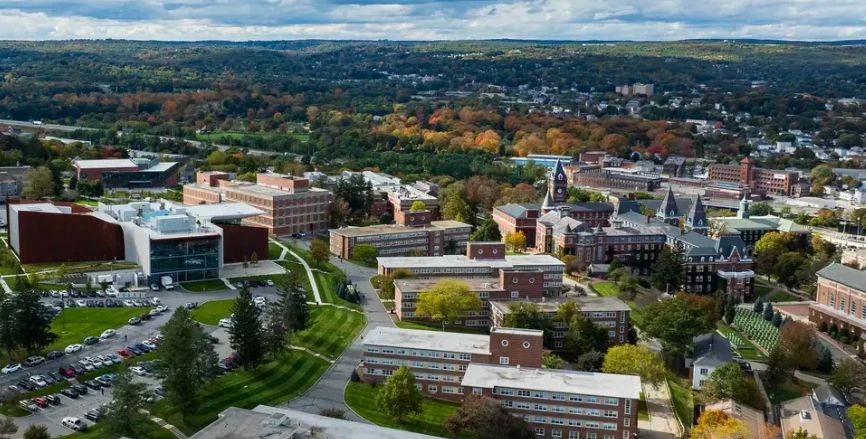
WORCESTER—The College of the Holy Cross recently launched a new micro-grant program designed to support small, community-focused projects that connect the campus more closely with the city of Worcester.
Announced last month, the Worcester Pillar Micro-Grant Pilot Program provides one-time grants to Holy Cross faculty and staff for projects intended to deepen collaboration with local organizations, expand student learning opportunities in the city and create more welcoming connections between campus and community.
The program is tied to Holy Cross’ strategic plan, Aspire, which identifies the college’s relationship with Worcester as one of its central priorities. Known as the “in and of Worcester” pillar, that part of the plan calls on the campus community to engage more directly with the city’s cultural, educational and civic life.
“The Worcester Pillar Micro-Grant Program is a powerful expression of our commitment to being In and Of Worcester,” Holy Cross President Vincent D. Rougeau said in the announcement. “These projects demonstrate the creativity and care our faculty and staff bring to deepening the ties between campus and community — and to ensuring that the College’s mission is lived out in partnership with our city.”
The pilot program has $10,000 available in the current fiscal year, with individual awards ranging from $250 to $1,000. The funding supports projects that pair Holy Cross students, faculty and staff with Worcester-based partners on initiatives that blend learning, service and community engagement.
In its first year, the program is backing a wide range of efforts, including student-led storytelling projects focused on Worcester residents, collaborations with organizations such as Big Brothers Big Sisters and the Worcester Public Library, arts programming connected to Worcester Public Schools, environmental and sustainability initiatives, and hands-on learning experiences tied to health care, cybersecurity and urban ecology.
Several of the funded projects emphasize creating opportunities for students to learn directly in Worcester through experiential programs, while others focus on bringing Worcester residents and organizations onto campus for exhibitions, workshops and public events.
College officials described the micro-grants as a way to seed ideas that can have an outsized impact, allowing faculty and staff to test new partnerships and approaches without the scale or bureaucracy of larger funding programs.
