
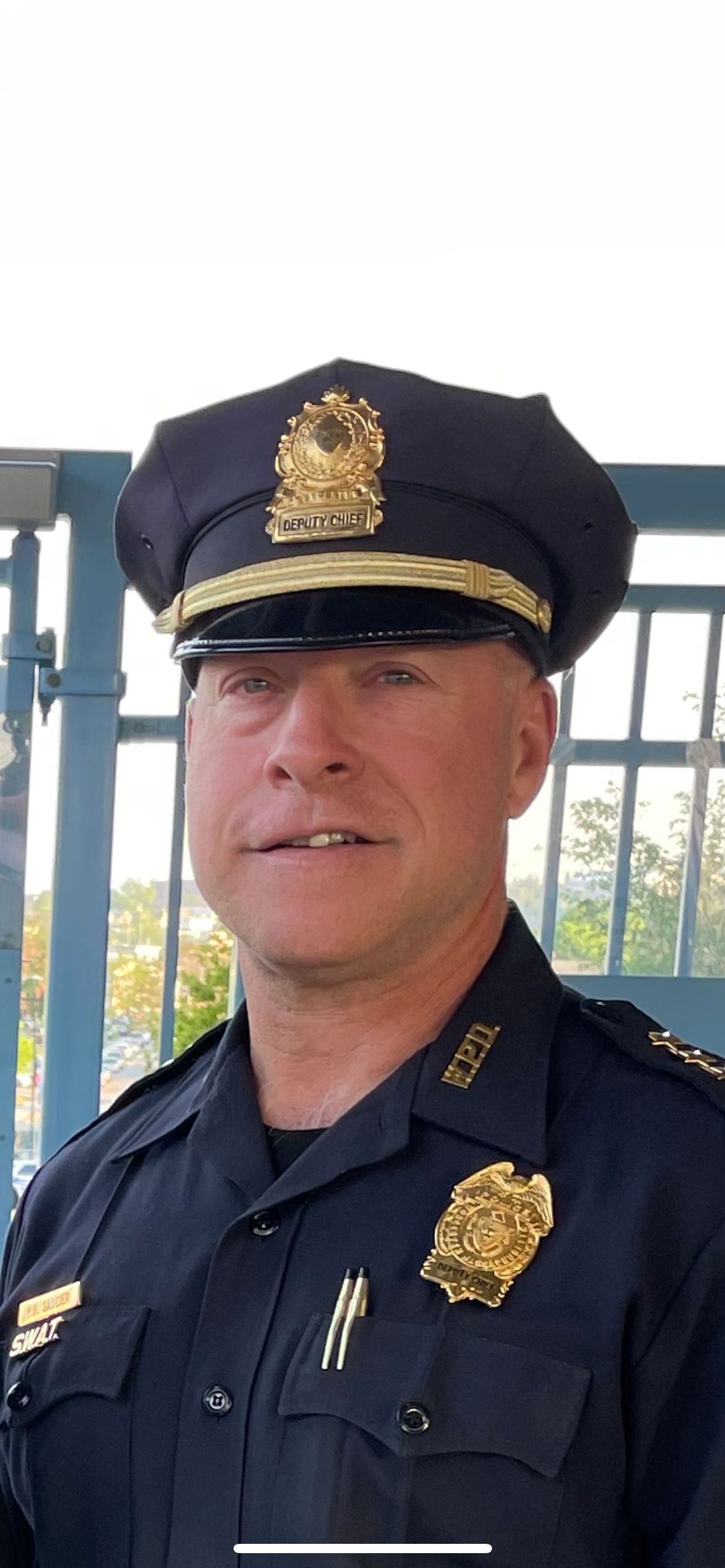
Paul Saucier was named interim police chief on Sept. 1, the same day former Chief Steven Sargent announced his retirement. While interim chief, he said he’s pushing for more transparency in the WPD, and hopes he’ll be the department’s permanent chief.
WORCESTER – It’s been over a month since Paul Saucier took the reins of the Worcester Police Department in an interim capacity, and he’s looking to keep them.
“I wouldn’t have taken this if [being named chief permanently] wasn’t my goal,” Saucier told the Worcester Guardian of taking on the interim position. “I’ve been here going on 30 years. I’ve worked in pretty much every single division and I was deputy chief for seven years prior to this. I’m definitely qualified for it.”
City Manager Eric Batista thinks Saucier is doing an amazing job, telling the Worcester Guardian that Saucier has hit the ground running.
“Anything that I’ve asked him to do he’s done,” Batista said. “He’s doing it graciously. Right now, within the department he’s looking for areas to improve… strengthen.”
As he looks at candidates for the permanent position, Batista said Saucier has the potential to be a strong candidate for chief.
“I think he has the ability and the skills to lead the department,” Batista said.
The search process for the new chief may be influenced by the city council. Mayor Joseph Petty has put forward a request for Batista to review the hiring process and consider hiring a commissioner of public safety and Councilor At-Large Khrystian King has requested the manager consider eliminating the civil service requirement for the position.
Saucier was named interim chief by Batista on Sept. 1, following the sudden retirement of Chief Steven Sargent.
On the Talk of the Commonwealth radio program, Batista told host Hank Stolz that Sargent had already been talking about his retirement with him when revelations about investigations into Sargent’s conduct led them to mutually agree upon a “much-sooner date” for that retirement.
Reports from the Telegram & Gazette and Worcester Patch revealed a 2021 investigation found Sargent engaged in a pattern of harassing and retaliatory behavior toward an officer in the service division and a 2020 investigation found Sargent acted in a manner unbecoming of an officer during a 2019 road rage incident.
The latter investigation found then-Deputy Chief Saucier violated policy by failing to ensure the complaint was properly investigated, however then-City Manager Edward Augustus determined the reported evidence was not conclusive and did not accept the investigation’s findings about Sargent or Saucier.
On Monday, Saucier pointed out that he was the deputy chief at the time of the road rage incident, not the chief.
‘You always report to a higher person’
“You always report to a higher person, the chief of police did not report to the deputy chief,” Saucier said. “As far as I’m concerned, once the police chief tells the city manager then there’s nothing left for me to do.”
He said that’s why Augustus did not sustain the report’s findings, since he “had no control over that.”
Saucier took on his new role during a difficult period for the department. In addition to the chief’s sudden departure, in November 2022 the Department of Justice and the U.S. Attorney for the District of Massachusetts launched an investigation into the possible use of excessive force or discriminatory policing based on race or sex within the department.
When the investigation was launched, the Worcester Police Department was among only 74 law enforcement agencies out of over 18,000 in the nation to be investigated by the DOJ for pattern or practice, according to a Worcester Regional Research Bureau report.
Investigators have spoken with Saucier and his staff, but he said he’s not involved in the investigation.
To build trust with the community while the investigation is ongoing, Saucier said he’s focused on transparency.
His push for transparency has included posting the department’s daily incident logs on the city website, which includes a list of calls the police have responded to, including the type of call, the location, the officer involved and the action taken.
Make log easier for people to access
The daily incident log is a public record and therefore something anyone can come into the police station and ask for, but Saucier said he wanted to publish it online to make it easier for people to access.
Saucier is also insisting the department make more of its documents available online, he said, giving records and other official papers the WPD prepares for the city council as an example.
The documents the department prepares for city council are also public, but he said it can be cumbersome to find them as attachments to council agendas. By having the department share it on its social media pages and website, Saucier said it will be easier to access.
Going forward, Saucier said he plans to have the department share its monthly statistics for overdoses and gunfire incidents and a map showing the areas in the cities receiving shots fired calls and vehicle break-ins.
“We want the public to have as much information as they can,” Saucier said.
The department will also continue to share the work it’s doing in the community on social media, such as the summer camp held over the summer for 300 inner city youth: Big in Blues – a Big Brother, Big Sister program with officers and youth and Arts and Music Police Partnership (AMPP), a program that provides music therapy to at-risk youth, according to Saucier.
“We do a lot of good work here and I want to make sure people know that,” he said. “You know, we are human beings, people do make mistakes, but when they do we take care of business.”
Regarding complaints against officers, according to Saucier the department follows state law, and any complaint that comes into the department is sent to the Peace Officer Standards and Training (POST) Commission within 48 hours.
Saucier then pointed out that all use of force incidents are published online and the department goes in front of the Human Rights Commission every year and explains any investigation into misconduct.
Review all of the department’s policies
Since taking office, the interim chief has also launched a Policy Review Committee that is going to review all of the department’s policies and determine if there are any “disparate policies out there…that may hinder somebody from advancement,” according to Saucier.
In 2021, the city settled a lawsuit for $1.5 million brought forth by two black police officers alleging discriminatory racial bias regarding promotions. The officers originally filed separate complaints with the Massachusetts Commission Against Discrimination in 1994 and eventually settled a class action lawsuit against the state for $40 million in April 2023 related to bias in the civil service promotional exam.
Saucier said they had 60 volunteers within the department for the Policy Review Committee and narrowed that down but made sure they had representatives from every division in the department as well as diversity officers.
The committee will be working in conjunction with the Human Rights Commission, according to Saucier. The policies are available online and any member of the public is also welcome to review them and send their thoughts via email to the committee, Saucier said.
Four lieutenants and a deputy chief will review the emails from the public, according to Saucier. When asked if the American Civil Liberties Union will be involved in looking over the policies, Saucier said the ACLU has access to the policies just like the public does and can submit any comments to the department in the same way.
Since taking office, Saucier said he’s also made a point of meeting with members of the community and says anyone can stop by and talk to him.
“I want people to know me on a first name basis, and as a regular guy, not the police chief,” Saucier said.
He’s reached out to community members
He said he’s reached out to community members and all the city councilors to sit down, have coffee with them and hear their concerns and what they think can be improved and also to share his philosophy with them.
Fred Taylor, the president of the Worcester branch of the NAACP, was one of the community members Saucier reached out to for a meeting.
“I appreciate him being proactive,” Taylor said of Saucier calling for the meeting and called Saucier’s push for transparency music to his ears.
Taylor said he and the interim chief are in a “good spot,” but that actions speak louder than words and he will be keeping an eye on the chief’s actions going forward.
During their meeting, Taylor said he brought up something that the previous chief had said that was really troubling to him. In a September 2020 Human Rights Committee meeting, the Telegram & Gazette reported then-Chief Sargent said institutional racism does not exist within the department.
“In my 35 years I have not observed racism in the department,” Sargent said, according to the newspaper. “We would not allow it.”
Taylor said Saucier admitted to him there was racism within the department because there’s racism everywhere.
“I know when you say there’s racism everywhere it kind of waters it down, but honestly it’s better than what we got from the last chief,” Taylor said.
Saucier told the Worcester Guardian that creating the Policy Review Committee will help “address any types of structural racism that we may not see.”
There’s racism throughout the country
He then echoed to the Worcester Guardian what he said to Taylor, saying there’s racism throughout the country, whether you’re working at a McDonald’s or within a police department. The Worcester Police Department looks to prevent it within its department with extensive background checks, Saucier said, but when any racist incidents arise, they are addressed.
The police department also underwent a racial equity audit conducted by an external firm, the results of which should be reported soon, according to Batista.
“We’ve provided all the data, they’ve done all the interviews, they’ve done all the surveys,” Batista said. Once the report is completed, Batista said he will share it with the council just as he shared the report detailing audits of the city’s human resources department and health and human services department.
In Saucier and Taylor’s meeting, Taylor said he also raised the issue of gun violence and developing alternative ways to address it, such as offering counseling and different outreach programs in the community.
“He was open to it,” Taylor said.
To address gun violence, Saucier said he has been meeting with the Bureau of Alcohol, Tobacco, Firearms and Explosives to create a crime gun intelligence center that will use ShotSpotter technology along with evidence from scenes to find commonalities in incidents and determine if they involved the same gun.
“There’s not thousands of guns out there shooting people,” he said. “It’s a very small percentage of offenders that are trigger pullers and they’re causing damage. So once you take them out of the equation, then you reduce gun violence.”
Meeting with the chief was positive
Overall, Taylor said his meeting with the chief was positive and they only disagreed on the best way to diversify the police force. Saucier is looking into the possibility of allowing people from outside of the city to work in the department to help diversify it, according to Taylor.
“I disagree with that…I think that we need to do more like give incentives for people who are police officers, firefighters and school teachers to live here in the city,” Taylor said.
Saucier himself has lived in the city for decades, which he argued adds to his qualifications to stay on as chief.
“I shop here, my kids go to school here or went to school here and this is where I go to sleep at night,” Saucier told the Worcester Guardian.
He loves the city, he said, because it has a small town vibe.
“Everywhere you go, you know people,” he said. “It’s close knit.”
Kiernan Dunlop is an award-winning journalist who has spent the past five years reporting in Worcester, New Bedford and Antigua and Barbuda. She’s been published in Bloomberg, USA Today, Canary Media, MassLive, and the New Bedford Standard Times, among other outlets. She can be contacted at kdunlop@theworcesterguardian.org