
WORCESTER—The Greater Worcester Community Foundation and the Worcester Regional Research Bureau have joined forces to introduce Worcester County Insights, an innovative community indicators platform. This dynamic tool was crafted to offer vital data on multiple aspects of life across Worcester County, the organizations announced last week.
Worcester County Insights is a collaborative venture to deliver up-to-date data on pivotal indicators influencing the community’s well-being. Crafted by the Center for Governmental Research, drawing from credible sources including the Census Bureau’s American Community Survey, this platform offers analysis encompassing 60 indicators.
These indicators span across various dimensions, providing comprehensive insights into the community’s fabric, including:
- Community life: including arts and entertainment, voter engagement, and internet access
- Demographics and diversity: including changes to the population regarding age, language diversity, immigration and race/ethnicity
- Economic mobility: including income levels, homeownership rates, poverty rates and housing costs
- Employment and workforce: including business ownership, unemployment rates and female-to-male earning ratios
- Health and wellbeing: including prenatal care, disease rates, substance use and health insurance
- Youth and education: including student test rates, children who are economically disadvantaged and disengaged youth
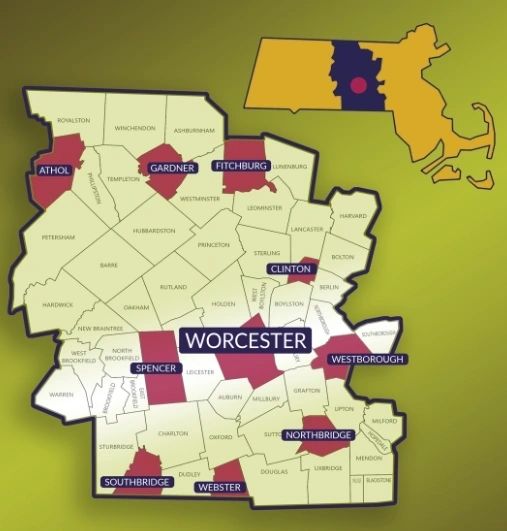
The data found on Worcester County Insights can be used to compare Worcester County to the state of Massachusetts and the nation. When available, users can also compare and contrast data across 10 towns in Worcester County, selected to represent the different geographies and types of communities (rural, urban, suburban; large and small) that make up the County.
The towns are Athol, Gardner, Fitchburg, Clinton, Spencer, Worcester, Westborough, Southbridge, Webster and Northbridge.Worcester County Insights also provides data disaggregated by race whenever possible, ensuring a nuanced understanding of the challenges and opportunities facing different communities within Worcester County.
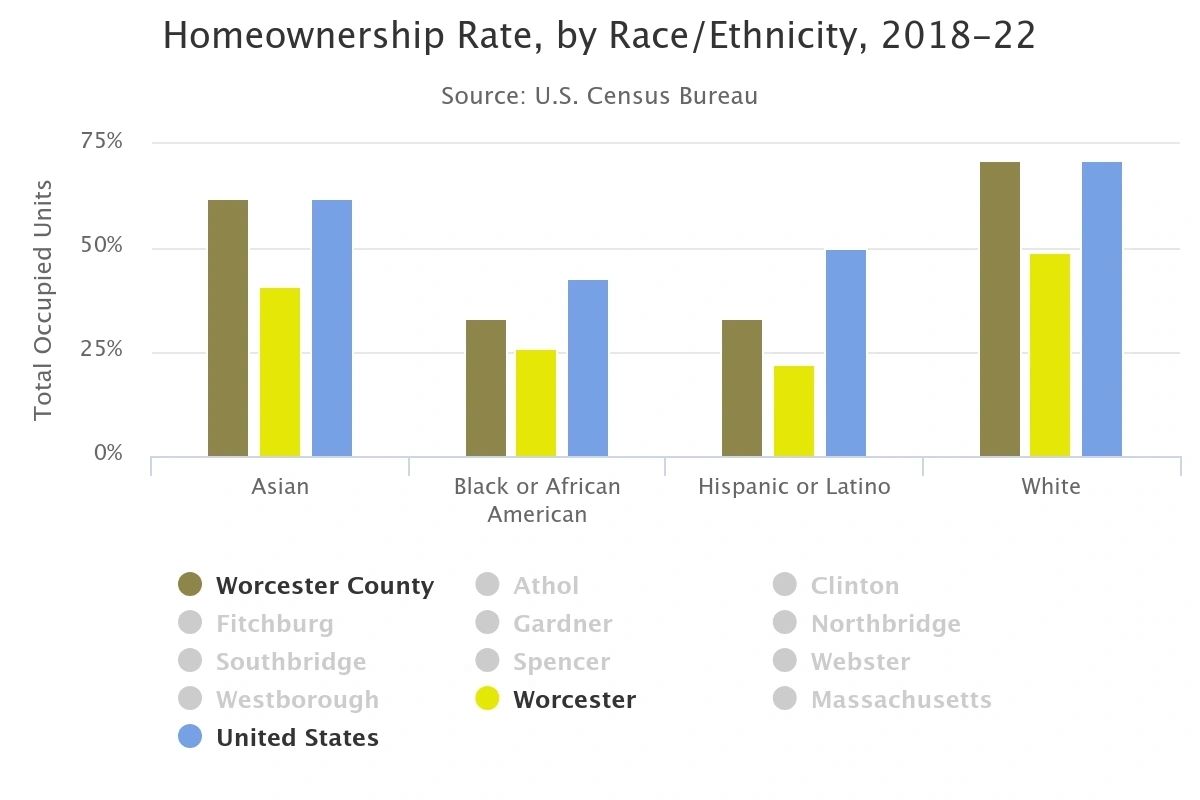
For instance, the chart above provided by Worcester County Insights demonstrates the stark racial disparities in homeownership rates. Seventy-one percent of white and 62 percent of Asian residents in the county own their homes, compared to only 33 percent of both African American and Latino residents.
Homeownership rates in the city are lower across all races/ethnicities but still show disparities and Worcester County has greater racial and ethnic disparities in homeownership rates compared to the nation, according to the announcement.
“At Greater Worcester Community Foundation, we believe that data-driven decision-making is crucial for creating positive change in our communities, both through our own grantmaking and beyond,” said Pete Dunn, president and CEO of Greater Worcester Community Foundation, in a statement. “Worcester County Insights helps give residents, policymakers, nonprofits, and other stakeholders the information they need to address disparities, advocate for equitable policies, and drive meaningful progress across Worcester County.”
Quarterly insights insiders research briefs
Worcester Regional Research Bureau said it plans to publish quarterly research briefs on Worcester County Insights to provide deeper insight into specific community issues and data points.
“We believe Worcester County Insights and our Insights Insider research briefs will be a valuable new resource for the region,” said Paul Matthews, executive director and CEO of Worcester Regional Research Bureau, in a press release. “By providing easily accessible and up-to-date data, the platform aims to educate the public, inform policymakers, foster collaboration, and support evidence-based initiatives that address the most pressing issues facing Worcester County.”
The inaugural edition of Insights Insider, “Introducing Worcester County Insights,” explores the datasets that are used in the dashboard, highlights the dashboard’s useful features and sample visualizations, and notes its value to specific stakeholders such as municipal officials, not-for-profits, businesses, community or advocacy organizations, higher education institutions, and more.
Users can visit worcestercountyinsights.org to explore interactive data visualizations and maps, create their own dashboards, access downloadable reports, and stay informed about the latest trends and developments affecting Worcester County.
Where possible, downloadable data is available on all 60 cities and towns in the county.
Send news releases to Charlene Arsenault at carsenault@theworcesterguardian.org
