
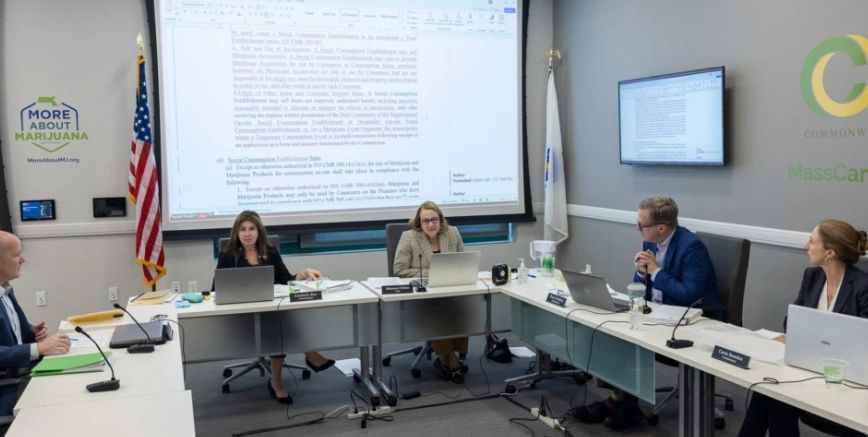
WORCESTER—Massachusetts took a major step toward allowing adults to legally consume cannabis in social settings, as the state’s Cannabis Control Commission voted 4–0 Thursday in Worcester to approve three new license types for on-site use.
The unanimous vote at Union Station, where the commission is headquartered, clears the way for Massachusetts to become the first state in New England to authorize regulated cannabis consumption lounges, events and hospitality-based models. The new rules are expected to take effect Jan. 2, 2026, after final review by the Secretary of the Commonwealth.
According to the commission’s announcement, the social consumption licenses are the first new cannabis business models introduced in the state in five years and allows adults 21 and older to purchase and use cannabis on-site. The license types include supplemental licenses for existing businesses, hospitality licenses for new or non-cannabis businesses partnering with licensees and event organizer licenses for temporary consumption events.
“The Commonwealth has been eagerly waiting social consumption, so we’re proud to move this effort across the finish line,” said Chair Shannon O’Brien in the release. She added that the new licenses are expected to create opportunities for small businesses and entrepreneurs disproportionately harmed by the War on Drugs.
Commissioner Bruce Stebbins, co-chair of the Social Consumption Working Group, said in the announcement that the regulatory package reflects “years of stakeholder engagement, research, and policy discussion and deliberation,” noting that municipalities will need to opt in before hosting social consumption sites.
Commissioner Kimberly Roy said finalizing the license type “marks a long-awaited and carefully considered milestone,” and that the next chapter involves public education to ensure the new sector operates safely.
The commission outlined a series of safety and public-health measures that will govern the sites, including responsible vendor training focused on impairment recognition, last-call rules, transportation plans coordinated with public safety partners, and product menus that provide estimated onset times for intoxication. Consumers will also be allowed to take home unused product in sealed, child-resistant bags to reduce the risk of overconsumption.
Local control remains central to the program: municipalities must opt in through a referendum, ordinance or bylaw, and each Social Consumption Establishment will be required to secure a host community agreement.
The regulations also permit non-infused, pre-packaged food and beverages to be sold on-site for the first time in the state’s cannabis industry. Establishments may also seek additional permits to serve other food options or partner with nearby restaurants or food delivery services.
Beyond social consumption, the commission approved several regulatory updates requested by industry stakeholders, including simplified employee badging requirements, changes to waste-handling documentation, and new rules requiring establishments to report medical or safety emergencies to the state.
The commission noted that Thursday’s vote caps more than two years of public meetings, listening sessions and comment periods. Social consumption was originally part of the 2016 ballot measure that legalized adult use in Massachusetts but required later changes to state law before municipalities could opt into hosting such venues.
Once regulations are formally promulgated, the commission begins working on the implementation part of the equation, including launching new license applications and rolling out public education efforts.
Have news, tips, or a story worth telling? Reach Editor Charlene Arsenault at carsenault@theworcesterguardian.org—because good stories (and great scoops) deserve to be shared.
The Worcester Guardian is an independent nonprofit news organization. Support local journalism by making a DONATION today.