

WORCESTER—The state Office of the Child Advocate (OCA) released a detailed investigative report Wednesday examining the circumstances leading up to the death of 4-year-old Worcester resident A’zella Ortiz and the serious injuries suffered by her two siblings. The report outlines multiple failures in how the Department of Children and Families (DCF) assessed risk and managed the family’s case over several years.
A’zella died on Oct. 15, 2024. Her father, Francisco Ortiz, told police she fell from a kitchen table in their Worcester apartment, according to police reports. She was taken to UMass Memorial Medical Center, where she was pronounced dead. Ortiz is currently awaiting trial and faces several charges, including assault and battery on a child with substantial injury, domestic assault and battery, reckless endangerment of a child and charges connected to injuries found on his two other children, ages 2 and 5 at the time.
According to the OCA announcement, the family had been involved with DCF from 2018 to 2023, with the agency supporting findings of neglect involving all three children. DCF closed its case roughly one year before A’zella’s death and was not involved with the family at that time.
The OCA is authorized under state law to review the actions or inactions of state agencies when a child who has been receiving state services is seriously injured or dies. The office said it chose to publicly issue this report because the case “exemplifies concerns regarding DCF’s risk assessment and case management practices” that the OCA has raised before in past investigations and through its oversight work.
“The vast majority of children served by DCF are living at home, with their families,” OCA Director Maria Mossaides said in the release. “Our goal as a Commonwealth should be to ensure that these children can stay home – safely. For that to happen, state intervention with families where maltreatment has occurred must be child-centered, based on an accurate assessment of risk, time-limited, and serve to support and stabilize the family. Unfortunately, that is not what happened in this case, with tragic results for A’zella and her siblings.”
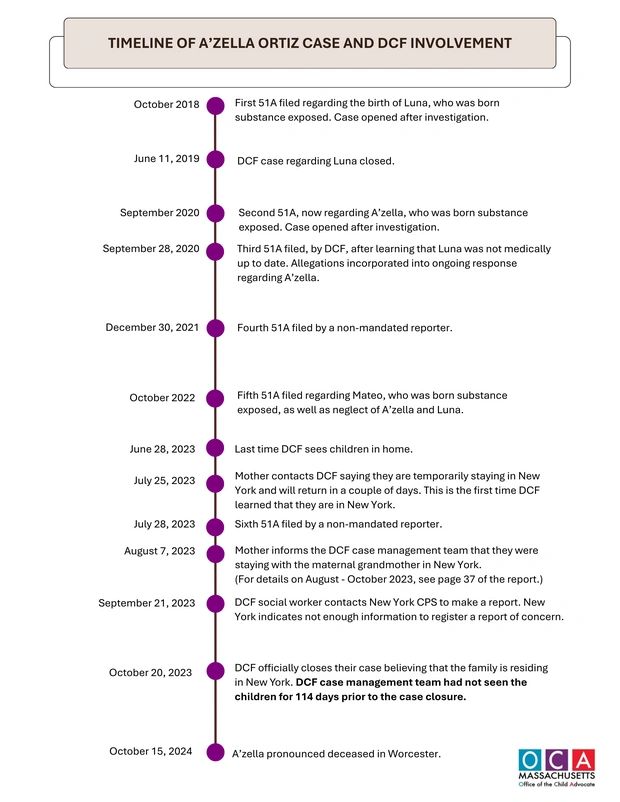
The investigation found that the DCF case team “did not have a comprehensive understanding of the dynamics and needs of the family,” resulting in an inaccurate risk assessment. Warning signs accumulated over more than three years, the OCA said, but the agency’s approach did not shift. Despite no improvements in the children’s well-being, the case management team continued the same strategy.
The report describes “chronic and cumulative” neglect, including inadequate supervision, parental substance use, and long-standing failures to obtain medical and specialist care. Two of the children were nonverbal, and the family missed numerous pediatric appointments, leading to untreated developmental delays, poor nutrition, and isolation.
The case ultimately closed under the mistaken belief that the family had moved to New York. At that point, the children had not been seen by DCF staff for 114 days, according to the release. A’zella died approximately a year later.
While the OCA noted that the escalation following case closure was “rare and may not have been foreseeable,” the office concluded that DCF’s years-long involvement “provided no measurable improvement to the safety of the children.”
Broad recommendations for statewide reform
The report positions this case as part of larger systemic issues involving how DCF evaluates risk, particularly in intact families—those in which children remain at home rather than in foster placement. The OCA said 78% of families served by DCF in FY25 fall into this category.
The recommendations outlined in the report call for several systemic changes. The OCA urges DCF to revise its case-closing policy, particularly in situations involving long-term involvement or uncertainty about a family’s location. It also calls for the creation of a structured, statewide quality-assurance framework for intact-family cases, mirroring the oversight that already exists for children in state custody.
The office recommends strengthening the definition and use of “clinical formulation” so caseworkers have clearer guidance in assessing risk and making decisions, and integrating an understanding of chronic neglect into everyday casework and training. Finally, the OCA advises DCF to conduct a comprehensive assessment of its workforce training needs, particularly around child development, parental engagement, substance use, neglect, and clinical decision-making.
“This report asks that we, as a Commonwealth, consider seriously the investment needed to support and stabilize families so that children can truly thrive,” Mossaides said in the release, noting that any improvements will require both DCF and the broader state to commit to systemic support.
The full report is available through the Office of the Child Advocate.
Have news, tips, or a story worth telling? Reach Editor Charlene Arsenault at carsenault@theworcesterguardian.org—because good stories (and great scoops) deserve to be shared.
The Worcester Guardian is an independent nonprofit news organization. Support local journalism by making a DONATION today.
