
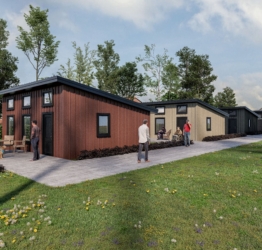
A narrow, awkwardly shaped piece of land on Claremont Street that once appeared unusable is about to become home to one of Worcester’s newest experiments in addressing homelessness among older adults.
City officials, nonprofit leaders and community partners are breaking ground Tuesday, May 19, at noon on the Seeds of Hope Tiny Home Village, a four-unit development designed to provide permanent supportive housing for homeless seniors on fixed incomes.
The project, located at 6 Claremont St., is being framed not just as a housing initiative, but as a test case for whether smaller, collaborative and potentially less expensive housing developments can help address a growing affordability crisis among older residents.
Tim Garvin, president and CEO of United Way of Central Massachusetts, told the Worcester Guardian the project grew out of both urgent need and unusual opportunity.
“Need married with opportunity to create this unique ‘demonstration’ project,” Garvin said. “My hope, our hope is that this could be replicated in other neighborhoods, other communities, other states.”
The tiny home village includes four homes serving seniors, including the possibility of couples, organizers said. Support services are expected to include medical and mental health care coordination and transportation assistance.
Garvin said the project emerged through what he called “the Worcester Way,” bringing together city officials, state leaders, nonprofits, architects, engineers, healthcare partners and funders.
Among those involved are former Worcester Health and Human Services Commissioner Dr. Matilde “Mattie” Castiel, former Senate President Harriette Chandler, state housing secretary and former Worcester City Manager Ed Augustus, city officials including Chief Economic Development Officer Peter Dunn and Chief Sustainability Officer John O’Dell, as well as the United Way and The George I. Alden Trust.
The city had acquired the parcel previously, Garvin said, but it was considered difficult to develop because of its unusual size and layout.
The project also arrives as homelessness among older adults continues to rise nationally and locally. Garvin pointed to a June 2025 NPR report describing seniors as the fastest-growing population experiencing homelessness in the United States.
“The challenges—fixed income with rapidly rising costs,” Garvin said.
Organizers say the project’s comparatively small scale is also part of the point. Garvin said the total development cost is expected to come in below the price of many traditional affordable housing units in Massachusetts, which he said often range from roughly $500,000 to $850,000 per unit.
Construction is expected to continue through the summer, with organizers hoping residents could move in this fall.
The project announcement describes the village as an “innovative Permanent Supporting Housing initiative” that combines modular construction with “brilliant design” to support “some of the most vulnerable, at-risk seniors in our area.”
Garvin said he hopes the project demonstrates that communities can rethink overlooked land and collaborate more creatively around housing needs.
“Worcester is a city that works together to address issues and improve lives,” Garvin told the Guardian. “And that this kind of collaborative effort can be replicated and make use of ‘un-usable’ property.”