
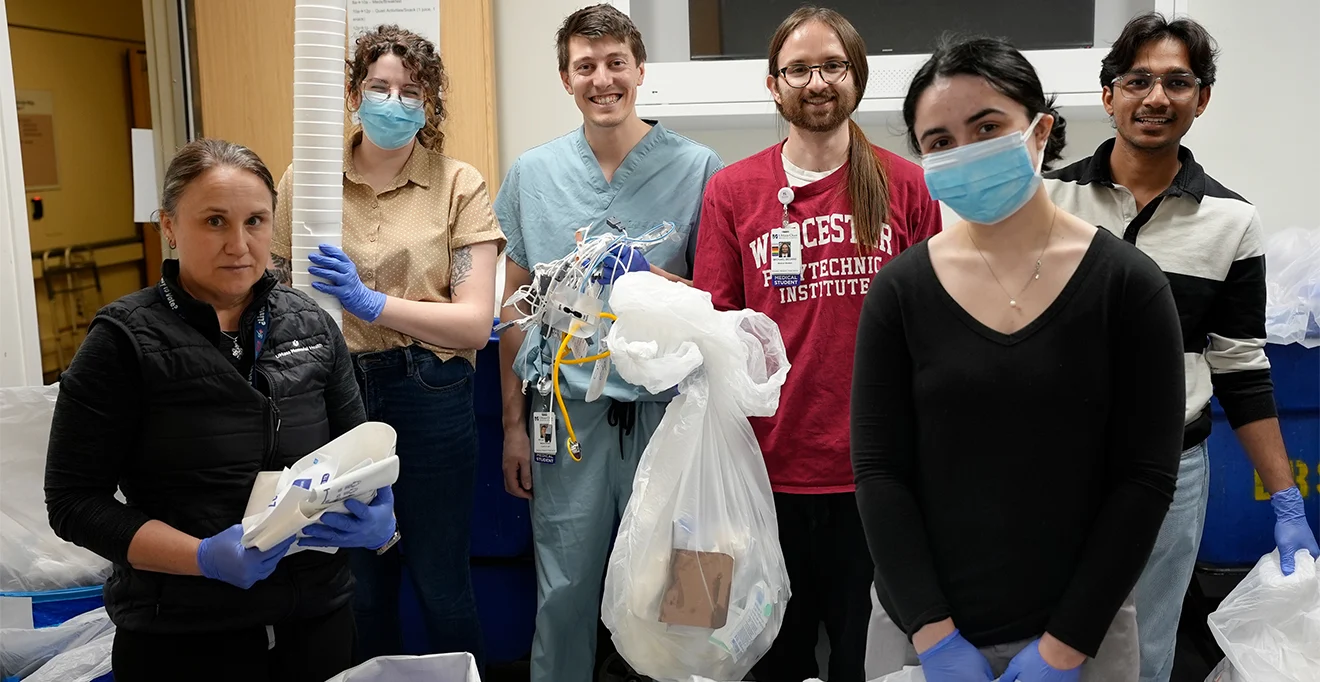
WORCESTER—At several Central Massachusetts emergency departments, a team of researchers and medical students is taking an unusual approach to improving health care: sorting through the trash.
Led by Hillary Irons, an associate professor of emergency medicine at UMass Chan Medical School and physician with UMass Memorial Health, the initiative is examining waste generated in five emergency departments across the system. The goal is to better understand what is being discarded — and identify opportunities to reduce waste, lower environmental impact and improve community health.
The project, supported by UMass Chan’s Department of Emergency Medicine and Office of Sustainability, comes as the health care sector faces growing scrutiny for its environmental footprint. According to data cited in the announcement, health care accounts for roughly 8.5 percent of U.S. emissions, contributing to air and water pollution and worsening conditions that can ultimately affect patient health.
“If we go through the trash and know what we produce, then we can take that data and use it to change things,” Irons said in a statement released by the institutions involved. “The health care sector contributes approximately 8.5 percent of the emissions in the entire country, which in turn worsens air quality, pollutes water cycles and contributes to weather extremes, which can further exacerbate many medical conditions. So, the waste from the care that we’re providing can make many medical conditions need more treatment. It’s a cyclical problem.”
Over nearly two years, teams of students, faculty and staff have measured waste collected at emergency departments in Worcester, Leominster, Clinton and Marlborough. The audits are designed to inform waste-reduction strategies and evaluate how effectively materials are being recycled.
Third-year T.H. Chan School of Medicine student Alexa Smith, who is helping lead the effort, said the scale of hospital waste far exceeds what individuals typically generate.
“I do all I can at home to reduce waste, but it pales in comparison to how much waste the medical system produces,” Smith said in the release. “The audit is a great opportunity to try and change the system or help make improvements in the hospitals that we work in to reduce waste where we can.”
During a recent 24-hour audit at the UMass Memorial Medical Center emergency department, volunteers sorted and weighed roughly 1,500 pounds of waste. That included 121 pounds of personal protective equipment, 82 pounds of recyclables, 37 pounds of unopened medical supplies such as syringes and gauze, and more than 14 pounds of unused food and drink items.
Third-year medical student Kyle Timmer said the findings highlight opportunities to reduce reliance on disposable products.
“Ultimately, we want to learn how hospitals can continue to provide the utmost care while minimizing the amount of waste generated,” Timmer said in the release. “We found a lot of different items, including single-use pulse oximeters and single use blood pressure cuffs—items that we already have reusable versions of—which can be considered an unnecessary source of waste.”
Kortni Wroten, a sustainability and energy manager involved in the effort, said the audits are a critical first step.
“You can’t manage what you can’t measure. The audit is about finding that measurement so we can use data to inform decisions related to waste reduction. This is our way of getting a more detailed view of the waste that leaves the emergency department,” Wroten said in the release.
Riley McLean-Mandell, medical director of green initiatives at UMass Memorial Health, said the work builds on broader sustainability efforts already underway across the system.
“This is one of the best ways to evaluate where to focus our energies. Audits like this have helped UMass Memorial clinicians make changes already, from materials used for draping surgical patients, to switching to reusable devices, but this is the largest, most comprehensive audit that I’m aware of,” McLean-Mandell said in the release. “The students and Dr. Irons have done a great job, and we look forward to collaborating with them on next steps we can all take to create a more sustainable environment across our organizations.”
Findings from the audits will be presented next month at the CleanMed conference in St. Louis, where researchers plan to share insights that could inform similar efforts at hospitals nationwide.
