
WORCESTER—In an agreement with Italy’s Ministry of Culture, the Worcester Art Museum (WAM) in Massachusetts has uncovered and addressed the illicit origins of two ancient Greek vessels in its collection, establishing a new model for cultural restitution and international cooperation.
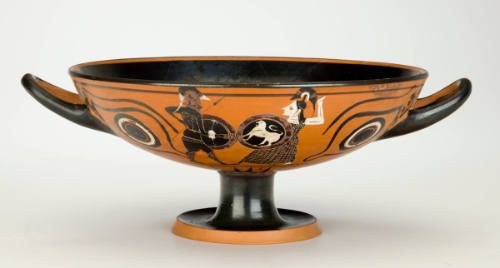
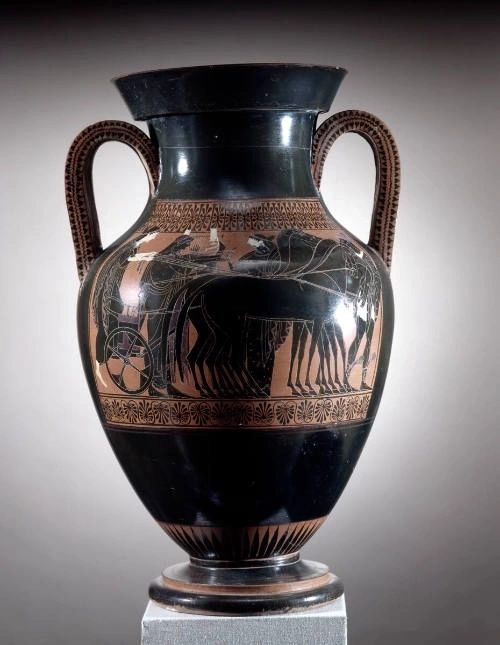
The objects in question—a black-figure amphora from 515-500 BCE and a black-figure kylix (drinking cup) from 500 BCE—were discovered to have been illegally removed from Italy. Rather than immediate repatriation, the agreement allows WAM to retain the artifacts for four to eight years as a long-term loan, after which they will be exchanged for comparable Italian antiquities in a rotating arrangement.
The discovery emerged from systematic research conducted by WAM Provenance Research Specialist Daniel W. Healey, who joined the institution in early 2024.
“My responsibilities include researching the provenance of objects in the museum’s collections,” Healey said, “assisting curators to research the provenance of new acquisitions, and sharing collecting histories with Museum audiences in our galleries, publications, and online.”
During a routine database search, Healey found connections to Robert Hecht, a dealer notorious for trafficking in looted antiquities.
“When we performed a search for ‘Robert Hecht,’ the black-figure amphora came up. That initiated a more intensive investigation into this object and Hecht’s role in its provenance,” Healey added.
When Healey dug even deeper, he found that both artifacts shared a complex ownership history, noting that the museum purchased the amphora from a woman named Elie Borowski in Switzerland in 1956.
“Going through the Museum’s records on the amphora, however, two things became clear,” he said. “The amphora shared a provenance with a second Greek vase in the collection, the black-figure kylix, which Borowski gifted to the museum in 1956 at the same time he sold us the amphora; and Borowski acquired both the amphora and kylix from Robert Hecht.”
WAM confirmed the findings and promptly contacted Italian authorities, armed with photos and documentation. The Carabinieri quickly confirmed that both vessels were listed in their database of stolen cultural property.
The resulting agreement represents an innovative approach to cultural heritage management. “Under the new Cultural Cooperation Agreement, the museum has formally transferred ownership of the amphora and kylix to the Republic of Italy,” Healey said. “The museum will retain both objects as loans from the Republic of Italy for the first loan period of four to eight years. After that, these objects will be returned to Italy in exchange for new long-term loans of antiquities from Italian museums.”
This arrangement extends beyond simple object exchange. In addition to loans, the agreement also covers other types of collaboration between the Worcester Art Museum and the Italian Ministry of Culture going forward.
“For example, the ministry has agreed to assist the museum in vetting any potential loans or acquisitions of Italian antiquities,” said Healey.
The artifacts can now be viewed in WAM’s While We Build gallery, where they serve as educational tools about both ancient Greek culture and modern museum ethics. “Displaying these two objects as loans from the Republic of Italy has provided us with an exciting opportunity to recontextualize them for our visitors,” Healey said. “While short descriptive labels offer insights into each object’s original function and iconography, an additional label discusses their provenance, the museum’s decision to voluntarily return them to Italy, and the museum’s new Cultural Cooperation Agreement with Italy.”
Looking forward, “Provenance research [at WAM] remains a priority at the Worcester Art Museum,” Healey affirmed. “If we identify other artifacts that require special scrutiny in future, we will follow a similar process of research that we did here, and will announce the outcomes of our work when the time is right.”
Through this agreement, WAM hopes to establish and follow a model that benefits both source countries and current holders of contested cultural property while serving the public interest in cultural education and preservation.
Matt Olszewski is a freelance content and news writer based in Boston, MA. In his free time, Matt enjoys running, hiking or skiing. Matt just graduated with his MPH from Tufts University. He can be reached at mattoskier@gmail.com