
WORCESTER—Worcester has crossed over into billion-dollar territory.
City Manager Eric D. Batista on Friday unveiled a proposed $1 billion operating budget for Fiscal Year 2027—the first in the city’s history—a milestone that reflects both Worcester’s rapid growth and the rising cost of maintaining it.
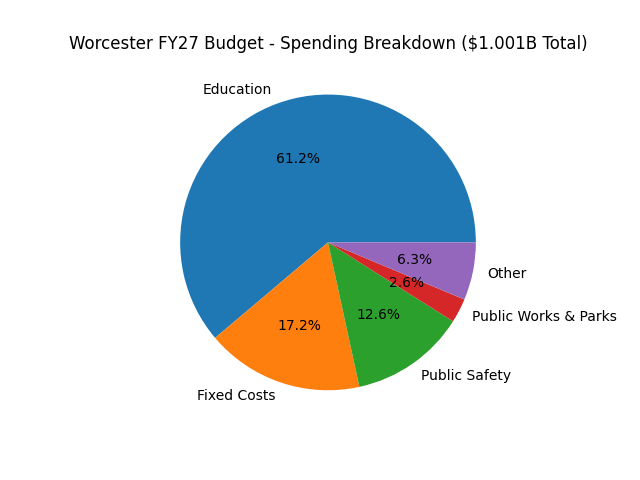
The budget, driven in part by increased state aid through the Student Opportunity Act, higher property values and continued private investment, signals a city that is expanding—but also facing mounting pressure on infrastructure, services and long-term planning.
Batista framed the proposal around the theme “Funding the Future: Smart Spending, Stronger Outcomes,” focusing on stability and forward-looking investments even as financial constraints limit expansion in other areas.
“This year’s budget is built on a simple but powerful principle: smart investments today create stronger outcomes for our community tomorrow,” Batista said in a statement. “By focusing on thoughtful planning, responsible spending, and long-term value, we are ensuring that every dollar contributes to a safer, more resilient, and more efficient city.”
What’s fueling the billion dollar budget
Crossing the $1 billion threshold is less about a single spending decision and more about years of compounding factors: rising property valuations, sustained development and significant increases in education-related state aid.
At the same time, the number mirrors a reality facing many municipalities—that maintaining existing services, infrastructure and staffing levels is becoming more expensive year over year.
Despite the record-setting total, the proposed budget includes no net new positions, a sign of those constraints. Instead, the administration is shifting resources from vacant roles to targeted hires, including new inspectors aimed at speeding up permitting and a position focused on small business support. Unrepresented employees would receive a 2% cost-of-living adjustment under the plan.
Infrastructure spending at the heart of the budget
Where the budget grows most aggressively is in capital investment.
The proposal includes a $46 million increase—about 41%—in the capital budget, with a heavy focus on roads, sidewalks and public works equipment. That push comes after a punishing winter—the eighth snowiest in Worcester history—that exposed ongoing weaknesses in road conditions and strained city operations.
To address that, the administration is proposing an $11 million increase, or 66%, in borrowing for the Department of Public Works. The funding would go toward street and sidewalk repairs, equipment purchases including snow removal gear, and improvements to facilities. The plan also expands hours at the Millbury Street drop-off center, a smaller but tangible operational change aimed at improving service access.
Public safety and schools remain priorities
The budget directs major capital funding toward public safety infrastructure, including a $25 million investment in a new South Division fire station and an additional $5 million for upgrades to Worcester police headquarters.
At the same time, the city is proposing a $10 million increase in funding for school building projects. That includes closeout costs for Doherty Memorial High School, the start of a feasibility study for Burncoat High School, and accelerated repair work at Belmont Street Community School and Rice Square School.
Growth, but with limits
Even as the city continues to grow, the budget reflects a cautious approach.
There are no broad expansions in staffing, and new investments are tightly targeted—a strategy that shows city’s effort to balance competing demands: maintaining services, improving infrastructure and avoiding overextension.
Batista pointed to the city’s stable bond rating and increased levy capacity as signs Worcester remains on solid financial footing. But the broader message of the budget is clear—growth alone does not ease pressure; in many cases, it intensifies it.
What comes next
The proposed budget now moves to the Worcester City Council for hearings and revisions before a final vote.
For residents, the billion-dollar figure may stand out. But the more immediate impact will come down to how those dollars translate — smoother roads, faster permitting, more reliable services—and whether the city can keep pace with its own momentum.
Charlene Arsenault can be reached at carsenault@theworcesterguardian.org
