
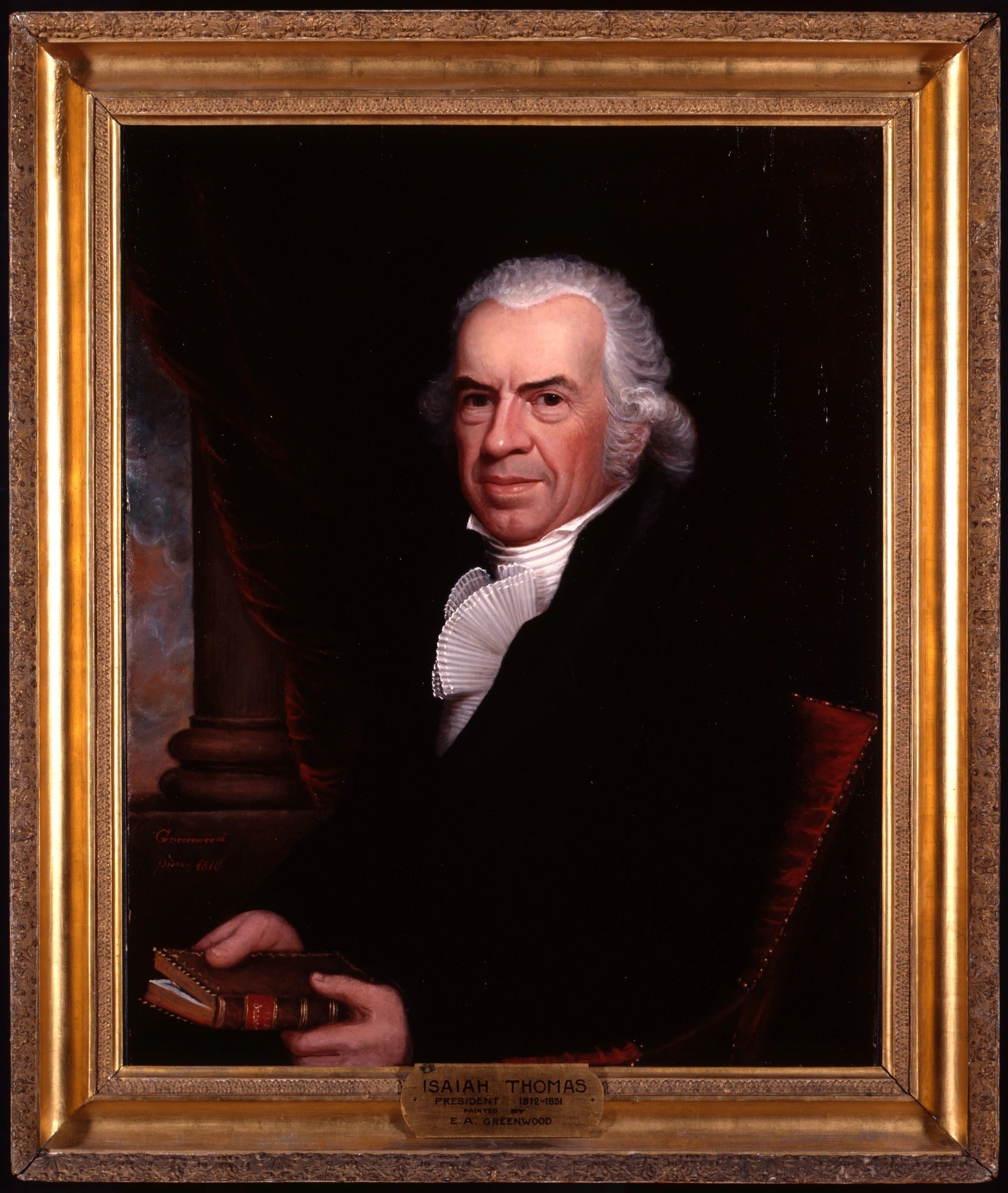
WORCESTER—When people today hear the name Isaiah Thomas, they are likely to think of a well-known professional basketball player—not a Revolutionary War hero. But Isaiah Thomas is also the name of one of the most influential figures in the nation’s fight for independence, a legendary printer and collector, and the founder of the American Antiquarian Society, a national research library in Worcester.
That Thomas’s life is a true rags to riches story. Born poor in Boston in 1749, he was apprenticed to a printer at the age of six after his father abandoned the family and his mother could no longer support him. His formal education consisted of “not more than six weeks’ schooling, and poor at that,” he would record later in life.
Thomas taught himself to read, learning his letters by typesetting broadsides, newspapers, and other publications, which were printed on an English-made wooden common press. In time, he became an accomplished printer and astute businessman, buying out the shop in which he was originally apprenticed and publishing what was to become one of the most important and long-lived of American newspapers: The Massachusetts Spy.
He also became a sharp critic of the British and staunch supporter of independence, along with other Boston patriots such as John Hancock and Paul Revere, according to Scott Casper, president of the American Antiquarian Society (AAS), “Thomas used his publications, especially the Spy, to undermine British authority,” he said, “and rouse his fellow citizens to the Patriot cause, risking both his business and his life to do so.”
The story of how Thomas ended up in Worcester reads like a thrilling adventure. Fearing his printing press would be seized by the British, Thomas smuggled it out of Boston on the night of April 16, 1775. With the help of two friends, he packed the dismantled press onto a wagon and ferried it across the Charles River to Charleston. The friends then carted it off to safety in Worcester. Three days later, Thomas witnessed the Battles of Concord and Lexington, which launched the American Revolution. On May 3, 1775, he published the first Worcester issue of The Massachusetts Spy─-the first thing ever printed in the city—which included his account of the battles.
Thomas remained in Worcester, continuing to support the war for independence and building his printing business. He also began a practice that showed remarkable foresight and cemented his legacy, according to Lauren Hewes, vice president for collections at AAS. “During the Revolution, Isaiah Thomas recognized that he was living in a significant time, and he began collecting printed materials. It was important to him to save the evidence of how the colonies became a country and to preserve the thoughts and actions of the people who had helped achieve independence,” she said.
Thomas’s collections began with swapped newspapers. “He would send an issue of the Spy to another publisher and ask for an issue in return,” Hawes explained. “Then he saved the swapped papers. He kept doing this as the young nation grew, obtaining newspapers from across the country.”
Collecting newspapers expanded to saving anything that had been printed in America. “Thomas didn’t just collect fine press. He was interested in everything. He believed that to preserve a complete history of the country, all the printed evidence had to be saved,” Hewes said. This ranged from published materials, such as books and newspapers, to things that were meant to be used just for a short time, such as broadsides, theater tickets, and penny sheets.
Hewes explained that printed ballads, or so-called penny sheets, are a good example of Thomas’s collecting philosophy. “After theater performances, patrons could buy the lyrics to music they had just heard,” she said. “These were sold cheaply on the street by ballad sellers. They weren’t meant to be saved yet Thomas collected more than three hundred of them and bound them for safekeeping, labelling the volumes “verses in vogue with the vulgar.” Many are the only known copies of these songs.”
In the early 1800s, after earning his fortune and passing his business on to his son, Thomas embarked on another monumental project. “He had spent his whole life in the American printing trade and believed its history needed to be written before the facts were lost,” said Casper. Thomas spent two years writing the History of Printing in America, using his own library of 8,000 volumes as the basis for his research. The two-volume book, published in 1810, is still used by print historians today.
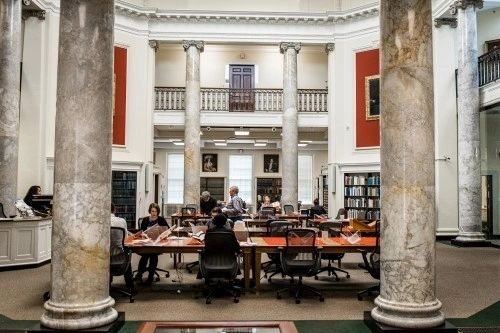
Writing the History of Printing in America inspired another chapter in Thomas’s life. In 1812, acting on his strong belief in the need for a national library of the historical record, he and five partners founded the American Antiquarian Society. Thomas’s personal collections provided the foundation for the library, now located at 185 Salisbury St. The library has grown to be the world’s largest collection of printed, handwritten, and visual materials from before 1900 in what is now the United States. The newspaper collection alone, which began modestly with Thomas’s swapped papers, now stands at two and a half million issues.
“We are fortunate that Isaiah Thomas believed in saving the infinitely varied evidence of the nation’s history for future generations,” said Hewes. “Because he cast such a wide net, he captured the voices of people from all walks of life and backgrounds. Some of those voices have been silent for centuries, but because they are preserved in the primary sources stored at AAS–diaries, letters, books, newspapers, photographs, penny sheets, etc.—those voices can be found and heard by anyone who chooses to look for them.”
The public can learn more about Isaiah Thomas and the American Antiquarian Society during an open house on Saturday, April 12, 2025, from noon to 4 p.m. The free event commemorates 250 years since Isaiah Thomas brought his printing press and newspaper to Worcester―a move that helped shape the American Revolution. The event includes activities for all ages, including operating a full-size replica of an eighteenth-century wooden printing press; chatting with curators and getting up close to a variety of original printed materials from the Revolutionary War; touching a variety of early publications in a paper petting zoo; and taking a guided, behind-the-scenes tour to see how AAS stores and preserves its vast collections.
This article is part of an ongoing, monthly series supplied by the American Antiquarian Society that focuses on the society’s collections and how they deepen the community’s understanding of Worcester’s–and the American–past. Through wide-ranging programs, community engagement, and research support for scholars and students, the AAS works to cultivate a broad community of inquiry―locally and nationally.
- The Worcester Guardian is an independent nonprofit news organization. Support local journalism by making a DONATION today.
