
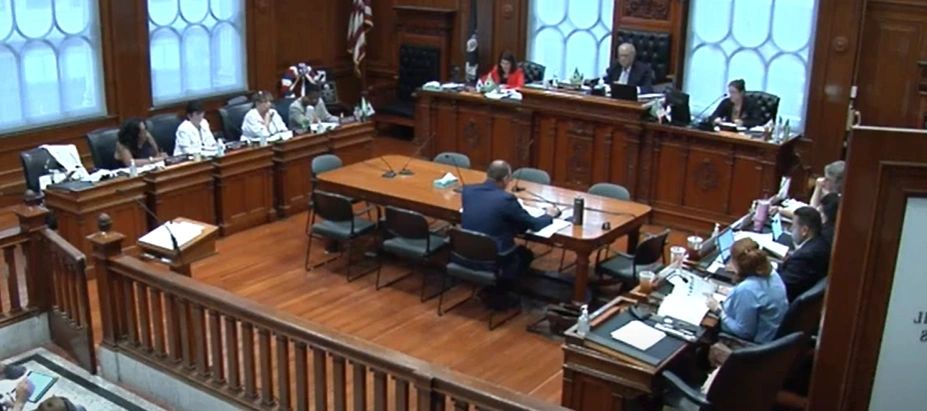
WORCESTER—The amount allocated for instructional materials, administrative salaries and climate and culture specialists commanded by far the most attention at Thursday’s 2024-25 budget meeting of the Worcester School Committee, with Maureen Binienda and Dianna Biancheria arguing for a shift of some of those monies to support teachers and students.
Motions put forth by Binienda and Biancheria in an attempt to address a projected $22 million budget deficit for next school year were all defeated on a 6-3 vote.
Kathleen Roy joined Binienda and Biancheria in supporting their request that several hundred thousand dollars be moved from the aforementioned accounts and put toward per-pupil spending, special education and elementary teaching positions.
Superintendent Rachel Monárrez and her administrative team were subjected to a barrage of questions from Binienda and Biancheria over the course of late-afternoon deliberations that got testy at times.
In her own introductory remarks, the superintendent said this has been one of the most challenging years of her educational life. She pointed out that “we have advocated for a higher inflation rate with the state. It angers me, but as your superintendent I have to carry this burden” with the reductions that are on the table.
She encouraged members of the school committee to take into consideration that “the fingerprints and voices of hundreds of people” have gone into creating the fiscal blueprint, and that “efficiencies and streamlining” have been put into place as the budget moved along the path to acceptance.
In her preparatory comments, Monárrez urged school committee members to base their queries on “facts.” She repeatedly responded to questions from Binienda and Biancheria with the phrase “for clarity,” as a way of addressing their concerns, which she implied were misplaced.
Binienda and Biancheria stated their cases forcefully.
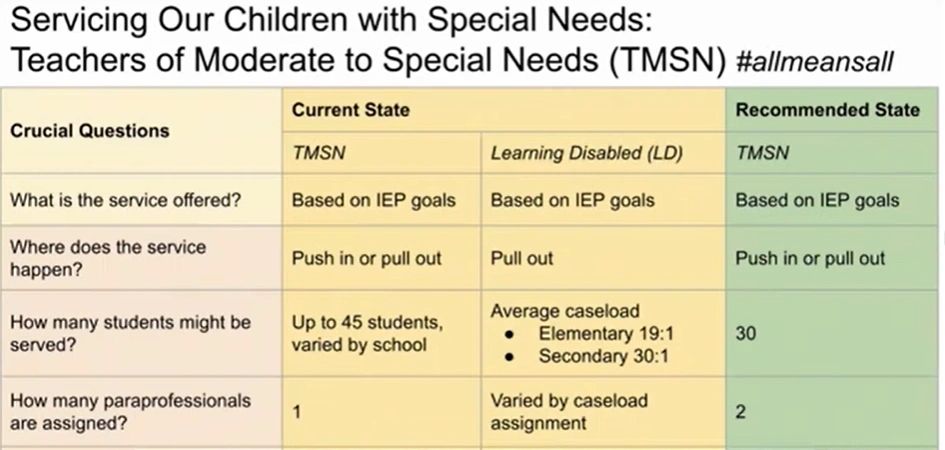
In asserting that $250,000 ticketed for administrative salaries be moved to the special education salary account for “kids in transition” age 18 to 22, for instance, Binienda said “these are nice positions when you have the money, but we don’t. Kids in transition need the extra help.”
If “big thinking” is guiding things, “maybe we need to rethink” that approach, she said.
Biancheria honed in on the same item with a question about how many dean of students are “certified in administration.” This year, she was told, 98% are DESE-certified. Frustrated by how long it took to get an answer, Biancheria remarked “after five tries asking the same thing…”
Biancheria also asked “if the new citizens’ center has gone from 25 to 19 employees, what are we accomplishing?” She was told that of the 110 students enrolled in the new citizens’ center, 30 are being transitioned to a comprehensive high school, leaving about 70, but that number is in flux. She noted too that “we are updating the model.”
The superintendent also defended the system being used to move kids in transition along as fast as possible, saying “it’s detrimental to keep students away from their English-speaking peers.”
Biancheria responed, “I just want to ensure that we are continuing to build. No counselors and no history and social studies teacher? I don’t want to lose this program and that’s what it comes down to.”
Mayor Joseph Petty, who chairs the school committee, said Monárrez has brought “a new set of eyes” to the structure of the district, with good results in her first two years on the job.
Binienda and Biancheria both weighed in on climate and culture specialists. Binienda expressed concern about these jobs and requested that money for 21 new climate and culture positions be moved to special education.
But Molly McCullough quickly countered. Educators throughout the system say that the climate and culture position is one of the best additions to the system in more than 20 years because of its impact and difference it makes in the schools, she said.
Biancheria said “$1.169 million, all for nonteaching positions, we are looking at glorified bouncers in our schools. No one in uniform or associated with the police department, or security. We are losing classrooms, elementary teachers, high school teachers.”
She made a motion that money earmarked for seven climate and culture specialists be “brought back to teacher salaries.”
Jermaine Johnson objected, maintaining climate and culture specialists are needed. He said, too, that the number of administrative positions has been increasing for years, predating Monarrez’s arrival.
Binienda said there is a misconception about climate and culture specialists. “They are not trained professionals. Put teachers back in the schools.” To which Biancheria added “I’m looking for middle ground, spread the money around a little differently.” She made a motion for seven positions to be funded for MCAS tutors or literacy tutors.”
Rod Lee is a career journalist, a veteran of the media scene in Central Massachusetts and the author of seven books including the recently published “Gil Cristopher,” a novel about the difficulties associated with aging. He can be contacted at rodlee1963@gmail.com
