
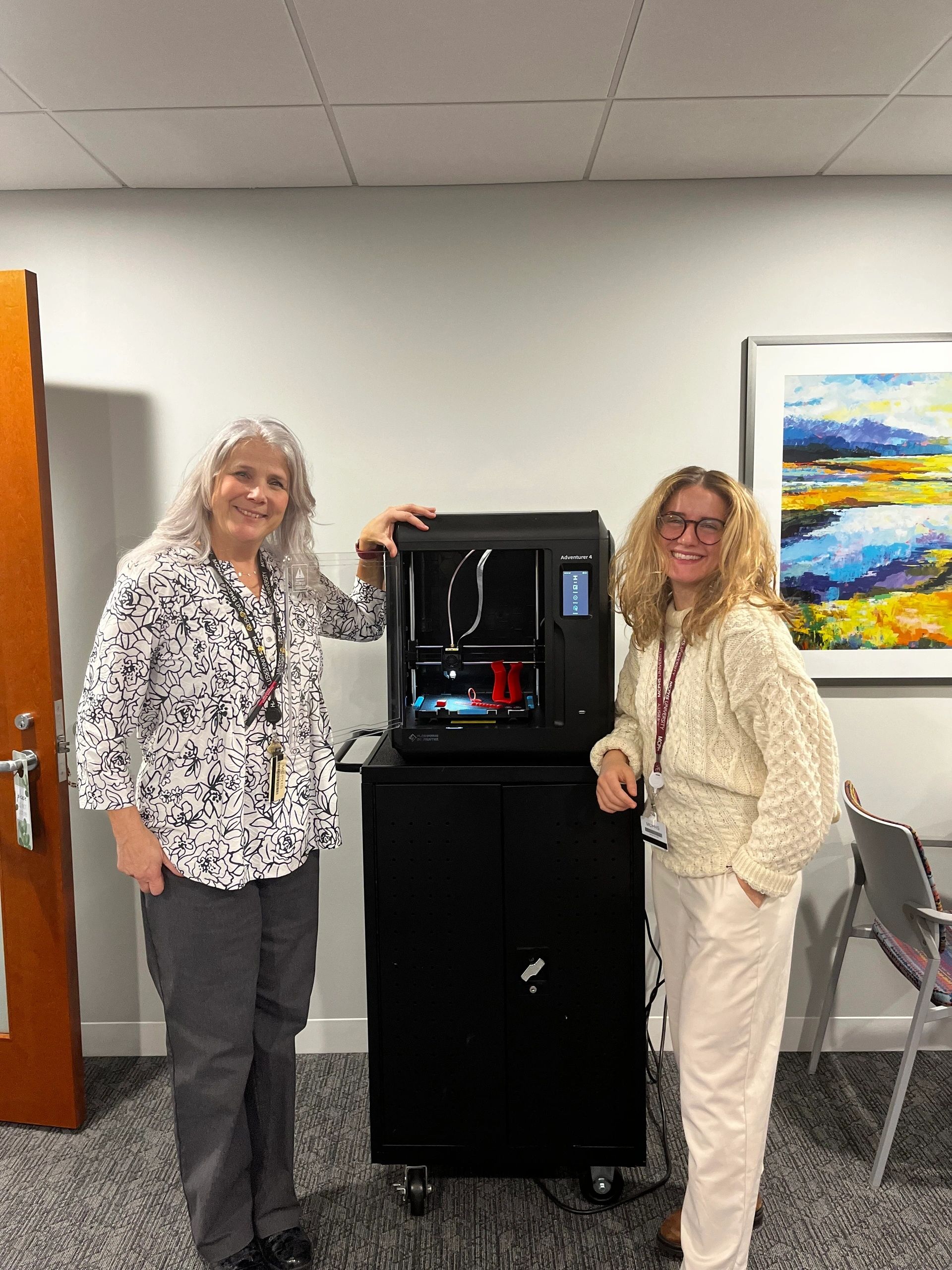
WORCESTER—Michelle Dowling, OTD, said that occupational therapy has been regarded as a “high-touch, low-tech profession.”
But the Massachusetts College of Pharmacy and Health Sciences (MCPHS) assistant professor’s interaction with an OT conference vendor is transforming that description.
“I met this gentleman in 2023 from the Perkins School for the Blind with 3-D printed stuff on the table including phone stands,” Dowling explained. “I thought, `What does Perkins School have to do with 3D printing?’”
Dowling learned that the stand helps people with low vision hold their phones at an appropriate distance while reading text. A certified hand and low vision therapist, Dowling began envisioning how 3D printing could create customized accessibility devices to benefit patient care as well as serve as learning tools for MCPHS students.
What Dowling knew about 3D printing previously was through her daughter, who used 3D modeling software in engineering classes at Worcester Polytechnic Institute (WPI).
She teamed up with Danielle Amero, OTD, assistant professor of occupational therapy at the MCPHS Manchester campus, to explore ways the technology could work in their Environments and Technologies classes.
They also identified the most appropriate printers, both by cost and decibel volume.
With support from program director Doug Simmons, they pitched the idea to faculty on both campuses. It was met with positivity about the practical and educational possibilities.
“We had the perfect conglomeration to get this going,” Dowling said.
Each site received a 3-D printer with which to work.
With labs created at both campuses, Dowling said her Worcester students’ initial reaction was “`We’re going to do what?’ They were unsure and thought this might be bigger than what they are cut out to do.”
“The energy in the class that day was daunting,” recalled student Jaiden Mayo about her experience the previous year. “It was a scary concept that seemed complicated…But once we got into it, we started having fun and it was exciting to work with this new material.”
“Our students are making immediate changes after one year,” concurred Dowling. “They see the benefits of learning new things. Technology is here to stay and an important part of healthcare.”
Lower cost and flexibility to meet patients’ needs of all ages are among the advantages of 3-D printed devices, according to Dowling and Mayo.
Examples include fidgets for students with Attention Deficit Hyperactivity Disorder (ADHD); button grip aids for people with arthritis and splints.
Armed with knowledge from the Environments and Technologies class, Mayo was on level one pediatric rounds at Worcester Arts Magnet School Transitions Program where she met a speech and language pathologist.
The speech and language pathologist told her about a client with communication problems who relied on an Augmented Alternative Communication (AAC) device. The individual was having difficulty clicking on the button that would select the correct words.
“I might be able to help,” Mayo thought, by creating a key guard to help improve accuracy (while guiding the person’s touches to activate a command or generate speech).
With support from Dowling, Mayo got to work using the computer-aided design (CAD) software she learned in the MCPHS lab to make mock ups and create different dimensions which she is sending back and forth to the speech and language pathologist to ensure the best fit.
The process involves the 3-D printer reading the CAD file like a recipe and producing an object with the heat-activated plastic stored in the printer.
In addition to OT items, Dowling has used the technology to make a tactile model of the brain and spinal column for students in a neuroanatomy course.
In the future, she envisions 3D printing being helpful in other areas like physical therapy and optometry at MCPHS.
“There’s a constant evolution…coming up with ideas in exact moments, AHA moments,” Dowling added.
“We’re changing the high-touch, low-tech landscape with creativity by using every ounce of technology we can,” she said.
“By making adaptations for accessibility, we can think of new ways to help people,” Mayo added.
In the spring 2025 semester, a second group of students will be introduced to 3D printing in their OT Environments and Technologies class.
To those peers, Mayo said, “Get comfortable being uncomfortable. I was not sure I had the skills at first but where there is a will…It is possible if you care and want to try.”
Susan Gonsalves is currently editor-in-chief of a mental health trade journal and a freelance writer/editor specializing in education, medical/health and business. She previously worked at the University of Massachusetts Dartmouth and has contributed to publications at Worcester Polytechnic Institute and College of the Holy Cross. At the Worcester Telegram, she covered the town of Leicester and wrote for Business Matters. She can be reached at smgedit@comcast.net
As the Worcester Guardian marks a year of delivering free, independent digital news to our city, our dedication to this mission strengthens. Please consider a tax-deductible donation to support our ongoing commitment to providing hyperlocal news coverage to Worcester. Scroll to the bottom of our home page to sign up for our daily newsletter
