
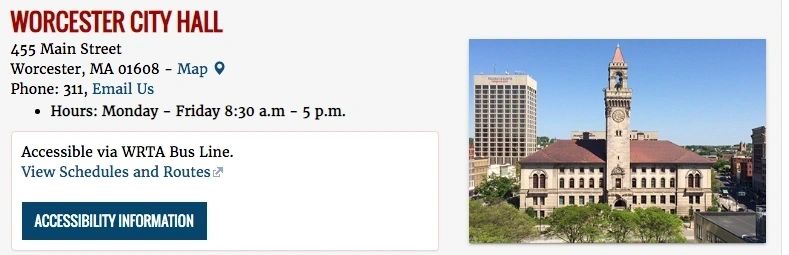
WORCESTER—At WorcesterMa.gov, you don’t always get an answer, at least according to a month-long study conducted to test such things.
Nearly 30 percent of city departments contacted failed to respond to simple email test queries.
WorcesterMa.gov, the official website of the City of Worcester, can serve as a pipeline to the public, allowing citizens and their government to interact in a quick, convenient, cost-effective manner.
Through the portal, citizens can ask questions, submit complaints and make requests for help to officials, among other communication. But a test in October of the responsiveness of Worcester city officials found that simple questions emailed to them by a Worcester Guardian reporter often fell on deaf ears. (The reporter did not identify himself in order to make the test more realistic.)
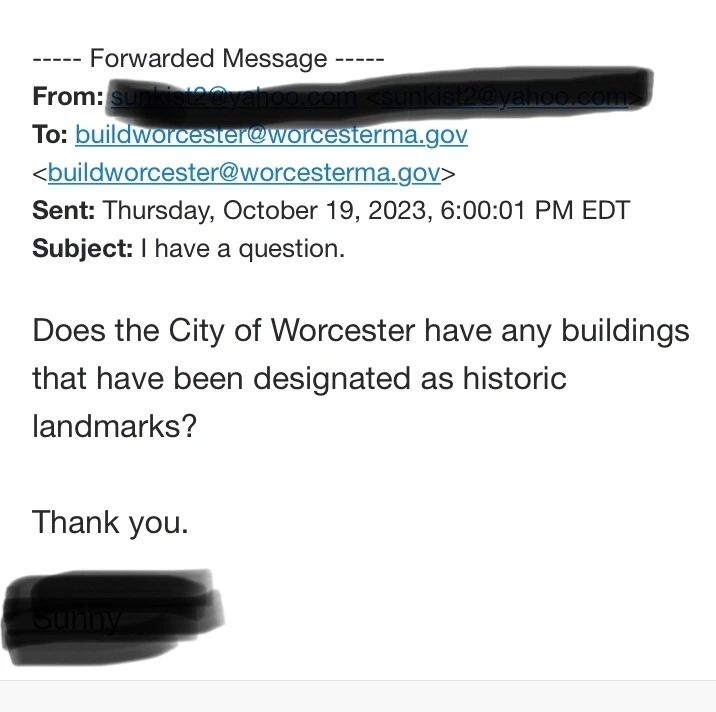
About 30 percent of the 38 city departments contacted failed to respond to the test email inquiries.
- Health and Human Services, for example, neglected a question about finding a doctor in Worcester. (HHS finally responded, but only after a reporter called and pointed out the department’s lack of a response.)
- The Fire Department ignored a request for information on buying a fire extinguisher.
- Worcester Public Schools failed to respond to a question about getting an appointment with the superintendent.
- Administration and Finance (Purchasing) neglected an inquiry asking if any preferences are given to minority bidders.
- Youth Opportunities ignored a request for help finding a job for a teen.
- Workforce Development failed to respond to a request for help preparing a resume.
Other city departments that did not respond to the test email inquiries were the City Auditor, the Law Department, Public Facilities, Economic Development, and Innovation and Technology. (The city auditor and I&T responded after a reporter called and pointed out the department’s lack of a response.)
Some city departments that did respond to the email inquiries were relatively slow in responding. Cultural Development took five business days to respond; Emergency Management, four business days; and Human Rights, three business days.
All the non-responders were contacted for explanations
All the non-responders were contacted by phone for explanations. Now identifying himself as a reporter, messages were left for them with the details of the test emails and asked to call back. Only four did:
- Christopher Gagliastro, director of A&F’s purchasing department, said that he had drafted a response to the inquiry sent to his office, but then forgot to send it.
- Jeffrey Turgeon, the executive director of Workforce Development, said the inquiry sent to his department “fell through the cracks.” Knowing that, he said, “will help us solve a problem we didn’t know existed.”
- City Auditor Robert Stearns responded that his department had changed over to a different email system, but hadn’t made the corresponding change on the city’s website.
- A webform was used to submit the email inquiry about getting an appointment with the superintendent to Worcester Public Schools that was ignored. Dan O’Brien, the chief communications officer for the district, explained that an upgrade to the school system’s website is in the works. “When the superintendent [Rachel Monárrez] started a little over a year ago, she recognized that there was an issue with communication with the public,” O’Brien said. “So we are now in the process of making a lot of improvements in that area by getting feedback from the community.”
City: Two of the emailed inquiries were ‘quarantined’
The City of Worcester declined requests for an interview, including one with City Manager Eric Batista. Instead press official Thomas Matthews issued a prepared written statement saying that two of the emailed inquiries were “quarantined” because they were received in quick succession and had a “suspicious nature” pertaining to the content and the address.
The email messages sent to the Economic Development Office and the Law Department were from an innocuous Yahoo email address. The email inquiry sent to Economic Development sought information on programs to help small businesses. The email to the Law Department asked for information on how to make a claim against the city.
“The municipality values engagement with residents, evidenced by the recent launching of Worcester 311, a new [for the city] one-stop resource for all non-emergency questions,” Matthews said.
In contrast to the non-responders, a number of City of Worcester departments experienced no problems responding to the test email inquiries.
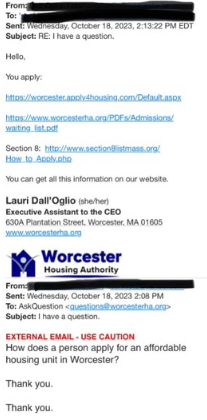
Quickest response from the Worcester Housing Authority
The quickest response came from the Worcester Housing Authority, in which executive assistant Lauri Dall’Oglio responded within five minutes to a question seeking information on how to apply for affordable housing in Worcester.
Close behind was the Elections Commission, which responded in 13 minutes to an inquiry about how to get a job working at the polls. Shannon Emmons provided detailed information on the job description, salary, and working hours.
The Worcester Police Department took 21 minutes to respond to a question about the towing of abandoned vehicles. An unsigned response provided a link to the requested information.
Other city departments that responded in less than an hour include Human Resources, Licensing, Parking, Parks, Planning, Public Health, and Treasury.
Batista and Petty’s offices responded to inquiries quickly
City Manager Batista’s office responded in 70 minutes to an inquiry concerning the city budget. Mayor Joseph Petty’s office responded in 1.5 business days to a question regarding how the jobs of mayor and city manager differ. And City Clerk Nikolin Vangjeli responded in 6 hours and 10 minutes to a query asking whether he marries people, which is actually allowed by state law (he does).
Members of the City Council and School Committee were both asked whether citizens are allowed to speak at their respective meetings. At-Large Councilor Khrystian King never responded, and said that he did not get the email inquiry. It was then forwarded to him as proof that it was sent, but the reporter never heard anything further from King.
School Committee member Jermoh Kamara responded in two business days to the email inquiry sent to her. The rest of the councilors and School Committee members responded in a matter of hours or less.
Some responses did not contain names or phone numbers
A number of the responses that came from city departments did not contain the names, the phone numbers, or both of the employees who responded to the inquiries. This includes Treasury, Assessing, Parks, Parking, Licensing, Police, and the Worcester Public Library.
“Leaving your name off an email is cold and impersonal,” argues Jeff Toister, author of “The Service Culture Handbook.”
“The only logical reason for doing it is to avoid any accountability for the service you provide,” he said. “Customers are more likely to appreciate and trust a message that comes from a specific person.”
Toister points out that adding a phone number gives people extra assurance that they can contact someone directly if they need additional help.
He also recommends that government entities state on their websites when citizens can expect to hear back. “When people know how long something is going to take, they are far less likely to grow inpatient,” he says.
The big question is how fast should city officials be expected to respond to emails from constituents?
“The old standard of one business day is out the window,” Toister says. “It comes from a time when people would check their personal email just once a day.”
Toister’s current opinion: One hour, no more.
Colman M. Herman is a freelance investigative reporter. Most recently he has been writing about sexual misconduct and bullying at Boston Public Schools. He broke the story on the City of Boston refusing to release a critical report on sexual misconduct and bullying at the Mission Hill School in Jamaica Plain. He can be contacted at colman@verizon.net