
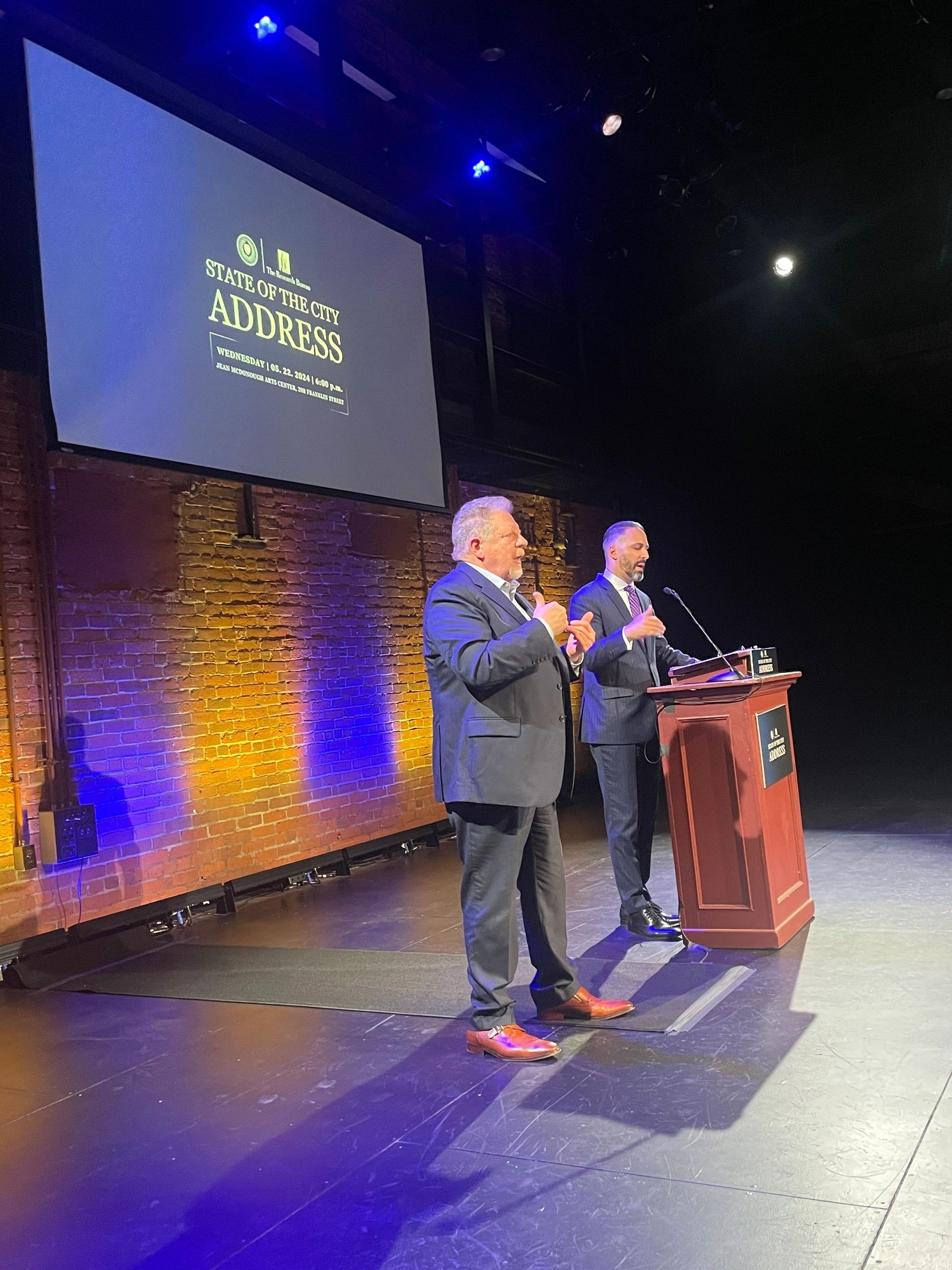
WORCESTER—Worcester continues to grow, adding an estimated 1,100 residents since the 2020 Census, to boost the population in New England’s second-largest city to 207,621.
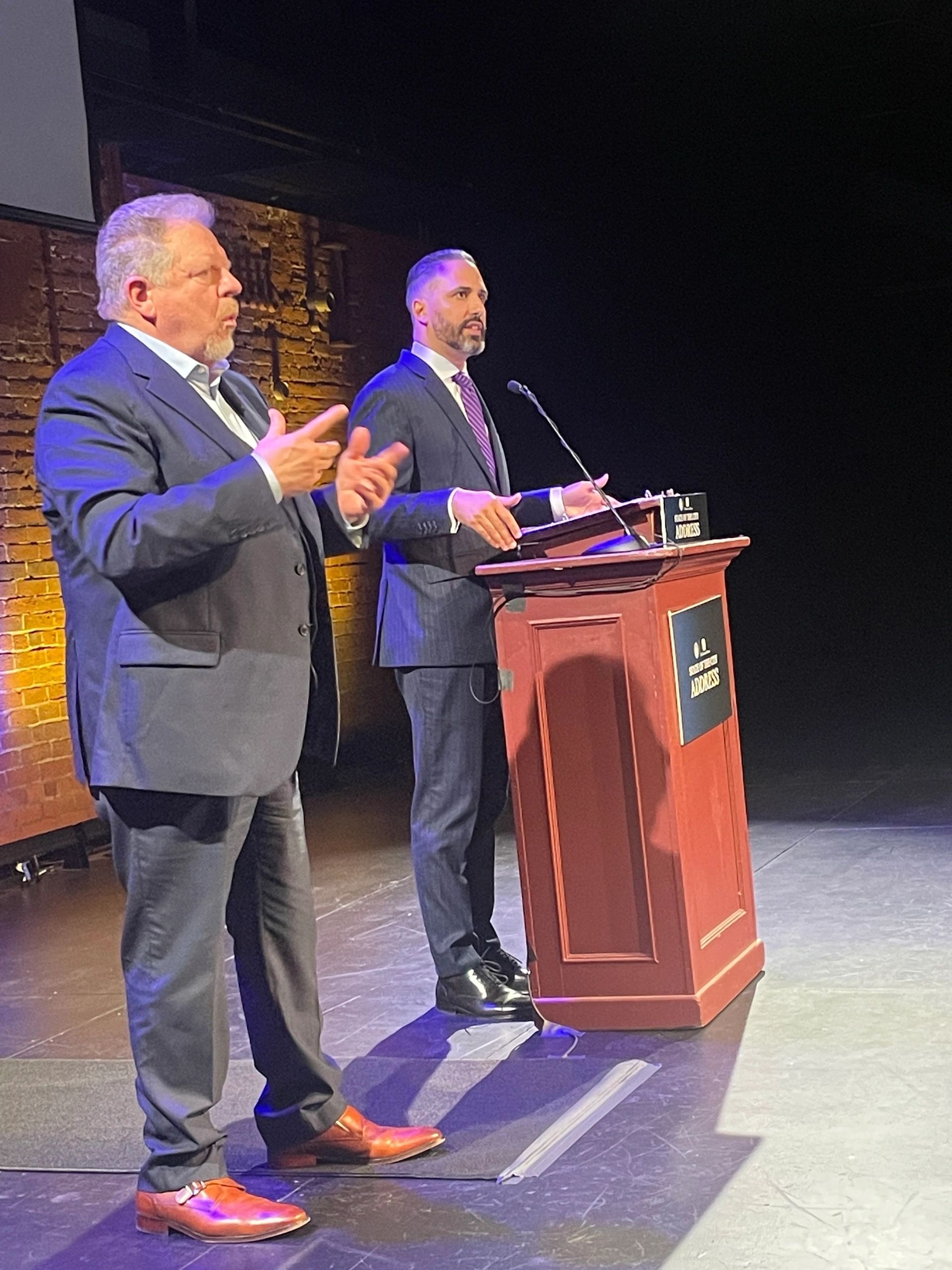
For that growth to continue, more housing and jobs are needed, City Manager Eric D. Batista said during his first State of the City Address Wednesday night at the Jean McDonough Arts Center.
“Right now, housing is the No. 1 priority,” he said in response to a question from the Worcester Guardian after his 37-minute address. “We need to provide more supply, we need to produce more units.”
Batista mentioned that in the last few months, Alta on the Row, the Revington and Sudbury Street Lofts brought more than 700 new units to the city and thousands more are at various stages of construction, permitting, and financing. Nevertheless, more units are needed.
Batista pointed out that Worcester has one of the lowest vacancy rates in the nation, but homelessness has nevertheless increased and more residents feel vulnerable each day. Since 2020, the city has launched at least 10 new programs such as Affordable Housing Preservation, Down Payment Assistance and Lead Abatement to address those needs and they are now unified by a comprehensive city-wide housing strategy to increase pathways to home ownership, address housing stability, reduce homelessness and protect tenants.
The Rental Registry aims to ensure that the 50,000 rental units in the city meet sanitary, fire and building codes to protect the safety of tenants, owners, inspectors and first responders.
“The registry will save lives and that is priceless,” Batista said in his address.
Batista reported that since the Housing First Task Force convened, the city has added 43 new permanent supportive housing units, and 152 more are planned.
The creation of the Permanent Supportive Housing and Services Group led to the opening of the emergency winter shelter known as the Restore, Motivate, Validate (RMV) Shelter in the former Registry of Motor Vehicles building.
Batista said his office plans to open a day resource center to provide unhoused individuals with housing, employment, income and health services.
He said the city also needs to provide more affordable housing to keep graduating students and working professionals here.
Batista announced a goal of adding 10,000 new jobs in Worcester by 2030, which he acknowledged will be more difficult to attain because of people working remotely at home. Nevertheless, he believes the goal can be reached with the help of the Worcester Now, Next Long-Range Plan program.
Batista said many of the issues facing the city will be addressed in a five-year Municipal Strategic Plan that will be launched soon.
He said he wants to facilitate more pre-apprenticeship and apprenticeship opportunities for minority and women-owned business enterprises, which have historically been disadvantaged.
To facilitate such projects as the construction of a new Burncoat High School, his office is creating a new School Capital Maintenance Fund with the Worcester Public Schools.
Batista listed several ambitious goals, telling the Worcester Guardian after his address that he was “pretty confident” they could be achieved because they were created in response to comments from the community and the Worcester City Council.
“So we know kind of that pulse of what the community wants and needs,” he said, “and we’ve been able to put together some ambitious goals that I think will lead us in a position to be stronger in our city.”
Batista gave Worcester’s first State of the City Address since the start of the pandemic.
“I think overall it was a strong message that we wanted to deliver to the community that we hear them, we hear them,” he said. “We understand the challenges that we’re facing as a city and we’re going to put some plans forward to achieve them.”
Batista was appointed city manager by the Worcester City Council on Dec. 6, 2022, after serving as acting city manager since the previous spring after the departure of Edward M. Augustus Jr. He joined the city manager’s office in 2012 as chief of operations and project management and became director of the Office of Urban Innovation in 2019. He was promoted to assistant city manager in the fall of 2021.
Batista, Worcester’s first Latino city manager, noted that the city’s growth in population is due in part to the city becoming more diverse with a quarter of the population Hispanic or Latino, 13 percent Black and seven percent Asian. Twenty-three percent of the residents were born outside the U.S. and Worcester Public School students speak 74 languages.
Before his address, a short film highlighting Worcester’s diversity was shown with people declaring “I am Worcester” in various languages.
Batista said he rejoiced in Worcester becoming the first community in the commonwealth to raise a flag at City Hall in support of the LBBTQ community.
A new Executive Office of Diversity, Equity and Inclusion will be more empowered and better staffed to carry out its mission, the city manager said. He pointed out that in the fiscal year 2024, 37 percent of all new hires were BIPOC (black, indigenous and other people of color) and 44 percent were women.
He mentioned that Worcester remains one of the safest cities of its size in the country, but that any gun violence is too much. He called gun violence an issue of public health as much as public safety so the city is working on it with the Worcester Public Schools, the Governance Council on Children, Youth and Families, the District Attorney’s Office, clergy, and local youth organizations.
He said such public safety programs as the Gun Intelligence Unit and Summer Impact must be compatible with such public health programs as the Worcester Youth Violence Prevention Initiative.
The city is also working on such issues as opioid use, traffic and climate change and Batista said new, larger recycle bins, free textile recycling and educational initiatives have helped the city reduce contamination by 50 percent.
Batista said that at a recent neighborhood meeting, Ms. Trainor, his third-grade teacher at Belmont Street Community School, asked him if he remembered her. He did. His family had just moved from Puerto Rico to Worcester and he didn’t speak English. As a bilingual teacher, she provided him the support he needed.
“We all have Ms. Trainors,” he said. “Role models from throughout our lives who made an impact and were there for us when we needed them.”
Batista urged his audience to serve as role models for others “because we are all Worcester.”
Paul Matthews, executive director and CEO of the Worcester Regional Research Bureau, welcomed those in attendance. Rev. Dr. Debora Jackson, dean of the WPI Business School, provided the invocation. Burncoat High students Jayden Bordes and Nevaeh Agyeman Duah sang the national anthem. The “In Da Zone” dance team from the Boys and Girls Club of Worcester, performed.
Mayor Joseph M. Petty introduced Batista.
Bill Doyle has been a professional journalist for 47 years, most of them as a sports writer for the Telegram & Gazette. He covered the Boston Celtics for 25 years and has written extensively about golf, boxing and local high school and college sports. He also worked for the campus newspaper when he attended UMass-Amherst. He can be reached at billdoyle1515@gmail.com