
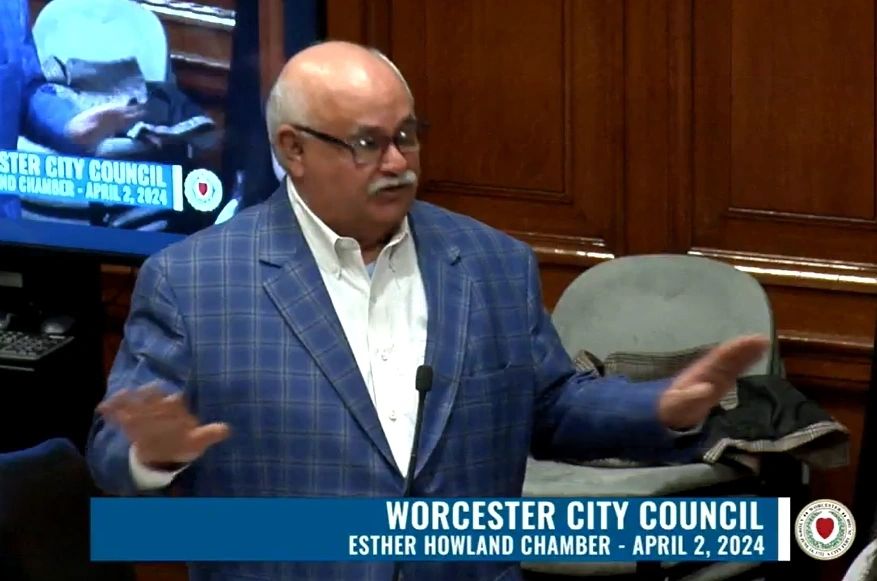
WORCESTER— Criticism and resistance against the city’s recently launched rental registry program persisted during Tuesday’s city council meeting. The program, initiated on March 9 after being in the works for more than two years, requires property owners to register every rented unit with the municipality. This mandate applies to various property types, including residential, commercial, industrial properties, and even vacant lots rented for any purpose.
In addition to a noncompliance penalty, which is still undetermined, the registry program, officially approved by the council in 2022, incorporates a nominal fee structure. These fees contribute to funding the program, including the hiring of new inspectors.
“I feel this is overreaching, and we have a lot of this info already in city departments that could be shared,” said Arthur Mooradian, a Worcester landlord, during the public speaking portion leading off the council meeting. “And I don’t understand why there has to be a fee. Why not try a type of incentive program, like a counselor mentioned last week? I don’t see how this will benefit the average owner or resident in Worcester. It’ll end up being more fees for the end user, and it’ll be discouraging for anyone investing in Worcester. It’s just another hurdle that landlords have to overcome.”
The aim of the new program is to provide the city with a thorough understanding of its rental housing inventory and to supply contact information for property owners. This facilitates swift communication in cases of emergencies, violations, or other rental property-related issues.
Another woman, who identified herself as an owner-occupied landlord in Worcester, said, “If there’s a violation of $300 day…well, ten days is $3,000. I don’t have that kind of money. For 15 years I had to rent to low-income people who couldn’t afford the rent half the time.”
Another citizen who identified himself as Mike, a landlord in the city, remarked, “I got about 30 of these letters. It’s a ridiculous thing that got shoved down everybody’s throats. I am a good landlord. I don’t understand how they can’t find out who owns the property. The fire department can reach us every year for our commercial properties, so why can’t they for our residential properties? The city contacts me all the time. If you want to do something like that, have the tenants register. Tenants are the biggest problem here for the landlords. We don’t put garbage out there, and you want us to register.”
The primary aim of the rental registry is to establish a structured system enabling direct communication between the municipality and rental property owners based on property type or geographic location within the city. It’s also a way to keep up with, and fund, inspections of these properties, say officials who support the program.
Councilor George Russell suggested that the concerns regarding the rental registry should be sent to the Economic Development Committee and that a discussion about how the program should continue is “necessary.”
“As far as I am concerned, this program should be put on hold, at the very least the guidelines about the fines,” said Russell. “This is not something I want to see implemented. We need to look at what these other towns and cities are doing. Boston charges $300 a month. I get calls on this every day. There is too much confusion, too big a fine, and it needs to be looked at more carefully.”
Russell added that when the idea for the rental property registry first emerged, the council was “concerned about deaths in fires. We weren’t concerned about registering garages, condos and rentals. We were concerned about where there were fire deaths.”
City Council Vice Chairman Khrystian King stressed that the council wouldn’t be voting to put an end to the registry, but rather implement some changes and initially push out the deadline for property owners to register.
“For transparency sake, I was the sole dissenting vote [on the rental registry],” said King. “I was not present. I had similar concerns then. I have questions about the 110 inspections, and I’ve asked and asked for years. I understand the spirit of this, and I filed a motion that we incentivize this to get better participation. But where are we with the backlog with the 110 inspections?”
For clarity, “110 inspections” are periodic inspections of multi-family buildings in accordance with 780 CMR “Table 110,” and are required to ensure compliance with safety and building codes for occupancy permit requirements.
Christopher Spencer, the commissioner of inspection services, said that “comprehensive numbers on this” were not available and that was part of the reason for instituting the rental registry in the first place.
“Our biggest problem with the 110 is our inability to be able to contact every property owner,” said Spencer. “We are constantly fighting that battle of getting hold of somebody and scheduling that inspection.”
“I’m extremely frustrated,” King responded. “I’ve been asking for this since…the fire department was here…it was around budget time…and we were told if we wanted to fund inspectional services, we were told we had to do this. I can’t get just basic numbers and it’s frustrating.”
Spencer said that the department was “looking to find that metric,” and also a better way to determine high-risk properties. Originally, he said inspections were completed in alphabetical order, proving to be an inefficient approach to the process.
City Manager Eric Batista echoed Spencer’s sentiments, indicating that the city doesn’t have updated and accurate data on registered rental properties because the right system hasn’t been in place, hence the need for the rental registry.
“The system will allow us to understand how many units are being rented and give us data on where we stand,” he said. “The registry was a creation to go in that direction.”
Council Chairman Donna Colorio said she supported sending a recommendation to economic development to study better the logistics, but more immediately to make a motion to extend the deadline for the registry to June 30 for “forms to come back.”
“I think there needs to be a longer time for people to get info to the city,” she said. “I want to think about what we can really add to this and have we thought about what is most efficient.”
Councilor Kate Toomey commented that she was under the impression that “problem properties would be addressed first, and we know what those are,” that a database already exists, and that the city should “have information on who is the latest owner of a property.”
“I’m hoping that the $300 [per month] was a miscommunication,” said Toomey. “That was a bit erroneous and an incentives program would be helpful.”
Batista said he has been working with Spencer on making changes to the program, but they “weren’t quick enough to make it onto tonight’s calendar,” but would be prepared to share updates soon that will “alleviate some of the challenges that we’ve heard from property owners about.”
Councilors approved a motion for a request to the city manager to make a recommendation to extend the deadline, at the least, to June 30.
Mill Street; “the best we can say is we haven’t made it worse”
Interim Police Chief Paul Saucier presented the city council with a crash report concerning Mill Street, which underwent a reconfiguration as part of a street improvement policy approved in 2018.
Completed on Dec. 1, 2023, the progressive revamp involved shifting its original striping and traffic patterns, adding parking spaces to shield bike lanes parallel to the sidewalk on both sides of the split street.
Issued to council before city council’s meeting, City Manager Eric Batista prefaced the report by writing, “The redesign has drawn a lot of public attention, and understandably so; it involves a configuration not yet seen in Central Massachusetts, even though it is well established and tested elsewhere.”
Saucier’s report reveals that since Dec. 1 there have been 13 reported calls for crashes on Mill Street, which is less than the 16 during the same period the year prior and “in line with the five-year average.” There were five crashes in December, three in January, three in February, and two in March.
With the exclusion of December 2020 to March 2021, when traffic was drastically lower because of COVID-19, the five-year look at crashes for the five-year average ranged between 10 and 16, with an average of 13.
“The decision to redesign Mill Street was not made lightly and is consistent with long-standing city policies,” said Batista in his letter to city council.
In 2018, Worcester City Council approved a Complete Streets Policy “calling for and establishing processes to develop streets with safe and convenient accommodations for all modes of transportation and people of all ages, abilities and means.” Its former configuration, proponents of the redesign said, caused drivers to treat it like a highway as opposed to a residential street, and drivers would too often travel at speeds of 45 mph or higher, rather than the 30 that is posted.
In 2021, the Massachusetts Department of Transportation granted funds for the Complete Streets Prioritization Plan for Worcester, which identified 22 projects to “improve the safety and multimodal accommodations on the city streets, including both interim and long-term improvements to Mill Street.”
The Mill Street redesign, according to Batista, is considered an interim Complete Streets project, which uses pavement markings and semi-permanent materials to make improvements in the short term. The city has received funding to further update Mill Street, including expanding sidewalks, additional sidewalks, separated bicycle facilities, upgraded streetscapes, safety and traffic control improvements at intersections, and roadway configurations to control speeds.
Colorio questioned the accuracy of the Mill Street crash report, referencing a neighborhood meeting several months ago in which accident numbers on Mill Street were shared, and were in stark contrast to those in the new report.
“Why is there such a discrepancy?” she asked.
Batista explained that the numbers provided at the neighborhood meeting encompassed Mill Street in its entirety and were not isolated to the reconfigured portion of the street, which extends from the area of Coes Pond to Chandler Street.
“Dispatch numbers and actual numbers are the same,” said Saucier. “This report that I have here started at 195 Mill St., and that’s where the actual reconfiguration starts. If you look at Mill Street as a whole, from Park Ave. to Chandler Street, there are a lot more accidents.”
“I know this will go to committee,” said Colorio, “and I would like to have additional information. I would like to have the October and November numbers also, and have the entire Mill Street. That would be more helpful because we could compare it to the entire Mill Street [data] a year ago.”
Batista said that “as a visual person, it could be helpful if we map it out.”
Colorio referenced a recent pedestrian death that occurred on Mill Street, which is reportedly the only crash-related death on the street in many years.
“For me, one death is too many,” said Colorio. “That was horrific. If we could have a report on the deaths that have happened, and if it was caused by speeding or whatever, that would be helpful.”
District 5 Councilor Etel Haxhiaj has been a strong advocate of the Mill Street reconfiguration, and continued her praise and support of the project, complimenting those involved in its implementation. Haxhiaj argued that the crash report numbers referenced by Colorio that were heard at a neighborhood meeting were “outlandish” and “caused confusion and have been incredibly harmful to the work we have tried to do.”
“The numbers Donna is referring to not only included those outside of this reconfiguration, it included calls and accidents around the area,” said Haxhiaj. “It inflated it and took hold on social media and it’s been disappointing and frustrating that here we are trying to reduce accidents and make public safety the primary goal and we are being sidetracked by inflated numbers. There’s no narrative or context attached to them, and it takes a lot of time and resources that we should put where they belong. We want an accurate figure on just the reconfigured part of Mill Street, or it’s only going to confuse our residents a lot more.”
Councilor Morris Bergman agreed that “we should compare apples to apples” and that an accurate conclusion cannot be drawn until at least four seasons have lapsed.
“We have barely gone through two seasons,” said Bergman. “As much as we shouldn’t be saying this is a failure, we shouldn’t be doing a victory lap. We spent more than three million and the best we can say is that we haven’t made it worse. And only in government can we say that’s a success.”
King said he supports protected bike lanes, and that he would like to see more money dedicated to “walkability” and “bikeability” in the city. He said that he looked forward to seeing updates promised soon to Mill Street, which include the installation of flex poles, additional lane marking and new signage. King also asked about car accident fatalities in the city.
Department of Transportation and Mobility Commissioner Steve Rolle responded that “city-wide, it’s about one per month, so far too many. Thankfully it’s still a rare occurrence. There have been no other fatalities [other than the recent pedestrian death] on Mill Street over the past five years.”
All orders for updates on the Mill Street reconfiguration were sent to the Standing Committee on Traffic and Parking.
Public restrooms for the unhoused, a matter of dignity
During the public comment portion of Tuesday’s meeting, a man approached the mic and said, “I know how important it is to have a place to pee and poo. I’ve been homeless before and they need a place to pee and poo.”
The comment pre-empted a later discussion about a request from Samantha Olney, a Worcester advocate for the homeless and founder of the Homeless Addicts Leadership Organization, who asked that council recognize the urgent need for access to public restrooms for unhoused individuals in the community. She further requested that the city manager consider prioritizing the establishment of public restrooms or portable toilets in areas with a high concentration of unhoused individuals. She calls the issue “critical.”
“People complain about us using the bathrooms, but we need to be able to use the bathroom,” said Olney. “People discriminate. The only place to go to the bathroom is Walmart, so if you can’t go to Walmart, what do you do? In Boston, they have public bathrooms open all night. Some of us are out all night.”
Haxhiaj said increased hostility continues to grow around the unhoused, and that “people were against the proposal” of purchasing public bathrooms and having them developed by an engineer familiar with unhoused communities. Haxhiaj made a motion to send the proposal to the Public Health Committee and “continue the work that [Chief Development Officer] Peter Dunn had provided, as we continue to talk about the unhoused community who don’t have dignified, basic human needs that we have, such as access to a bathroom.”
“The unhoused community is part of our community,” said Haxhiaj. “They are residents and should be treated as such. Public restrooms benefit not only people who don’t have a home, but they benefit the elderly, pregnant people, and visitors.”
King commented that the “administration was not open to public bathrooms years ago” and commended Batista for being amenable to the idea.
“It’s something I support,” said King. “I appreciate this petition coming from the community.”
District 2 Councilor Candy Mero-Carlson said there were currently two plans for public restrooms in development, and there is “ongoing discussion.” She made a motion to the city manager for a report on best practices for the design of these facilities.
“I think Samantha was pointing to a more holistic approach,” said Haxhiaj. “I am happy to sit down and provide some best practices. This is an issue of public health.”
Charlene Arsenault can be reached at carsenault@theworcesterguardian.org
As the Worcester Guardian marks six months of delivering free, independent digital news to our city, our dedication to this mission strengthens. Please consider a tax-deductible donation to support our ongoing commitment to providing hyperlocal news coverage to Worcester.